Meant or Ment: Meaning and Grammar Explained
If you have ever written a sentence such as “I meant to call you” and wondered whether meant should actually be spelled ment, you are not alone. The confusion mainly comes from pronunciation: meant sounds like “ment,” even though its spelling contains an a. The good news is that the standard form is straightforward. Meant is the past tense and past participle of mean. In ordinary modern English, ment is not the correct spelling when you are using the past form of mean.
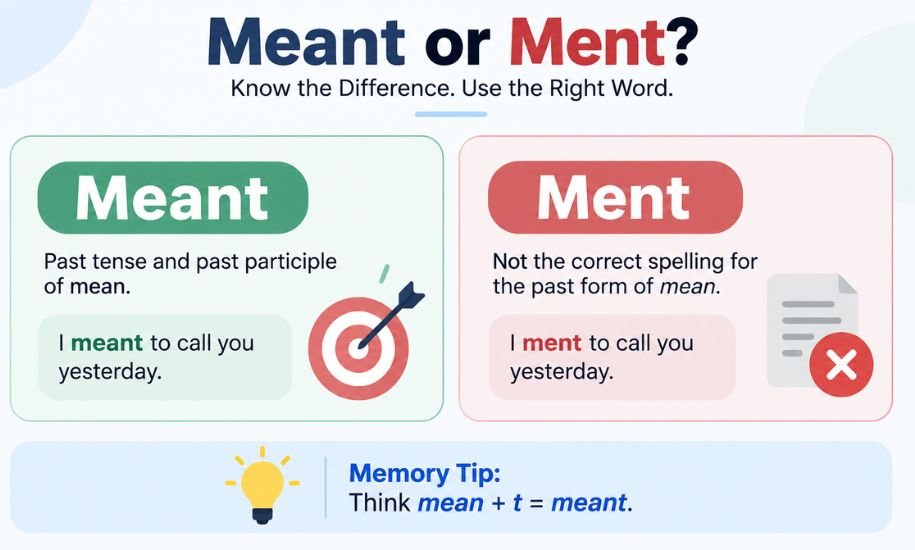
Meant is the correct spelling. It is the past tense and past participle of mean, as in “I meant what I said” or “I meant to call you.” Ment is not the standard spelling of this verb form.
Meant vs. Ment: The Key Difference
The distinction is simple:
| Form | Correct in standard English? | Use |
|---|---|---|
| meant | Yes | Past tense and past participle of mean |
| ment | No, for this verb form | Common spelling error |
The verb mean is irregular. Instead of adding a regular -ed ending to form its past tense, it changes to meant.
- Present: I mean what I say.
- Past: I meant what I said.
- Past participle: I have meant to tell you.
So, when you are talking about something you intended, expressed, or had in mind in the past, meant is the form you need.
What Does “Meant” Mean?
Meant is the past tense and past participle of mean. Its precise meaning depends on the sentence.
1. Intended to do something
One of the most common uses is to describe an intention.
- I meant to email you yesterday.
- She meant to arrive earlier.
- We meant to discuss the problem.
In these sentences, meant indicates something that a person intended to do.
2. Intended to say or express something
It can also describe what someone intended their words or actions to communicate.
- I meant something completely different.
- That’s not what I meant.
- He meant that as a compliment.
Here, the word concerns the intended message or interpretation.
3. Had importance or significance
Meant can also describe emotional or personal significance.
- Your support meant a lot to me.
- Her kind words meant more than she realized.
- That opportunity meant everything to him.
In this use, meant expresses the importance something had for a person.
4. Was intended for a particular purpose
The word frequently appears in constructions such as was meant to and meant for.
- This guide was meant to help beginners.
- The instructions were meant to be simple.
- This gift was meant for you.
These constructions indicate intention, purpose, or suitability.
Why Is “Ment” So Easy to Write by Mistake?
The main problem is pronunciation.
Meant is pronounced approximately like “ment.” The written a does not create a separate vowel sound. As a result, someone spelling the word based purely on how it sounds may naturally write ment.
Compare:
mean → meant
The pronunciation can make the spelling less obvious, but the spelling remains meant.
This is similar to other English words where pronunciation does not provide a perfect guide to spelling. If you hear “ment” in a sentence such as “I meant to tell you,” remember that the written form contains mea.
How to Spell It Correctly
If you are wondering how to spell meant, use:
M-E-A-N-T
A simple way to remember it is:
mean + t = meant
You can also connect it with the present form:
- mean → present
- meant → past
For example:
I mean to help.
I meant to help.
The spelling changes, but the connection between the two forms makes the correct version easier to remember.
“I Meant” or “I Ment”?
The correct expression is “I meant.”
Use it when referring to something you intended, said, or had in mind.
Correct
- I meant to call you.
- I meant what I said.
- I meant that as a joke.
- I meant something else.
- I meant no offense.
Incorrect
- I ment to call you.
- I ment what I said.
- I ment that as a joke.
- I ment something else.
In standard English, replace ment with meant in these sentences.
Meant Grammar: Understanding the Verb Form
Understanding the forms of mean makes the spelling easier to remember.
| Verb form | Example |
|---|---|
| Base form: mean | I mean what I say. |
| Third-person singular: means | She means well. |
| Past: meant | I meant what I said. |
| Past participle: meant | I have meant to ask you. |
| -ing form: meaning | What are you meaning by that? |
The important point is that meant serves two grammatical roles: it is both the simple past form and the past participle of mean.
For example:
Simple past:
I meant to speak with her yesterday.
Present perfect:
I have meant to speak with her for several days.
The form stays meant in both cases.
Common Expressions With “Meant”
Several everyday constructions use this word naturally.
“Meant to”
This usually expresses an intention.
- I meant to tell you earlier.
- She meant to finish the work today.
- They meant to invite him.
“Was meant to”
This can express intended purpose or something that was expected or arranged.
- The meeting was meant to start at nine.
- This button was meant to open the door.
- The exercise was meant to be challenging.
“Meant for”
This indicates that something was intended for a particular person, group, or purpose.
- This letter was meant for you.
- The course was meant for beginners.
- The room was meant for meetings.
“Meant a lot”
This describes emotional importance.
- Your message meant a lot to me.
- Her encouragement meant a lot during a difficult time.
Common Mistakes to Avoid
1. Writing “ment” because it sounds right
Ment may seem logical because it reflects the pronunciation, but standard spelling requires meant.
Incorrect: I ment to ask you.
Correct: I meant to ask you.
2. Treating “mean” as a regular verb
A regular past-tense pattern would suggest something like meaned, but English does not use that form.
Incorrect: I meaned to say something else.
Correct: I meant to say something else.
3. Confusing “meant” with “mean”
Use mean for the present and meant for the past.
- Present: What does this word mean?
- Past: What did that word mean?
- Past statement: I meant something else.
4. Confusing “meant” with “meaning”
Meaning is the -ing form of mean, while meant is its past and past participle form.
- What do you mean?
- What are you meaning?
- What did you mean?
- I meant something different.
The natural choice depends on the grammatical construction.
More Examples in Sentences
Here are some examples showing how the correct form works in different contexts:
- I meant to finish the report before lunch.
- She meant every word she said.
- I didn’t mean to interrupt you.
- That’s exactly what I meant.
- He meant no harm by his comment.
- The warning was meant to keep visitors safe.
- This package was meant for another address.
- Her advice meant a lot to me.
- We had meant to discuss the issue earlier.
- I think you misunderstood what I meant.
Notice that meant is used when the sentence refers to a past intention, expression, or significance.
Is “Ment” a Real Word?
If you are asking whether ment can replace meant in ordinary English, the answer is no.
In modern standard English, ment should not be used as the past tense of mean. You may encounter ment in historical or specialized dictionary material as an obsolete form or in other linguistic contexts, but that does not make it an acceptable substitute for meant in normal contemporary writing.
For everyday emails, essays, articles, messages, and other standard English writing, use meant.
An Easy Way to Remember the Spelling
The simplest memory rule is:
MEAN → MEANT
Think of the word as MEAN + T.
If your sentence could use the present-tense verb mean, but you are describing the past, change it to meant.
- I mean it. → I meant it.
- I mean to help. → I meant to help.
- I mean something else. → I meant something else.
Remember that the pronunciation may sound like “ment,” but the written word keeps the a.
Frequently Asked Questions
Is “meant” or “ment” correct?
Meant is correct when you need the past tense or past participle of mean. Ment is not the standard modern spelling for this verb form.
How do you spell “meant”?
The correct spelling is M-E-A-N-T. Although the word is pronounced like “ment,” the a is part of its standard spelling.
What is the meaning of “meant”?
Meant is the past tense and past participle of mean. Depending on context, it can indicate past intention, what someone intended to communicate, or the importance something had.
Should I write “I meant” or “I ment”?
Write “I meant.” For example, “I meant to call you” and “I meant what I said” are correct. “I ment” is a spelling error when it is intended as the past form of mean.
Is “meant” a verb?
Yes. Meant is a verb form: specifically, the simple past and past participle of mean. It appears in sentences such as “I meant to help” and “I have meant to ask you.”
Why does “meant” sound like “ment”?
The spelling contains ea, but the word is pronounced approximately /ment/. Because the pronunciation does not clearly reveal the written a, it is easy to spell the word incorrectly as ment.
Final Verdict: Meant or Ment?
When you need the past form of mean, choose meant. It is the standard spelling used for past intentions, meanings, expressions, and significance. Ment may sound right when spoken, but it is not the standard written form of the verb. For clear and correct English, remember mean → meant. That simple pattern is a useful rule to keep in mind whenever you write for school, work, or everyday communication. Grammarifyr is here to help make these easily confused English forms clearer and easier to use.
You may also Read : Flaky or Flakey: Meaning and Correct Spelling