Burry or Bury: The Correct Word Explained
English spelling can be surprisingly tricky when pronunciation does not clearly reveal the letters. Burry or bury is one such case. The word bury is pronounced differently from what many learners might expect from its spelling, which can make burry seem reasonable. There is also the separate word burry, although it is rare and has a different grammatical use. Understanding this distinction also helps with another frequent mistake: writing burried instead of buried. Here is a clear guide to the correct forms and how to use them.
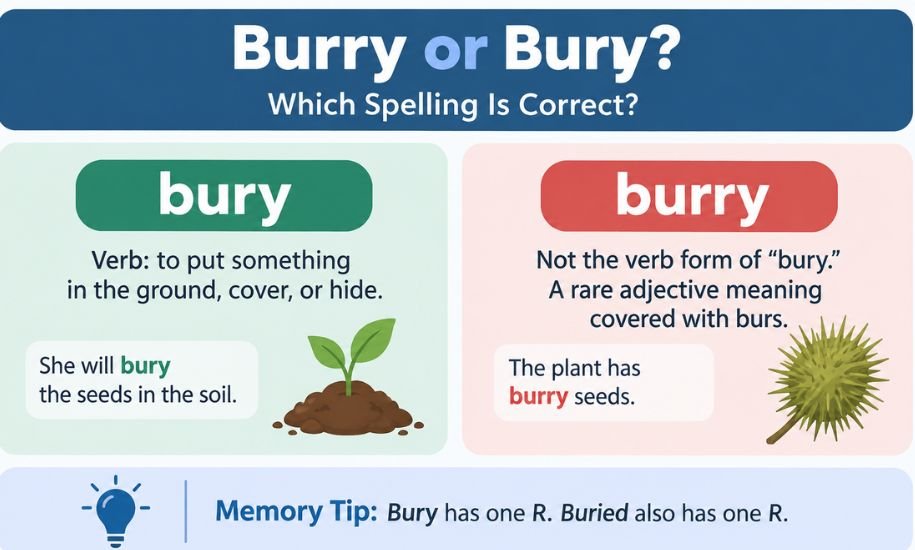
Bury is the correct spelling of the verb meaning “to put something in the ground,” “to cover,” or “to hide.” Burry is not the standard spelling of this verb, while buried is the correct past tense and past participle—not “burried.”
Burry or Bury: Which Is Correct?
If you mean to put something underground, cover it, or place a dead person in a grave, the correct word is bury.
| Form | Correct? | Meaning |
|---|---|---|
| bury | ✅ Yes | To put underground, cover, or hide |
| burry | ❌ Not as this verb | Not the standard spelling of bury |
| buried | ✅ Yes | Past tense/past participle of bury |
| burried | ❌ No | Common misspelling of buried |
For example:
- Please bury the seeds in the soil.
- The dog buried its toy.
- The treasure was buried beneath the tree.
The spelling burry should not be used as the present-tense verb.
What Does “Bury” Mean?
Bury is a verb. Its most literal meaning is to put someone or something beneath the surface of the ground.
For example:
The family decided to bury the ashes in the garden.
The squirrel buried the nuts beneath the soil.
The word also has several figurative meanings. Something can be buried when it is deeply covered, hidden, difficult to find, or overwhelmed by something else.
For example:
She tried to bury her disappointment.
The old documents were buried under a pile of books.
He was buried in paperwork all afternoon.
So, depending on context, bury can describe physical placement underground as well as hiding or covering something figuratively.
Is “Burry” a Real Word?
There is an important distinction here. Burry can exist as an English word, but it is not the standard verb spelling of “bury.”
As an uncommon adjective, burry can describe something associated with or covered in burs—the prickly seed structures that cling to clothing or animal fur.
For example, in a specialized context, someone might describe vegetation as burry because it produces many burs.
Therefore, saying that burry is “never a word” would be too absolute. The useful rule is:
If you mean “to put underground,” use bury.
Also, Burry may appear as a surname or proper name. That is unrelated to the spelling of the ordinary verb.
Bury or Burry Meaning in Everyday English
When someone asks about the bury or burry meaning, they are usually trying to determine which spelling belongs in a sentence.
Consider:
The pirates decided to bury the treasure.
Here, bury means to put the treasure underground so that it is hidden.
Another example:
The child wanted to bury the toy in the sand.
Again, bury is the verb.
The word can also be used metaphorically:
Don’t bury the important information at the end of the report.
Here, bury means to make something difficult to notice by placing it among less important material.
Buried or Burried: Which Is Correct?
The correct spelling is buried.
Burried is a misspelling.
This mistake is understandable because English has many words in which a consonant is doubled when a suffix is added. However, bury follows a different spelling pattern.
The correct transformation is:
bury → buried
Not:
bury → burried
Examples:
- The dog buried the bone.
- They buried the time capsule.
- The treasure was buried in the backyard.
- She buried the letter in a drawer.
Incorrect examples:
- ❌ The dog burried the bone.
- ❌ They burried the time capsule.
- ❌ The treasure was burried underground.
Why Is It “Buried” Instead of “Burried”?
The key is the ending of the base verb.
Bury ends in -y. When the past tense or past participle is formed, the y changes to i before -ed:
bury + ed → buried
This pattern also occurs in other verbs:
- carry → carried
- marry → married
- worry → worried
- hurry → hurried
That is why the correct spelling contains only one r:
B-U-R-I-E-D
The spelling burried incorrectly inserts another r.
Forms of the Verb “Bury”
Knowing the different forms makes the spelling easier to remember.
| Verb form | Correct spelling | Example |
|---|---|---|
| Base form | bury | They bury the seeds. |
| Third-person singular | buries | She buries the letter. |
| Past tense | buried | He buried the box. |
| Past participle | buried | The box was buried. |
| Present participle | burying | They are burying the seeds. |
Notice that none of these standard verb forms uses burry or burried.
Bury
Use bury with the base form of the verb.
We will bury the old tree roots.
Buries
Use buries with a singular third-person subject in the present tense.
The animal buries its food.
Buried
Use buried for the simple past and past participle.
They buried the treasure years ago.
The treasure has been buried for decades.
Burying
Use burying for the present participle or gerund.
They are burying the cables underground.
Why Do People Write “Burry”?
One major source of confusion is pronunciation.
In many varieties of English, bury is pronounced approximately like “berry.” The pronunciation therefore does not make the spelling bury obvious to someone encountering the word for the first time.
A person may hear the sound and naturally assume the spelling should resemble berry or burry. However, English spelling does not always follow pronunciation perfectly.
The correct spelling of the verb remains bury.
This is also why the mistake can appear when someone is writing from memory rather than copying the word from a text.
Correct Usage Examples
Seeing the words in context is one of the easiest ways to understand the distinction.
Correct
The gardener will bury the seeds tomorrow.
The children buried their treasure in the sand.
The dog is burying its favorite toy.
The evidence was buried beneath several layers of soil.
She tried to bury her painful memories.
Incorrect
The gardener will burry the seeds tomorrow.
The children burried their treasure.
The dog is burrying its toy.
The first group uses the standard forms of the verb correctly.
An Easy Way to Remember the Spelling
A simple memory rule is:
Bury has one R. Buried also has one R.
Think of the main forms as:
bury → buried → burying
Avoid adding an extra r:
burry ❌
burried ❌
Another useful point is that the spelling changes the y to i in buried:
bury → buried
If you remember those two facts, most spelling mistakes disappear.
Common Mistakes to Avoid
1. Writing “burry” as the verb
Incorrect:
They will burry the box.
Correct:
They will bury the box.
2. Writing “burried”
Incorrect:
The treasure was burried underground.
Correct:
The treasure was buried underground.
3. Writing “buryed”
Another possible mistake is buryed. The correct form is buried, because the final y changes to i before -ed.
4. Confusing “buries” and “burys”
The third-person singular form is buries, not burys.
She buries the seeds carefully. ✅
5. Confusing “burying” and “burrying”
The present participle is burying.
They are burying the cable. ✅
There is no need to double the r.
Is It Bury or Burry in Formal Writing?
If you are using the word as a verb meaning to put something into the ground or hide it, choose bury in all forms of standard formal writing.
For example:
The archaeological team discovered objects that had been buried for centuries.
Using burry in place of bury would be considered a spelling error in this context.
The rare adjective burry is a separate matter and would normally occur only in a specialized context. It should not be treated as an alternative spelling of the verb.
Frequently Asked Questions
Is it bury or burry?
It is bury when you mean “to put something underground,” “to cover,” or “to hide.” Burry is not the standard spelling of this verb. Although burry can occur as a rare adjective, that meaning is unrelated to the ordinary verb bury.
Is buried or burried correct?
Buried is correct. Burried is a misspelling. The past tense and past participle of bury are both buried, following the spelling pattern in which the final y changes to i before -ed.
How to spell buried or burried?
The correct spelling is buried, with one r and an i before e-d: B-U-R-I-E-D. A helpful pattern is bury → buried, similar to carry → carried and worry → worried.
Can “burry” ever be correct?
Yes, but not as the ordinary verb bury. Burry is an uncommon adjective associated with burs, and Burry can also occur as a proper name or surname. In a sentence about putting something underground, however, the correct word is bury.
What is the past tense of “bury”?
The past tense is buried. For example: “They buried the old documents.” The same spelling is used as the past participle: “The documents had been buried beneath the floor.”
What is the difference between bury and buried?
Bury is the base form of the verb, while buried is its past tense and past participle. For example, “They bury the seeds every spring” uses the present/base form, while “They buried the seeds yesterday” uses the past tense.
The Bottom Line
When you mean to put something underground, cover it, or hide it, the correct spelling is bury, not burry. Its past tense and past participle are buried, not burried or buryed. Remember the simple pattern bury → buried → burying, and you can avoid the most common errors. At Grammarifyr, the goal is simple: Know the Difference. Use the Right Words.
You may also Read : Dammit or Damnit: The Correct Spelling Explained