Monkies or Monkeys? The Correct Plural Explained
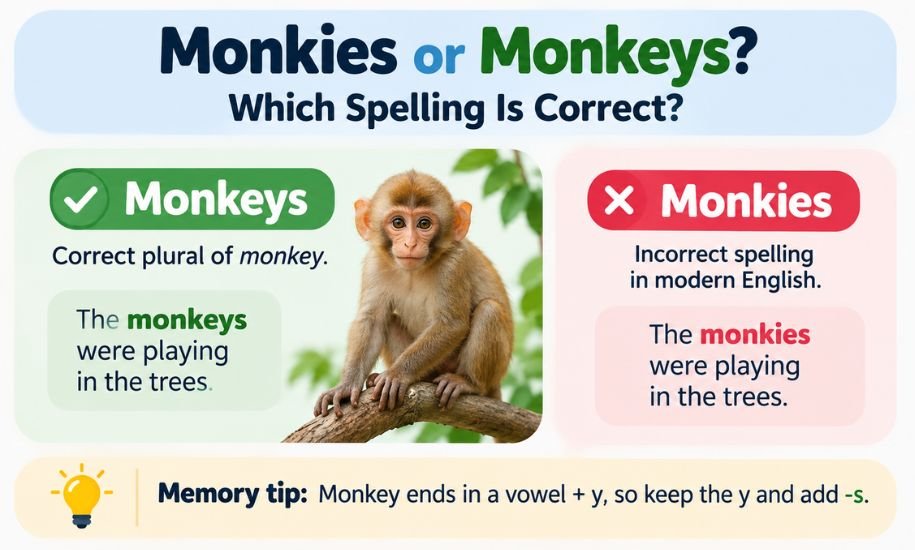
It is easy to hesitate over the plural of monkey. English has a familiar spelling rule in which nouns ending in a consonant followed by y change y to ies, as in baby → babies and city → cities. That can make monkies look reasonable at first glance. However, monkey follows a different pattern. The correct standard plural is monkeys, not monkies. The reason is simple: the letter before the final y is a vowel, so the y stays in place and we simply add -s.
Monkeys is the correct standard plural of monkey. Monkies is generally a misspelling in modern English. Because monkey ends in a vowel + y, you keep the y and add -s: monkey → monkeys.
Monkeys or Monkies: Which One Is Correct?
The correct spelling is monkeys.
| Form | Correct? | Explanation |
|---|---|---|
| monkey | Yes | Singular noun |
| monkeys | Yes | Standard plural |
| monkies | No | Nonstandard modern spelling |
| monkey’s | Yes | Singular possessive |
| monkeys’ | Yes | Plural possessive |
So, if you are talking about more than one animal, write monkeys:
- The monkeys were playing in the trees.
- We watched several monkeys at the wildlife park.
- The zookeeper feeds the monkeys every morning.
Do not write:
- The monkies were playing in the trees.
Why Does Monkey Become Monkeys?
The answer comes from a useful English plural rule.
When a singular noun ends in a vowel + y, the usual plural form is made by simply adding -s. The y does not change.
For example:
- monkey → monkeys
- donkey → donkeys
- boy → boys
- toy → toys
- key → keys
- day → days
In monkey, the final two letters are e + y. Since e is a vowel, the word follows the vowel + y pattern.
This is different from nouns ending in consonant + y.
For example:
- baby → babies
- city → cities
- country → countries
- story → stories
- puppy → puppies
Here, the letter immediately before y is a consonant. The usual plural formation changes y to ies.
That gives us a simple comparison:
Vowel + y → add -s
monkey → monkeys
Consonant + y → change y to -ies
baby → babies
This distinction explains why monkies looks plausible but is not the standard plural.
What Does “Monkey” Mean?
Monkey is a noun referring to a primate. In everyday English, the word can refer to various members of the primate group commonly called monkeys.
The word can also be used informally as a verb. To monkey with something means to interfere with, alter, or experiment with it, often in a way that is unnecessary or potentially troublesome.
As a noun, examples include:
- A monkey climbed onto the branch.
- The zookeeper observed a young monkey.
- That monkey has a distinctive face.
As a verb in the expression monkey with:
- Don’t monkey with the settings.
- He likes to monkey with old machines.
For the spelling question, however, the important form is the plural noun: monkeys.
Is “Monkies” a Real Word?
In modern standard English, monkies should not be used as the ordinary plural of monkey.
You may occasionally encounter the spelling in historical or unusual texts. Older forms of English spelling were not always standardized in the same way as modern English, and historical dictionaries can record forms that are no longer standard.
That does not make monkies the appropriate spelling for contemporary formal or everyday writing.
If you are writing an article, school assignment, email, report, or other modern English text, use:
monkey → monkeys
rather than:
monkey → monkies
It is also possible to encounter monkies online as a simple spelling mistake. Its appearance does not mean that it is an accepted alternative spelling in standard modern English.
Why Do People Write “Monkies”?
The most likely reason is confusion with the consonant + y plural rule.
Learners often remember:
baby → babies
and then apply the same pattern to another word ending in y.
But not every word ending in y changes to -ies.
Compare these pairs:
| Singular | Plural |
|---|---|
| monkey | monkeys |
| donkey | donkeys |
| toy | toys |
| boy | boys |
| baby | babies |
| city | cities |
| lady | ladies |
| story | stories |
Look at the letter before y. That is the key.
In monkey, the preceding letter is e, a vowel. Therefore, the word takes -s.
In baby, the preceding letter is b, a consonant. Therefore, the y changes to ies.
Monkey Plural: More Examples
Seeing the word in complete sentences makes the distinction easier to remember.
Correct
- The monkeys gathered around the food.
- Several monkeys were sitting on the rocks.
- We could hear the monkeys from across the park.
- The researchers studied how the monkeys interacted with one another.
- Young monkeys often stay close to their mothers.
Incorrect
- The monkies gathered around the food.
- Several monkies were sitting on the rocks.
- We could hear the monkies from across the park.
The incorrect version is especially easy to produce when you are thinking of words such as puppy → puppies or family → families.
Monkey’s or Monkeys’? Understanding Possessives
Another source of confusion is the difference between monkey’s and monkeys’.
Both forms are correct, but they have different grammatical functions.
Monkey’s
Monkey’s is the singular possessive form. It refers to something belonging to or associated with one monkey.
The monkey’s tail was unusually long.
Here, there is one monkey, so the possessive is formed with ‘s.
Monkeys’
Monkeys’ is the plural possessive form. It refers to something belonging to or associated with multiple monkeys.
The monkeys’ enclosure was cleaned before opening time.
There are multiple monkeys, so the plural is first formed as monkeys, and the apostrophe is then added after the s.
The pattern is:
- one monkey → monkey’s
- several monkeys → monkeys’
This is different from simply forming the plural.
Is the Spelling Different in British and American English?
No. Monkeys is the standard plural in both British and American English.
Unlike words such as color/colour or center/centre, there is no standard British-American spelling difference here.
So whether you are writing for readers in the United States, the United Kingdom, Canada, Australia, or another English-speaking region, the normal plural is:
monkeys
For example:
The monkeys were moving through the trees.
This spelling works in both American and British English.
An Easy Way to Remember the Correct Form
Use the vowel-before-y rule.
Ask yourself:
What letter comes immediately before the final y?
If it is a vowel, normally add s:
monkey → monkeys
donkey → donkeys
toy → toys
key → keys
If it is a consonant, the plural often changes y → ies:
baby → babies
city → cities
puppy → puppies
story → stories
For monkey, remember:
E + Y → keep the Y
So:
monkey → monkeys
not:
monkey → monkies
Common Mistakes to Avoid
1. Writing “monkies” as the plural
This is the main spelling mistake. The standard plural is monkeys.
2. Applying the -ies rule to every word ending in y
The -ies pattern does not apply to every noun ending in y. Check the letter immediately before the y.
3. Confusing plural and possessive forms
Monkeys simply means more than one monkey.
Monkey’s indicates possession by one monkey.
Monkeys’ indicates possession by multiple monkeys.
4. Assuming British English uses “monkies”
It does not. Monkeys is standard in British English as well as American English.
A Quick Comparison With Donkey
The word donkey follows exactly the same pattern as monkey.
- donkey → donkeys
- monkey → monkeys
Both words end in vowel + y, so the y remains unchanged.
This can be useful if you are unsure about the plural. If you know that donkey becomes donkeys, the same pattern applies to monkey.
FAQ
Is “monkies” or “monkeys” correct?
Monkeys is correct in standard modern English. Monkies is generally a misspelling and should not be used as the normal plural of monkey.
What is the plural of monkey?
The plural of monkey is monkeys. The word keeps its final y because it ends in a vowel followed by y.
Why is it monkeys and not monkies?
The letter before the final y in monkey is e, which is a vowel. Nouns ending in vowel + y generally form their plurals by adding -s, so monkey becomes monkeys.
Is “monkies” a word?
Monkies can appear in historical or nonstandard usage, but it is not the standard modern plural of monkey. In contemporary writing, use monkeys.
What is the plural possessive of monkey?
The plural possessive is monkeys’. For example: “The monkeys’ habitat was expanded.” The singular possessive is monkey’s.
Is “monkeys” correct in British English?
Yes. Monkeys is the standard plural in both British and American English. There is no British-American spelling distinction between these forms.
Final Verdict: Monkies or Monkeys?
The correct modern spelling is monkeys. The key is to remember that monkey ends in vowel + y, so the y remains when forming the plural: monkey → monkeys. Although monkies may occasionally appear as a mistake or in historical material, it is not the standard form for modern English writing. For more clear explanations of confusing English forms, Grammarifyr follows the same principle of helping readers choose the right word and spelling with confidence.
You may also Read : Grateful or Greatful: Correct Spelling Explained