Dammit or Damnit: The Correct Spelling Explained
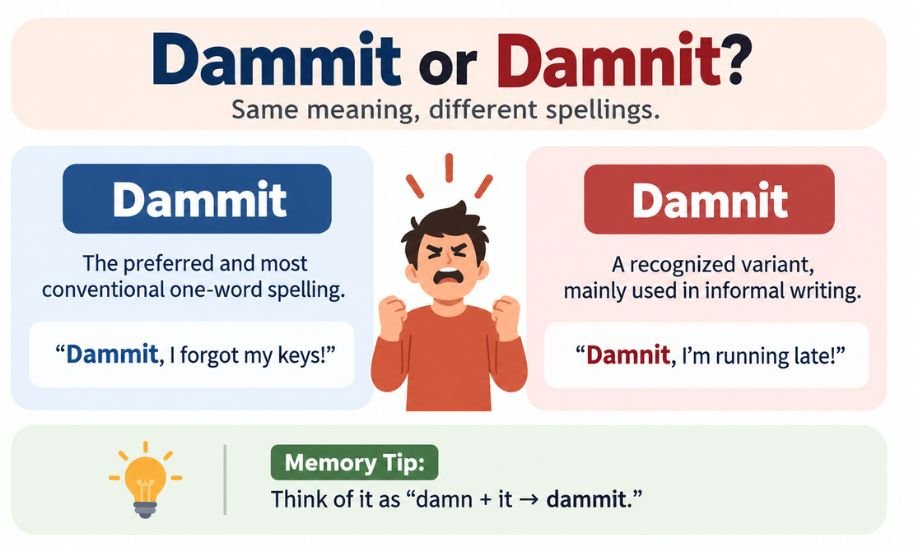
“Dammit” and “damnit” look almost identical, so it is easy to wonder which form belongs in your writing. The confusion becomes even greater because the expression comes from the two-word phrase “damn it.” In modern English, dammit is the most conventional one-word spelling, while damnit is also found as a variant, particularly in informal usage. The two forms generally express the same emotion, such as frustration, anger, or annoyance. Understanding the difference helps you choose the form that best fits your audience and level of formality.
Dammit is the preferred and most conventional one-word spelling. Damn it is also correct as the original two-word expression, while damnit is a recognized variant found in informal English. If you need the safest choice in edited writing, use dammit or damn it.
Dammit or Damnit: Which Is Correct?
If you are deciding between dammit or damnit, choose dammit when you want the established one-word form.
For example:
- Correct/preferred: “Dammit, I forgot my wallet.”
- Also correct: “Damn it, I forgot my wallet.”
- Variant: “Damnit, I forgot my wallet.”
The important point is that calling damnit simply a nonexistent word would be too strong. Some dictionary sources recognize it as an alternative or variant form. However, dammit is the better default choice for general-purpose English writing.
Quick comparison
| Form | Status | Meaning | Best use |
|---|---|---|---|
| dammit | Established one-word form | Expresses frustration, anger, or annoyance | Best default |
| damn it | Original two-word form | Same basic meaning | Standard phrase |
| damnit | Recognized variant | Same basic meaning | Informal/variant usage |
What Does “Dammit” Mean?
Dammit is an informal interjection used to express a strong negative reaction. Depending on context, it can communicate frustration, irritation, anger, disappointment, or emphasis.
It comes from the expression “damn it” and is generally used as an exclamation rather than as an ordinary grammatical part of a sentence.
For example:
“Dammit, the train just left.”
The speaker is not describing the train. Dammit communicates frustration about missing it.
Other examples include:
- “Dammit, I made the same mistake again.”
- “Oh, dammit! We are running late.”
- “I told you to be careful, dammit.”
- “Dammit, where did I put my keys?”
The word is highly informal, so it should be used with some awareness of your audience.
What Does “Damnit” Mean?
Damnit generally carries the same meaning as dammit. It is used as an exclamation expressing frustration, annoyance, anger, or disappointment.
For example:
“Damnit, I left my phone at home.”
In terms of meaning, there is normally no significant difference between damnit and dammit.
The distinction is primarily about spelling and conventional usage. Dammit is the safer and more widely established one-word choice, while damnit appears as a variant in informal English.
This is why the question “is it damnit or dammit?” does not have quite the same answer as a simple correct-spelling-versus-misspelling question. Both forms can be encountered, but they do not have equal status in edited general English.
Dammit or Damnit or Damn It?
There are three forms worth knowing:
Dammit
This is the conventional one-word spelling.
Damn it
This is the original two-word expression and remains completely usable.
Damnit
This is a variant spelling that occurs in informal English and is recognized by some references.
Consider these examples:
“Damn it, I missed the deadline.”
“Dammit, I missed the deadline.”
“Damnit, I missed the deadline.”
All three communicate essentially the same frustration. However, if you are writing an article, book, essay, or other edited material and specifically want the one-word version, dammit is the strongest choice.
Why Are These Spellings Confused?
The confusion largely comes from the way the expression is pronounced.
When people say “damn it” quickly, the two words can sound like a single unit. That makes it natural for speakers to turn the phrase into a single written word.
Once the expression becomes one word, however, there are different possible spellings. Someone familiar with damn may naturally write damnit, preserving the n. The established spelling dammit uses a different form.
This also explains why the variants can appear in casual writing, dialogue, text messages, and online conversations.
The important lesson is that pronunciation alone does not always tell you the conventional spelling of an English expression.
When Should You Use “Dammit”?
Use dammit when you need an informal exclamation and want the conventional one-word spelling.
It works particularly well in dialogue and casual writing:
“Dammit, I thought you had the tickets.”
“Dammit! The computer froze again.”
“You knew this would happen, dammit.”
The word can appear at the beginning, middle, or end of a sentence. Its position can slightly affect the tone, but its fundamental meaning remains the same.
Because it expresses emotion rather than providing factual information, punctuation often plays an important role.
For example:
“Dammit, we forgot the tickets.”
and
“Dammit!”
Both are natural, but the second is a standalone exclamation.
Is “Damn It” More Formal?
Not really. Damn it is still an informal and mildly profane expression. Writing it as two words does not make the expression formal.
For example:
“Damn it, I forgot the report.”
is not necessarily more professional than:
“Dammit, I forgot the report.”
If you are writing a formal email, academic paper, business document, or official communication, it is usually better to avoid both forms.
Depending on the situation, you could write:
- “Unfortunately, I forgot the report.”
- “I’m sorry, but I made an error.”
- “That is frustrating.”
- “I accidentally missed the deadline.”
The choice depends more on register and context than on whether the expression is written as one word or two.
Correct and Incorrect Usage Examples
Because damnit is encountered as a variant, it is better to distinguish between the preferred form and the variant rather than labeling every use of damnit as an absolute spelling error.
Preferred
Dammit, I forgot to lock the door.
Dammit! That was my last chance.
I tried three times, dammit.
Two-word alternative
Damn it, I forgot to lock the door.
Damn it! That was my last chance.
Variant
Damnit, I forgot to lock the door.
The last example is understandable and attested as a variant, but dammit is the better default if you are aiming for conventional edited English.
Is “Damnit” a Misspelling?
It depends on what standard you are applying.
If a teacher, editor, style guide, or writing application asks for the preferred conventional spelling, dammit is generally the safer answer.
But damnit should not automatically be described as meaningless or completely invalid. Some dictionary resources recognize it as an alternative form.
This distinction is important because English contains many words and forms that are:
- informal
- regional
- variant
- less common
- nonstandard in particular styles
A form can exist in actual English usage without being the preferred spelling for every situation.
Therefore, if someone asks “is it dammit or damnit?”, the practical answer is dammit, with the qualification that damnit exists as a variant.
Is “Dammit” a Bad Word?
Dammit is a mild swear or expletive, so it is not appropriate for every setting.
It can be acceptable in:
- casual conversation
- informal messages
- fictional dialogue
- personal writing
- informal online communication
It may be inappropriate in:
- academic assignments
- formal business writing
- official documents
- professional correspondence
- situations where profanity is discouraged
Context matters. A character in a novel might naturally say:
“Dammit, we have to leave now!”
But the same expression would probably be unsuitable in a formal report.
An Easy Way to Remember the Preferred Spelling
A simple way to remember the preferred one-word form is to connect it directly with the established spelling:
damn + it → dammit
Think of dammit as the conventional compressed form of “damn it.”
If you are unsure and want to avoid the spelling question entirely, you can simply write the original expression as two words:
damn it
That is especially useful when you are writing informally and want the relationship between the two words to remain obvious.
Common Mistakes to Avoid
1. Assuming “damnit” has a completely different meaning
It does not. When damnit is used as the variant of dammit, it expresses essentially the same emotion.
2. Claiming that “damnit” can never be used
That is too absolute. The form occurs in real English and is recognized as a variant by some dictionary sources.
3. Treating “dammit” as formal language
Although it is a conventional spelling, the expression itself remains informal and mildly profane.
4. Forgetting the two-word form
Damn it is not an error. It is the original phrase from which the contracted one-word form developed.
5. Using the expression in formal writing
The spelling may be correct, but the tone may still be inappropriate. Always consider the audience and context.
Examples in Different Situations
Seeing the expression in context makes the distinction easier.
Expressing frustration:
“Dammit, I missed the bus.”
Expressing disappointment:
“Dammit, I really wanted to win.”
Expressing irritation:
“Stop doing that, dammit.”
Using the two-word form:
“Damn it, I should have checked the instructions.”
Using the variant:
“Damnit, the door is locked.”
In each case, the emotional function is essentially the same.
Frequently Asked Questions
Is it dammit or damnit?
Dammit is the preferred conventional one-word spelling. Damnit is also found as a variant in informal English and is recognized by some dictionary sources. For general edited writing, dammit is the safer choice.
Is it damnit or dammit in standard English?
If you need the most conventional one-word form, use dammit. Damnit exists as a variant, but it is less suitable as the default spelling in carefully edited general English.
Is “damn it” correct?
Yes. Damn it is the original two-word expression and is grammatically and conventionally usable. It has essentially the same meaning as dammit.
Are dammit and damnit pronounced differently?
Usually, no meaningful pronunciation difference is intended. Both spellings generally represent the same spoken exclamation derived from “damn it.”
Is dammit appropriate in formal writing?
Generally, no. Dammit is informal and mildly profane. In formal writing, a neutral expression such as “unfortunately,” “that is frustrating,” or “I made an error” is usually more appropriate.
Which should I use: dammit or damn it?
Both are established forms. Choose dammit when you want the conventional one-word version, or damn it when you prefer to retain the original two-word phrase.
Final Verdict: Dammit or Damnit?
When choosing between dammit or damnit, dammit is the best default spelling. Damn it is equally useful as the two-word expression, while damnit is a recognized variant that appears mainly in informal contexts. None of these choices changes the basic meaning: they express frustration, annoyance, anger, or disappointment. For clear, conventional English, dammit is the one-word form to reach for. For more guidance on confusing spellings and word choices, Grammarifyr helps you know the difference and use the right words.
You may also Read : Swiftie or Swifty: The Correct Spelling Explained