Recieved or Received: Meaning and Examples
Have you ever written an email or message and wondered whether to spell the word recieved or received? The two forms look almost identical, so it is easy to mix up the letters when typing quickly. However, only one is correct in standard English. Received is the correct spelling, while recieved is a misspelling. The word is the past tense and past participle of receive, which means to get, accept, or be given something. Understanding the spelling pattern will help you use the word confidently in everyday messages, schoolwork, and professional writing.
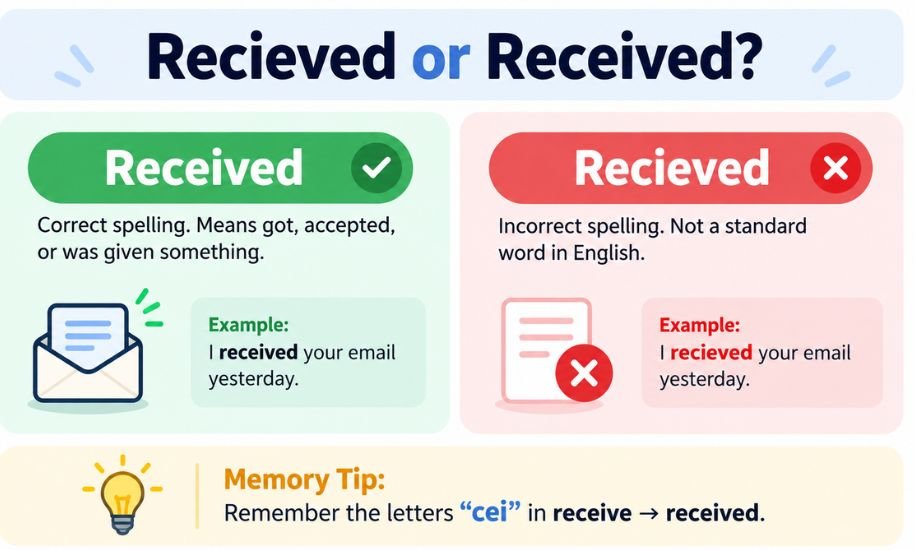
**Received** is the correct spelling. **Recieved** is incorrect in standard English. Both British and American English use *received*, with the letters **ei** appearing after the letter **c**.
Recieved or Received: Which Is Correct?
The correct spelling is received. You should use this form whenever you want to describe something that someone got, accepted, or was given in the past.
The incorrect version, recieved, usually results from placing the letters i and e in the wrong order. Although readers will often understand what you mean, the misspelling should be avoided in formal and informal writing.
Compare these examples:
- Correct: I received your invitation yesterday.
- Incorrect: I recieved your invitation yesterday.
- Correct: She received a certificate for her achievement.
- Incorrect: She recieved a certificate for her achievement.
Remember that the same spelling applies regardless of whether you are writing an email, completing an assignment, or preparing a business document.
Quick Comparison
| Feature | Received | Recieved |
|---|---|---|
| Correct spelling | Yes | No |
| Meaning | Got or was given something | No standard meaning as a separate word |
| Grammar | Past tense and past participle of receive | Misspelling of received |
| Standard British English | Accepted | Incorrect |
| Standard American English | Accepted | Incorrect |
What Does Received Mean?
Received is the past tense and past participle of the verb receive. It describes getting something, accepting something, or having something delivered to you.
The word can refer to physical objects, information, money, messages, invitations, and many other things.
Here are a few examples:
- I received a package this morning. The package arrived, and I got it.
- We received your application last week. The application was delivered to us.
- He received an award for his research. Someone presented him with an award.
- They have received the payment. The payment has arrived or been obtained.
- She received an important message from her manager. The manager sent her information that reached her.
The meaning depends on the context, but the central idea is getting or accepting something.
Receive, Received, and Receiving
These related forms serve different grammatical purposes.
| Form | Usage | Example |
|---|---|---|
| Receive | Base form or present tense | I receive several emails daily. |
| Receives | Present tense with he, she, or it | She receives a monthly statement. |
| Received | Past tense | We received the documents yesterday. |
| Received | Past participle | I have received your reply. |
| Receiving | Present participle or gerund | He is receiving training. |
Notice that received is used both for the simple past and with auxiliary verbs such as have, has, and had.
For example, “I received the letter yesterday” describes a past event. “I have received the letter” uses the present perfect tense to connect the event to the present situation.
Why Is Recieved Incorrect?
The mistake comes from reversing the two vowels in the middle of the word. The correct spelling is r-e-c-e-i-v-e-d, not r-e-c-i-e-v-e-d.
English spelling can be difficult because the relationship between letters and sounds is not always predictable. When people write a word based on how they remember its appearance or pronunciation, they may put the letters in the wrong order.
A familiar spelling guideline is “i before e, except after c.” In receive, the letters appear as ei after c. This makes the correct spelling easier to remember.
However, this guideline has many exceptions in English. It is best to use it as a memory aid rather than a rule that works for every word.
For this particular word, focus on the spelling of its base form:
receive → received
Once you remember receive, adding -d gives you the correct past tense and past participle.
Examples of Received in Sentences
Seeing the word in different contexts makes its meaning and spelling easier to understand.
Everyday communication
- I received your text but could not reply immediately.
- Have you received my email?
- She received a birthday card from her best friend.
School and work
- The teacher received the students’ assignments on Friday.
- Our department received permission to begin the project.
- The candidate received an offer after the interview.
Shopping and payments
- I received the parcel two days earlier than expected.
- The shop received a new shipment of products.
- We received confirmation that the payment was successful.
Formal writing
- The committee received several proposals for consideration.
- The organisation received funding for its educational programme.
- The office has received your complaint and will review it.
In each sentence, received describes something that arrived, was obtained, or was given. Its spelling remains the same in every context.
How to Remember the Correct Spelling
If you frequently confuse the two versions, use these simple techniques.
1. Memorise the base word.
Start with receive. When you need the past tense, write receive + d to get received.
2. Focus on the letters after C.
The middle of the word is cei, not cie. Think of the sequence as re-cei-ve.
3. Learn the word family together.
Practise writing receive, received, receiving, and receiver. Learning related forms together reinforces the shared spelling pattern.
4. Read your sentence aloud and check the written form.
Pronunciation can help you recognise the word, but it will not always reveal the correct letter order. Check the spelling itself rather than relying on sound alone.
A useful practice sentence is: “I received what I wanted to receive.” Writing this sentence a few times can help reinforce the correct form.
Is the Spelling Different in British and American English?
No. Received is standard in both British and American English. Unlike words such as colour and color, this word does not have two accepted regional spellings.
Examples in both varieties include:
- British English: I received the parcel this morning.
- American English: I received the package this morning.
The nouns parcel and package may differ in regional preference, but the spelling of received does not change.
The same applies to formal letters, academic writing, workplace communication, and everyday messages. You should always choose received, regardless of your intended audience.
Synonyms for Received
Depending on the context, several words can replace received. However, each synonym carries a slightly different meaning, so choose one that fits the sentence.
| Synonym | Example |
|---|---|
| Got | I got your message. |
| Obtained | She obtained permission to leave early. |
| Accepted | He accepted the invitation. |
| Acquired | The museum acquired a rare painting. |
| Collected | I collected the parcel from the post office. |
| Was given | She was given a certificate. |
Got is informal and common in conversation. Obtained often sounds more formal, while accepted suggests agreeing to take or welcome something. Collected usually means going somewhere to pick something up.
These words can overlap with received, but they are not interchangeable in every sentence.
Common Mistakes to Avoid
Even when you know the correct spelling, a few related errors are worth watching for.
Mistake 1: Reversing the vowels
Incorrect: I recieved the confirmation.
Correct: I received the confirmation.
Keep the sequence cei in mind.
Mistake 2: Confusing the base form with the past tense
Incorrect: Yesterday, I receive your email.
Correct: Yesterday, I received your email.
Use the past tense when describing a completed event in the past.
Mistake 3: Using the wrong form after an auxiliary verb
Incorrect: I have receive your application.
Correct: I have received your application.
The present perfect tense requires the past participle, received.
Mistake 4: Assuming British English uses a different spelling
Incorrect assumption: Recieved is the British form.
Correct understanding: Both British and American English use received.
Checking these details will make your writing clearer and help you avoid mistakes in important communications.
Frequently Asked Questions
1. Is it recieved or received?
Received is correct. The other form reverses the letters e and i and is a spelling error in standard English. Use the correct form in emails, essays, reports, messages, and other types of writing.
2. What is the meaning of received?
Received is the past tense and past participle of receive. It means got, obtained, accepted, or was given something. For example, “I received a letter” means that a letter came to me or was delivered to me.
3. How do you spell received correctly?
The correct spelling is R-E-C-E-I-V-E-D. Remember the base word receive and add -d. The letters e and i appear in that order after the letter c.
4. Is received the same in British and American English?
Yes. Both varieties use received. There is no standard British-versus-American spelling difference for this word.
5. Is recieved ever acceptable in informal writing?
It may appear as a typo or an informal spelling error in online messages, but it is not a standard alternative. Even in casual writing, received is the appropriate spelling.
6. What is the difference between receive and received?
Receive is the base verb, while received is its past tense and past participle. For example, “I receive letters regularly” describes a general situation, whereas “I received a letter yesterday” describes a past event.
Final Verdict: Received Is the Correct Choice
When deciding between the two spellings, choose received every time. It is the standard past tense and past participle of receive in both British and American English, while recieved is a misspelling. Remember the cei sequence, practise the related verb forms, and check your writing when necessary. At Grammarifyr, our goal is to help readers make confident language choices—following the principle shared by English Pairs: know the difference and use the right words.
You may also Read : Suprise or Surprise: Meaning, Spelling and Examples