Suprise or Surprise: Meaning, Spelling and Examples
It is easy to hesitate over the spelling of suprise or surprise, especially because the word is pronounced quickly in everyday speech. One version, however, is the standard spelling in English, while the other is a common spelling mistake. If you are writing an email, school assignment, article, or message, choosing the correct form matters. The good news is that the distinction is simple: the standard word contains two r’s.
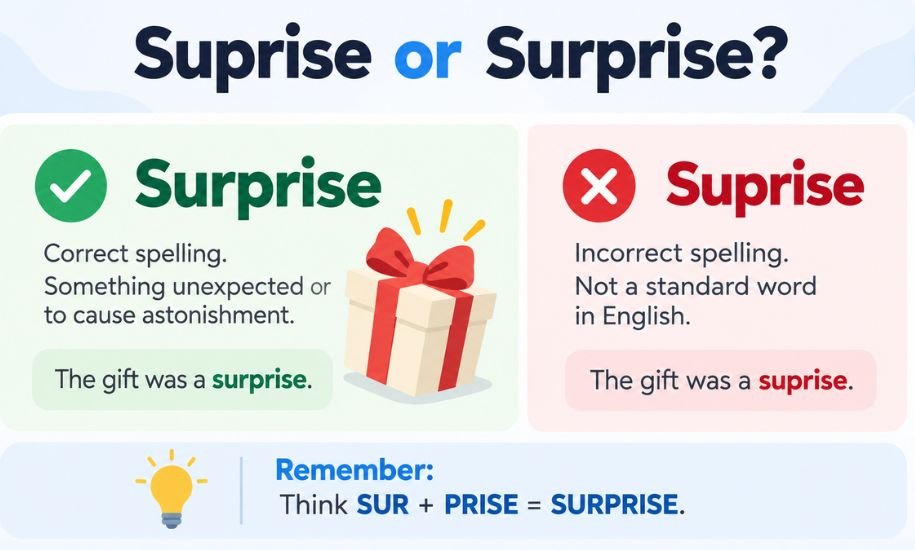
Surprise is the correct spelling. Suprise is a misspelling and should not be used in standard English. The correct word can be a noun meaning something unexpected or a verb meaning to cause someone to feel surprised.
Surprise or Suprise: Which Is Correct?
The correct spelling is surprise.
The incorrect form is suprise.
The standard spelling contains the sequence sur-pr-, giving us:
s-u-r-p-r-i-s-e → surprise
When the first r is accidentally left out, the result is:
s-u-p-r-i-s-e → suprise
That missing letter makes the spelling incorrect. Suprise is not a different word with its own meaning; it is simply a misspelling of surprise.
| Feature | Surprise | Suprise |
|---|---|---|
| Standard spelling? | ✅ Yes | ❌ No |
| Meaning | Something unexpected; or to cause astonishment | No separate standard meaning |
| Word type | Noun and verb | Misspelling |
| Formal writing | Correct | Avoid |
| Example | “The gift was a surprise.” | “The gift was a suprise.” ❌ |
What Does “Surprise” Mean?
Surprise has several closely related meanings.
As a noun, it can describe something unexpected or the feeling produced by an unexpected event.
For example:
- “The birthday visit was a pleasant surprise.”
- “Her announcement came as a complete surprise.”
- “What a wonderful surprise!”
- “I have a little surprise for you.”
As a verb, surprise means to cause someone to feel astonished because something happens unexpectedly.
For example:
- “The news surprised everyone.”
- “We decided to surprise our friend.”
- “His sudden arrival surprised me.”
- “The result surprised the entire team.”
The word can therefore function naturally in both everyday conversation and formal writing.
Is “Suprise” a Real Word?
In standard modern English, suprise is not an accepted alternative spelling of surprise.
If you see it in a text, it normally represents a spelling error. There is no useful distinction such as one form being a noun and the other being a verb.
For example:
Correct: “The announcement was a surprise.”
Incorrect: “The announcement was a suprise.”
Likewise:
Correct: “I wanted to surprise her.”
Incorrect: “I wanted to suprise her.”
It is best to correct the spelling rather than treat the two forms as separate vocabulary items.
Why Is the Spelling So Easy to Get Wrong?
The mistake usually comes from the arrangement of letters rather than from a difference in meaning.
The beginning of the word is particularly easy to mix up:
surprise
There are two consecutive r sounds/letters in the written structure around the first part of the word: the first r follows u, and another r occurs later in the -prise portion.
When writing quickly, it is easy to remember the general shape of the word but accidentally omit the first r.
Pronunciation can contribute to the confusion as well. The first syllable is not strongly stressed in ordinary English pronunciation, so the spelling may not feel as obvious as it looks when written out.
The solution is simply to remember the complete form:
SURPRISE
Examples: Correct and Incorrect Usage
Seeing the two forms side by side makes the difference easier to remember.
Example 1
Correct: The party was a complete surprise.
Incorrect: The party was a complete suprise.
Example 2
Correct: I planned to surprise my brother.
Incorrect: I planned to suprise my brother.
Example 3
Correct: Her visit was an unexpected surprise.
Incorrect: Her visit was an unexpected suprise.
Example 4
Correct: The teacher’s announcement surprised the students.
Incorrect: The teacher’s announcement suprised the students.
Notice that the same spelling pattern matters in related forms too. The first r should remain in surprised, surprising, and surprisingly.
Surprise, Surprised, and Surprising
Once you know the correct spelling of the main word, its related forms become easier to write correctly.
Surprise
This is the base form and can function as either a noun or verb.
“The result was a surprise.”
“We will surprise Dad tonight.”
Surprised
This is the past tense and past participle of the verb.
“She was surprised by the gift.”
Surprising
This is the present participle and can also function as an adjective.
“The result was surprising.”
Surprisingly
This is the adverbial form.
“Surprisingly, nobody noticed.”
Common misspellings include suprised and suprising, but the correct forms retain the r after u:
surprised
surprising
“Surprise Party” or “Suprise Party”?
The correct phrase is surprise party.
A surprise party is an event organized secretly so that the person being celebrated does not know about it beforehand.
For example:
“We are organizing a surprise party for Maria.”
The spelling suprise party is incorrect because suprise is not the standard spelling of the word.
The same rule applies to other expressions:
- surprise visit
- surprise guest
- surprise announcement
- surprise attack
- surprise winner
- surprise ending
- pleasant surprise
- complete surprise
The noun remains surprise in each case.
Surprise in British and American English
There is no British-versus-American spelling difference here.
Both British English and American English use:
surprise
You should not change it to suprise when writing for a British audience, nor is suprise an American spelling.
Other words do have genuine differences between British and American spelling, such as colour/color and centre/center. This is not one of them.
So, whether you are writing for readers in the UK, the United States, Canada, Australia, or elsewhere, surprise is the standard spelling.
How Do You Pronounce “Surprise”?
The spelling and pronunciation are related, but the word’s first syllable is relatively weak in normal speech.
English dictionaries give slightly different pronunciation symbols for British and American English, reflecting normal accent differences. However, these variations do not change the spelling.
The important point for spelling is that hearing the word quickly should not lead you to drop the first r when writing it.
If you are unsure, think of the word as having the written structure:
sur + prise
That visual pattern is more reliable than trying to spell the word purely from how it sounds.
An Easy Way to Remember the Spelling
A simple memory trick is to focus on the first four letters:
S-U-R-P
Think:
SUR + PRISE = SURPRISE
Do not let the r disappear after the u.
You can also connect it with related forms:
- surprise
- surprised
- surprising
- surprisingly
All of these retain the same opening sur-.
If you remember sur-, you are much less likely to write su- by mistake.
Common Mistakes to Avoid
1. Writing “suprise”
This is the most direct spelling error.
Incorrect: “It was a suprise.”
Correct: “It was a surprise.”
2. Writing “suprised”
The past-tense form also needs the first r.
Incorrect: “I was suprised by the result.”
Correct: “I was surprised by the result.”
3. Writing “suprising”
The adjective keeps the same opening.
Incorrect: “That was a suprising decision.”
Correct: “That was a surprising decision.”
4. Treating the two forms as different words
There is no standard meaning that separates suprise from surprise. The former should simply be corrected.
5. Assuming it is a UK/US spelling difference
It is not. Surprise is the standard spelling in both British and American English.
What Are Some Synonyms for “Surprise”?
The best synonym depends on the context.
Possible alternatives include:
- astonishment
- amazement
- shock
- wonder
- unexpected event
- unexpected development
These words are related but are not always interchangeable.
For example, shock can suggest a much stronger or more disturbing reaction than surprise, while amazement often emphasizes strong wonder or admiration.
So although a thesaurus may list several related words, surprise remains the most natural choice when you simply mean that something was unexpected.
Frequently Asked Questions
Is “suprise” or “surprise” correct?
Surprise is correct. Suprise is a misspelling caused by leaving out the first r. Use surprise in standard English writing.
Is “suprise” a word?
No, not as a standard modern English spelling. It is generally treated as a misspelling of surprise, not as a separate word with its own definition.
Is “surprise” spelled differently in British English?
No. Surprise is the standard spelling in both British and American English. The difference between British and American English does not apply to this word.
What is the plural of “surprise”?
The regular plural is surprises.
For example: “The birthday celebration included several surprises.”
How do you spell “surprise party”?
The correct spelling is surprise party. The word surprise must contain the first r.
How can I remember the spelling?
Remember the beginning as SUR- rather than SU-. You can break the word visually into SUR + PRISE, which helps prevent the first r from being omitted.
Final Verdict: Suprise or Surprise?
Surprise is the correct spelling, while suprise is a misspelling. The standard word works as both a noun and a verb and appears in expressions such as surprise party, pleasant surprise, and surprise visit. If you are unsure, remember the SUR- at the beginning. For more clear explanations of confusing English words and spellings, Grammarifyr helps you know the difference and use the right words.
You may also Read : Leaves or Leafs: Meaning and Correct Usage
One Comment