Tomorrow vs Tommorow: Correct Spelling and Meaning
When writing about plans, appointments, or future events, it is easy to make small spelling mistakes. One common example is tomorrow vs tommorow. Both spellings look almost identical, but only one is correct in standard English. The confusion usually comes from placing an extra m instead of using the correct letter pattern. Although the difference is just one letter, using the right spelling makes your writing clearer and more professional. Understanding the meaning, spelling, and usage of tomorrow can help you avoid this mistake in everyday conversations, emails, schoolwork, and formal writing.
Quick Answer
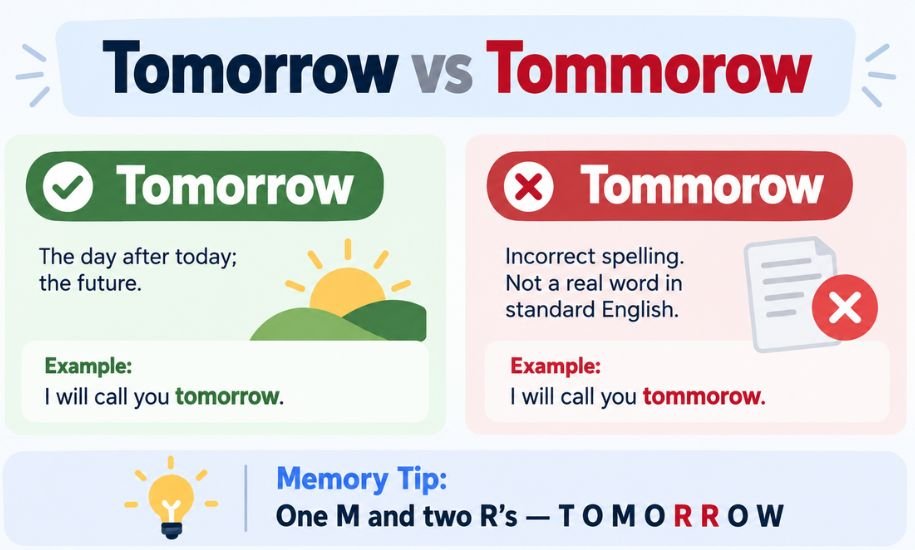
Tomorrow is the correct spelling, while tommorow is a misspelling. The word tomorrow means the day after today and can also refer to the future. It is spelled with one M and two R’s in both British and American English.
Tomorrow or Tommorow: Which Is Correct?
Tomorrow is the only correct spelling in standard English. It refers to the day that follows today and is commonly used when talking about future plans, events, or activities.
Tommorow is an incorrect spelling because it contains an extra m and does not follow the standard spelling of the word. It is not an accepted British or American English variant.
| Feature | Tomorrow | Tommorow |
|---|---|---|
| Correct spelling | Yes | No |
| Meaning | The day after today; the future | No standard meaning |
| Number of M’s | 1 | 2 |
| Number of R’s | 2 | 1 |
| British English | Correct | Incorrect |
| American English | Correct | Incorrect |
| Formal writing | Acceptable | Not acceptable |
For example:
- Correct: I will complete my assignment tomorrow.
- Incorrect: I will complete my assignment tommorow.
Whenever you refer to the following day, use tomorrow, regardless of whether you are writing informally or formally.
What Does Tomorrow Mean?
Tomorrow is a word that refers to the day after the present day. It can function as both an adverb and a noun, depending on how it is used in a sentence.
As an adverb, it describes when an action will take place. As a noun, it refers to the following day or, more broadly, the future.
Examples of tomorrow in sentences:
- We are going to visit our grandparents tomorrow.
- She has an important interview tomorrow morning.
- Tomorrow is the last day to submit the application.
- Young people will shape the world of tomorrow.
In the first two examples, tomorrow acts as an adverb because it tells us when something will happen. In the last two, it functions as a noun.
The word can also appear in phrases such as tomorrow’s meeting, tomorrow’s schedule, and a brighter tomorrow. These expressions are grammatically correct and widely used in everyday English.
Is Tommorow a Real Word?
Tommorow is not a recognised spelling of a standard English word. It is simply a misspelling of tomorrow and does not have a separate dictionary meaning in standard English.
People may write it accidentally when typing quickly, relying on an incorrect memory of the spelling, or confusing the placement of repeated letters.
For example:
- Incorrect: I have to wake up early tommorow.
- Correct: I have to wake up early tomorrow.
Similarly:
- Incorrect: We will discuss the project tommorow afternoon.
- Correct: We will discuss the project tomorrow afternoon.
If you encounter tommorow in a message, its intended meaning is usually clear from the context. However, it should be corrected in academic assignments, professional emails, articles, and other forms of standard writing.
Why Do People Confuse These Spellings?
The confusion between the two forms mainly comes from their visual similarity. Both contain almost the same letters, and the difference can be easy to overlook when writing quickly.
There are a few reasons this spelling mistake occurs:
- Incorrect letter repetition: Writers may accidentally double the m instead of the r.
- Uncertain spelling patterns: English contains many words with doubled consonants, which can make the correct sequence difficult to remember.
- Typing mistakes: When writing quickly, people may enter an additional letter without noticing.
- Incorrect spelling habits: Repeatedly seeing or writing the misspelled form can make it seem familiar, even though it is incorrect.
The important point is that tomorrow has one m followed by two r’s. Remembering this pattern can prevent the mistake.
How to Use Tomorrow in a Sentence
The word tomorrow is useful when discussing schedules, future activities, deadlines, and expectations. It can appear at the beginning, middle, or end of a sentence.
Examples in everyday English:
- I am planning to clean my room tomorrow.
- Tomorrow, we will start our new training programme.
- Are you free to meet tomorrow evening?
- The results will be announced tomorrow.
- He promised to return the book tomorrow.
Examples in formal writing:
- The final report will be submitted tomorrow.
- Tomorrow’s meeting will begin at 10 a.m.
- The revised schedule will take effect tomorrow.
- The committee will review the proposal tomorrow afternoon.
The possessive form tomorrow’s is also correct when referring to something associated with the following day.
For instance, Tomorrow’s presentation requires additional preparation uses the possessive form to describe a presentation scheduled for the next day.
Tomorrow in British and American English
There is no spelling difference between British and American English when it comes to tomorrow. Both varieties use exactly the same spelling.
| Variety | Correct spelling | Example |
|---|---|---|
| British English | Tomorrow | I will see you tomorrow. |
| American English | Tomorrow | I’ll call you tomorrow. |
| Australian English | Tomorrow | We are leaving tomorrow. |
| Canadian English | Tomorrow | The event begins tomorrow. |
Unlike words such as colour and color or centre and center, tomorrow does not have regional spelling variations in standard English.
Therefore, you do not need to change its spelling when writing for readers in the United Kingdom, the United States, Australia, or other English-speaking regions.
Easy Way to Remember the Correct Spelling
A simple way to remember tomorrow is to focus on its consonants.
THE SIMPLE SPELLING RULE
T O M O R R O W
One M + Two R’s
Remember: Double the R, not the M.
You can also practise writing the word a few times to become familiar with its correct letter sequence.
Another useful method is to check the word visually before submitting an important piece of writing. Look for the single m and the two consecutive r’s. This quick check can help you catch the most common mistake.
Common Mistakes to Avoid
Besides tommorow, there are several other incorrect spellings that you may encounter.
| Incorrect spelling | Correct spelling |
|---|---|
| Tommorow | Tomorrow |
| Tommorrow | Tomorrow |
| Tomorow | Tomorrow |
| Tomarrow | Tomorrow |
| Tomoroww | Tomorrow |
These forms should not be treated as alternative spellings. The correct form remains tomorrow.
Another mistake is confusing tomorrow with yesterday. Although both refer to days in relation to today, they describe different points in time.
- Yesterday: The day before today.
- Today: The current day.
- Tomorrow: The day after today.
For example, if today is Monday, yesterday was Sunday and tomorrow will be Tuesday.
Frequently Asked Questions
1. Is tomorrow or tommorow the correct spelling?
Tomorrow is the correct spelling in standard English. Tommorow is a misspelling that contains an extra m. Use tomorrow in all forms of standard writing, including text messages, emails, academic assignments, and professional documents.
2. What is the meaning of tomorrow?
Tomorrow means the day after today. It can also refer to the future in a general sense. For example, “I will visit you tomorrow” refers to the following day, while “The leaders of tomorrow” refers to people who will lead in the future.
3. Is tomorrow spelled differently in British English?
No, tomorrow has the same spelling in both British and American English. Unlike some words that have regional spelling variations, this word does not change depending on the variety of English being used.
4. Why does tomorrow have two R’s?
The standard spelling of tomorrow includes two consecutive R’s and only one M. This is the established spelling of the word in modern English. Remembering the letter pattern is a practical way to avoid writing tommorow.
5. Is tomorrow a noun or an adverb?
Tomorrow can be both a noun and an adverb. It is an adverb in “I will travel tomorrow,” because it explains when the action will happen. It is a noun in “Tomorrow is a holiday,” because it refers to the following day.
6. Is tommorow acceptable in informal writing?
No, tommorow is still a misspelling, even in informal writing. Readers may understand what you mean, but tomorrow is the correct form for both casual conversations and formal communication.
Final Verdict: Tomorrow vs Tommorow
The difference between tomorrow and tommorow is a matter of correct spelling. Tomorrow is the accepted form in standard English, meaning the day after today or the future, while tommorow is a misspelling. Remembering to use one M and two R’s will help you write the word accurately. For more straightforward explanations of confusing words and common spelling mistakes, Grammarifyr helps you know the difference and use the right words.
You may also Read : Aid or Aide: Meaning, Usage, and Examples