While or Awhile: Simple Grammar Rules Explained
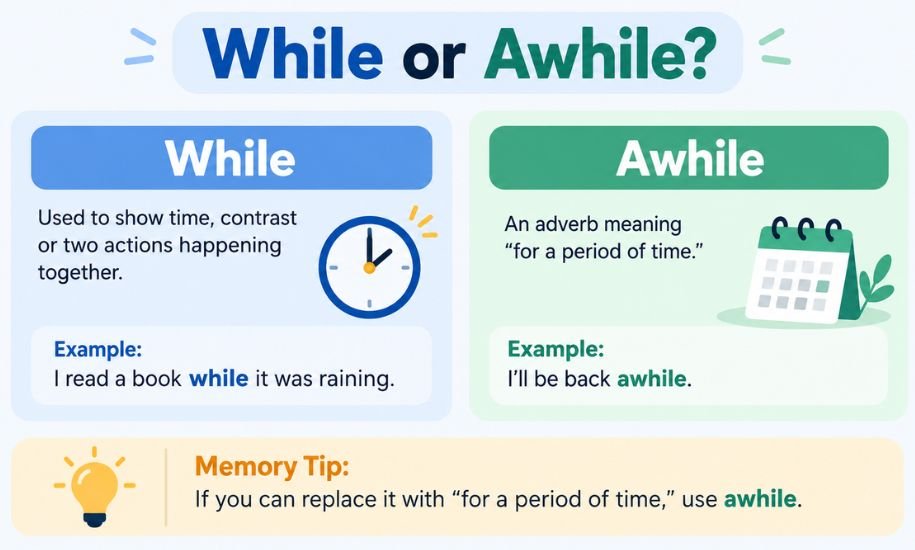
The difference between while and awhile can be confusing because both words refer to time and are sometimes used in similar sentences. However, they have different grammatical functions, and knowing when to use each one can make your writing clearer. While can function as a conjunction or a noun, whereas awhile is an adverb meaning “for a period of time.” The two-word phrase a while is also correct and refers to an unspecified length of time. Understanding this small distinction will help you choose the right form in everyday conversations, emails, and formal writing.
Both while and awhile are correct English words, but they have different grammatical uses. While connects ideas or refers to a period of time, while awhile is an adverb meaning “for a period of time.” Use a while as a noun phrase, especially after prepositions, as in “for a while” or “in a while.”
While or Awhile: What’s the Difference?
The main difference is their grammatical function. While can connect two clauses to show that events happen at the same time, express contrast, or refer to a period of time. Awhile is an adverb that describes how long an action continues.
The phrase a while consists of the article a and the noun while. It refers to an unspecified period of time.
| Feature | While | Awhile | A while |
|---|---|---|---|
| Part of speech | Conjunction or noun | Adverb | Noun phrase |
| Meaning | During the time that; a period | For a period of time | An unspecified duration |
| Main function | Connects clauses or names a duration | Modifies a verb | Refers to a length of time |
| Example | She read while waiting. | She read awhile. | She read for a while. |
| Correct spelling | Yes | Yes | Yes |
The easiest way to remember the difference is that “awhile” usually means “for a while,” while “a while” names the period itself.
What Does While Mean?
While is a versatile English word that is commonly used as a conjunction and a noun. Its meaning depends on how it is used in a sentence.
As a conjunction, while connects two clauses and often indicates that two actions are happening at the same time. It can also introduce a contrast between two ideas.
Examples of while in sentences:
- I prepared dinner while my sister watched television.
- He listened to music while travelling to work.
- While the weather was cold, we still enjoyed our walk.
- She prefers tea, while her brother prefers coffee.
In the first two examples, while connects activities that take place simultaneously. In the last two, it introduces contrasting information.
While can also function as a noun to describe a period of time.
Examples:
- We talked for a while after the meeting.
- It took a while to understand the instructions.
- She stayed with her grandparents for a short while.
In these examples, while refers to a duration rather than connecting two clauses.
What Does Awhile Mean?
Awhile is an adverb that means “for a period of time” or “for a short time.” It describes the duration of an action and generally appears with a verb.
Unlike a while, which is a noun phrase, awhile is written as a single word.
Examples of awhile in sentences:
- Please sit awhile and relax.
- He rested awhile before returning to work.
- We stayed awhile to enjoy the peaceful atmosphere.
- She read awhile before going to bed.
In each sentence, awhile tells the reader how long the person performed an action.
A useful way to check whether awhile works in a sentence is to replace it with for a while. If the sentence still makes sense, the adverb may be suitable.
For example:
- Stay awhile.
- Stay for a while.
Both sentences communicate the same general idea. The first uses an adverb, while the second uses a preposition followed by a noun phrase.
Awhile vs. A While: Examples in Sentences
Awhile and a while are often interchangeable in sentences where they describe the duration of an action. However, their grammatical structures are different, so they cannot be substituted in every situation.
Compare these examples:
Using awhile
Let’s wait awhile before making a decision.
Awhile is an adverb modifying the verb “wait.”
Using a while
Let’s wait for a while before making a decision.
A while is a noun phrase introduced by the preposition “for.”
Another common construction
We haven’t spoken in a while.
“In a while” is a conventional phrase referring to a period of time.
Here are more examples that show how the forms work:
- Awhile: The children played awhile in the garden.
- A while: The children played for a while in the garden.
- Awhile: He sat awhile, enjoying the sunshine.
- A while: He sat for a while, enjoying the sunshine.
In edited writing, choosing a while after a preposition is the clearest approach. The adverb awhile works naturally when it directly modifies an action.
It Has Been a While or Awhile?
The conventional form is “It has been a while.” This expression refers to an unspecified amount of time that has passed since an event or experience.
Examples:
- It has been a while since we last met.
- It has been a long while since I visited my hometown.
- It has been a while since she called me.
- It has been quite a while since they worked together.
Although “It has been awhile” is also found in informal writing, “It has been a while” is the preferred form in standard edited English.
The reason is that a while functions as a noun phrase referring to a duration. The expression is particularly common with since, as in “It has been a while since we talked.”
It Takes a While or Awhile?
Both “It takes a while” and “It takes awhile” are used in English. The first is a conventional noun-phrase construction, while the second uses awhile as an adverb.
Consider these examples:
- It takes a while to learn a new language.
- It takes awhile to complete the assignment.
- It may take a while to get used to a new routine.
- The process could take awhile, so be patient.
For formal and carefully edited writing, “It takes a while” is a clear and widely accepted choice. The adverbial form awhile is also established in general usage, so it should not automatically be treated as a spelling mistake.
A While Ago or Awhile Ago?
The standard expression is “a while ago,” which means an unspecified amount of time before the present.
Here, a while is a noun phrase, and ago indicates that the period is in the past.
Examples:
- I spoke to my teacher a while ago.
- She moved to London a while ago.
- We discussed this subject a while ago.
- He sent me a message a while ago.
Although awhile ago sometimes appears in informal writing, a while ago is the conventional form recommended for formal writing and edited content.
Similarly, use a while in expressions such as:
- For a while: We waited for a while.
- In a while: I’ll call you in a while.
- After a while: After a while, the rain stopped.
- Quite a while: It took quite a while to finish.
These expressions use a while as a noun phrase, so keeping the two words separate is important.
Common Mistakes When Using These Words
Understanding a few common errors can make it easier to choose the appropriate form.
| Incorrect or less-preferred form | Preferred form | Explanation |
|---|---|---|
| I haven’t seen him for awhile. | I haven’t seen him for a while. | Use the noun phrase after “for.” |
| She arrived awhile ago. | She arrived a while ago. | “A while ago” is the conventional expression. |
| We talked in awhile. | We talked in a while. | “In a while” requires the noun phrase. |
| Stay for awhile. | Stay for a while. | Use “a while” after “for” in standard edited writing. |
| While I waited awhile, he left. | While I waited, he left. | The extra adverb may be unnecessary if duration is not the point. |
One important distinction is that awhile itself is not incorrect. It is a valid adverb. The mistake occurs when it is used in a grammatical structure that calls for the noun phrase a while.
Synonyms for While and Awhile
The appropriate synonym depends on whether the word refers to duration, simultaneous actions or contrast.
| Word or expression | Possible synonym | Example |
|---|---|---|
| Awhile | For a short time | Rest briefly. |
| Awhile | Temporarily | Stay temporarily. |
| A while | A period of time | We waited for a period of time. |
| A while ago | Some time ago | I saw her some time ago. |
| While (time) | As | She sang as she worked. |
| While (contrast) | Whereas | He likes coffee, whereas I prefer tea. |
| While (concession) | Although | Although it was late, we continued. |
These synonyms depend on context. For example, briefly can replace awhile in some sentences, but whereas only works when expressing a contrast, not when describing the duration of an action.
How to Remember the Difference
A simple grammatical check can help you choose between the two forms.
- Use “while” when connecting two clauses, expressing contrast or referring to a period of time.
- Use “awhile” when you need an adverb meaning “for a period of time.”
- Use “a while” when referring to a duration as a noun phrase, particularly after prepositions such as for and in.
Easy memory tip
If you can naturally add “for” before the expression, you can often use a while instead of awhile.
- Rest awhile. → Rest for a while.
- Wait awhile. → Wait for a while.
- Stay awhile. → Stay for a while.
Remember that this is a helpful test, not a rule that makes the two forms interchangeable in every sentence.
Frequently Asked Questions
1. Is it awhile or a while?
Both are correct, but they serve different grammatical purposes. Awhile is an adverb meaning “for a period of time,” while a while is a noun phrase referring to a duration. Use a while after prepositions, as in “for a while” or “in a while.”
2. Is “it has been awhile” grammatically correct?
“It has been awhile” is common in informal writing, but “it has been a while” is the conventional form in standard edited English. The two-word expression treats while as a noun referring to a period of time.
3. Should I write “wait awhile” or “wait a while”?
Both are acceptable. “Wait awhile” uses an adverb, while “wait a while” uses a noun phrase. You can also write “wait for a while,” which is another natural and widely accepted construction.
4. Is “awhile” one word or two?
Awhile is always written as one word when it functions as an adverb. However, a while is written as two words when it is a noun phrase. For example, “Stay awhile” and “Stay for a while” are both correct.
5. Is “a while ago” or “awhile ago” correct?
“A while ago” is the conventional form in standard English. It refers to an unspecified period in the past, as in “I spoke to her a while ago.” This form is preferred in formal writing and edited articles.
Final Verdict: While or Awhile?
Both while and awhile are correct English words, but the right choice depends on their grammatical role. Use while to connect ideas or refer to a period of time, awhile to mean “for a period of time,” and a while as a noun phrase, particularly after prepositions. Once you understand these differences, choosing the right form becomes much easier. At Grammarifyr, understanding distinctions like these helps you write more clearly, confidently and accurately.
You may also Read : CBFW Meaning in Text: What Does CBFW Mean?
One Comment