Weening or Weaning: Meaning, Spelling and Examples
The English language contains many words that sound similar but are easy to misspell, and weening and weaning are a good example. If you are writing about introducing solid foods to a baby, stopping breastfeeding, or gradually reducing dependence on medication, choosing the correct spelling matters. Although both forms may look reasonable, only one is the standard spelling of the verb used in these contexts. Understanding its meaning, grammatical forms, and usage can help you avoid common mistakes in everyday and formal writing.
Quick Answer
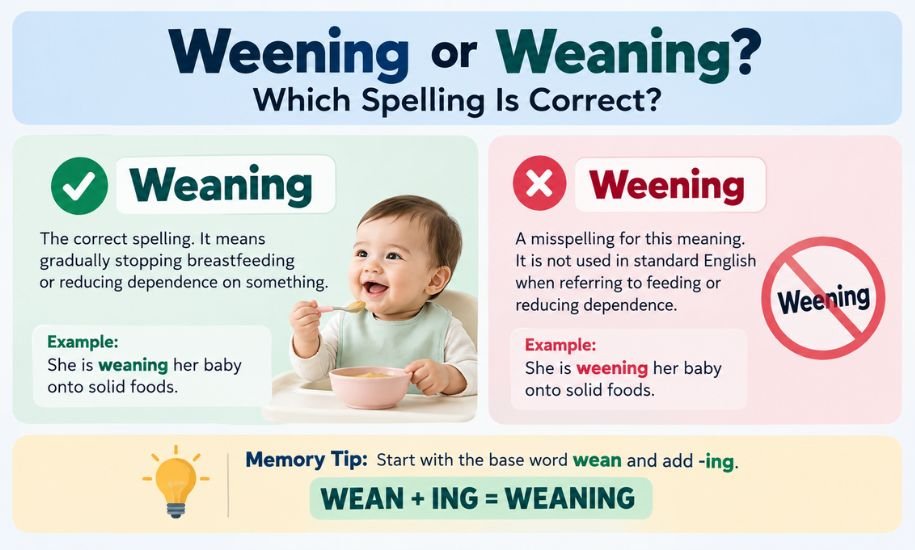
Weaning is the correct spelling when referring to gradually stopping breastfeeding, introducing other foods, or reducing dependence on something. Weening is a misspelling of weaning in these contexts and should be avoided in standard English. For example, “She is weaning her baby” is correct, while “She is weening her baby” is incorrect.
Weening or Weaning: Which Is Correct?
Weaning is the correct spelling. It is the present participle of the verb wean, which means to gradually stop feeding a baby or young animal with milk or to reduce someone’s dependence on a substance, activity, or habit.
The confusion usually comes from the similar appearance and pronunciation of the two forms. However, weaning follows the standard spelling of the verb wean when adding -ing. The letter a remains part of the word.
| Feature | Weening | Weaning |
|---|---|---|
| Correct spelling | No, for this meaning | Yes |
| Word type | Misspelling | Verb form / gerund |
| Meaning | No standard meaning as this verb form | Gradually stopping or reducing dependence |
| Usage | Avoid in standard English | Standard English |
| Example | Incorrect: Weening a baby | Correct: Weaning a baby |
Examples:
- Correct: The parents are weaning their baby onto solid foods.
- Incorrect: The parents are weening their baby onto solid foods.
- Correct: He is gradually weaning himself off caffeine.
- Incorrect: He is gradually weening himself off caffeine.
Remember that weaning is used in parenting, animal care, medicine, and everyday conversations about reducing dependence.
What Does Weaning Mean?
Weaning is the process of gradually transitioning a baby or young animal from its mother’s milk to other sources of nourishment. The term is also used when someone gradually reduces their reliance on a particular substance, treatment, or habit.
The word comes from the verb wean, and weaning is its -ing form. It can function as a verb form or as a noun describing the process itself.
Examples of weaning in sentences:
- The mother is weaning her baby from breastfeeding.
- The farmer started weaning the young calves from their mothers.
- She is weaning herself off sugary drinks.
- The patient is undergoing a medically supervised process of weaning from respiratory support.
The precise meaning depends on the context. When discussing babies, it often refers to introducing complementary foods or gradually ending breastfeeding. In other situations, it generally describes a gradual reduction in dependence.
Is Ween a Word?
Although ween exists as a word in English, it is not the standard verb used to describe stopping breastfeeding or reducing dependence. The correct verb for these meanings is wean.
Ween is an archaic or literary verb meaning to think, suppose, or imagine, and it is rarely used in modern everyday English. This is different from weaning, which is the standard form of wean.
For example:
- Correct: The parents are weaning their child from breastfeeding.
- Incorrect: The parents are weening their child from breastfeeding.
If you are writing about feeding, dependence, or gradual withdrawal, use wean, weaned, or weaning, depending on the sentence.
Weaning a Baby: Meaning and Examples
Weaning a baby refers to the transition from exclusive milk feeding towards the introduction of other foods. It may also refer to the gradual process of stopping breastfeeding.
These two aspects are related, but they are not exactly the same. A baby may begin eating complementary foods while continuing to breastfeed.
Examples:
- Weaning a baby can be an important developmental transition.
- The parents are preparing soft foods for their baby’s weaning journey.
- She spoke to her healthcare professional about when to begin introducing solid foods.
- The baby is adjusting to new textures during the weaning process.
The timing and approach to weaning can vary according to a baby’s development and individual needs. Parents should seek guidance from a qualified healthcare professional if they have questions about feeding or nutritional requirements.
In all these examples, weaning is the correct spelling. Writing weening a baby is a spelling error in standard English.
What Does Weaning Off Medication Mean?
The phrase weaning off medication describes gradually reducing or stopping a medicine as part of a medically supervised plan. It may be used when a healthcare professional determines that a patient can reduce a particular treatment.
The process can depend on the type of medication, the length of time it has been used, and the patient’s individual circumstances.
Examples:
- The doctor discussed weaning the patient off the medication.
- He is following a medically supervised plan for weaning off treatment.
- The patient asked how long the medication-weaning process might take.
It is important not to stop or reduce prescribed medication without consulting an appropriate healthcare professional. Some medicines can cause withdrawal symptoms or other complications if discontinued suddenly.
In this context, weaning off is the correct phrase, not weening off.
Wean, Weaned, and Weaning: Understanding the Word Forms
The verb wean has several grammatical forms. Knowing how they are used makes it easier to spell the word correctly in different sentences.
| Word form | Grammatical use | Example |
|---|---|---|
| Wean | Base form | They plan to wean the baby gradually. |
| Weans | Third-person singular, present tense | She weans her child at a suitable pace. |
| Weaned | Simple past or past participle | The baby was weaned gradually. |
| Weaning | Present participle or gerund | Weaning takes patience and care. |
The spelling pattern is straightforward: when adding -ing to wean, the final n is retained, producing weaning. There is no need to change the vowel or add an extra letter.
More examples:
- The farmer will wean the lambs next month.
- She weaned her child gradually.
- The process of weaning requires patience.
- They are weaning the young animals from milk.
These forms all come from the same verb and retain the letter a.
Wean Synonyms and Alternative Words
The best synonym for wean depends on what you are describing. When referring to feeding, words such as transition may be suitable. When discussing dependence, reduce or withdraw may fit better.
| Synonym | Meaning | Example |
|---|---|---|
| Transition | Move from one stage to another | The baby is transitioning to solid foods. |
| Reduce | Make something smaller or less frequent | He wants to reduce his caffeine intake. |
| Withdraw | Gradually remove or discontinue something | The doctor planned to withdraw the treatment. |
| Discontinue | Stop using something | The medicine was discontinued under medical guidance. |
| Detach | Become less dependent or connected | She is learning to detach from the habit. |
| Accustom | Help someone become familiar with something | Parents can gradually accustom a child to new foods. |
These words have related meanings, but they are not interchangeable in every situation. For example, transition is often suitable for describing changes in infant feeding, while reduce may be more natural when discussing caffeine consumption.
How to Use “Weaning” in a Sentence
The word weaning can be used in different grammatical structures, depending on whether it describes an ongoing action or the process itself.
As a verb:
- She is weaning her baby onto solid foods.
- The farmer is weaning the calves from milk.
- He is weaning himself off sugary drinks.
As a noun (gerund):
- Weaning can be a gradual process.
- The weaning of young animals requires appropriate care.
- The doctor explained the process of weaning from medication.
With the phrase “weaning off”:
- He is weaning off caffeine.
- She is gradually weaning herself off the habit.
- The patient is weaning off medication under medical supervision.
The spelling remains weaning in each of these examples.
Common Mistakes to Avoid
Writers sometimes make spelling and usage mistakes when using this word. Recognizing the correct forms can help you write more accurately.
- Using “weening” instead of “weaning”: The standard spelling is weaning when referring to feeding transitions or reducing dependence.
- Confusing weaning with stopping immediately: Weaning generally involves a gradual transition, although the exact process depends on the context.
- Treating weaning and complementary feeding as identical: Introducing other foods does not necessarily mean breastfeeding has ended.
- Using “wean out” instead of “wean off”: Wean off is the established phrase when describing a gradual reduction in dependence.
- Stopping medication without medical advice: Medication changes should be planned with a healthcare professional.
Paying attention to the meaning and grammatical context will help you select the correct form.
Easy Way to Remember the Correct Spelling
A simple way to remember the correct spelling is to start with the base verb wean and add -ing.
Remember this spelling pattern
WEAN + ING = WEANING
- Wean: the base verb
- Weaned: the past tense
- Weaning: the present participle or gerund
Keep the a in every form.
You can also associate weaning with feeding. Both words contain the letter a, which may help you remember the correct spelling when writing about babies or young animals.
Frequently Asked Questions
Is weening ever correct?
Weening is not the standard spelling of the verb used for breastfeeding transitions or reducing dependence. Although ween exists as a rare or archaic word with a different meaning, weening should not be used in place of weaning in ordinary modern English.
How do you spell weaning a baby?
The correct spelling is weaning a baby. It refers to introducing complementary foods or gradually ending breastfeeding, depending on the context. For example, “They are weaning their baby gradually” is a correctly spelled sentence.
What does “wean off” mean?
Wean off means to gradually reduce or end dependence on something, such as caffeine, a habit, or medication. When referring to prescribed medicines, the process should be guided by a qualified healthcare professional.
Is wean a real word?
Yes, wean is a standard English verb. It means to gradually move a baby or young animal away from milk or to reduce someone’s dependence on something. Its forms include weans, weaned, and weaning.
What is another word for weaning?
Depending on the context, alternatives include transitioning, reducing, and withdrawing. For baby feeding, transitioning to solid foods may be appropriate, while gradually reducing dependence can describe weaning off a substance or habit.
Is weaning the same as stopping breastfeeding?
Not necessarily. Weaning can involve introducing complementary foods while breastfeeding continues, or it can refer to gradually stopping breastfeeding altogether. The intended meaning depends on how the word is used.
Final Verdict: Weening or Weaning?
Weaning is the correct spelling when talking about transitioning a baby to other foods, stopping breastfeeding, or gradually reducing dependence on a substance or habit. Weening is a misspelling for these meanings and should be avoided in standard writing.
Remember the base word wean and simply add -ing to form weaning. With this simple rule, you can use the word confidently in everyday communication, academic work, and professional writing. Grammarifyr helps readers understand such spelling differences so they can know the difference and use the right words.
You may also Read : Tomorrow vs Tommorow: Correct Spelling and Meaning