Woah or Whoa: Meaning, Usage and Examples
Have you ever written “woah” or “whoa” when reacting to something surprising? Both spellings appear in everyday conversations, text messages, and online posts, so it is easy to wonder which one is correct. Although they generally have the same meaning and pronunciation, they are not equally preferred in standard written English. Understanding their usage will help you choose the right form for different situations, from casual chats to formal writing.
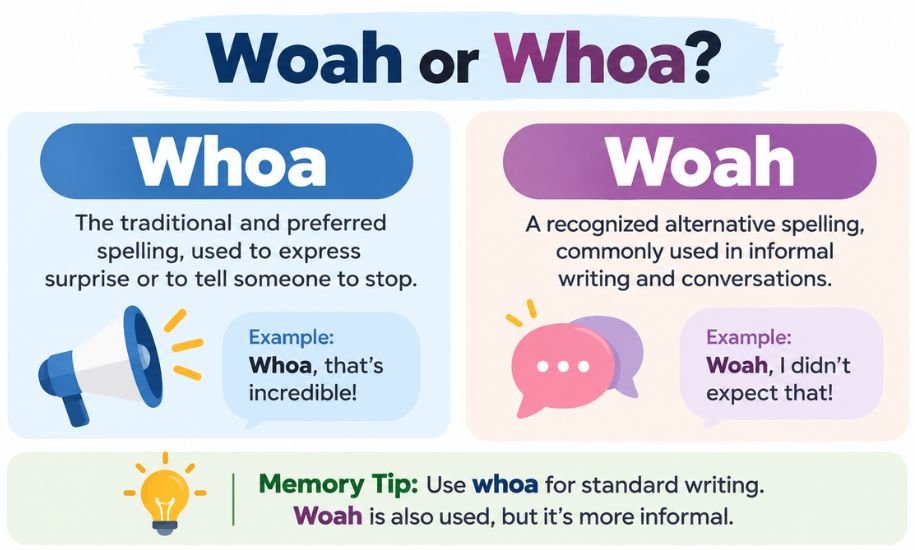
**Whoa** is the traditional and preferred spelling in standard English. **Woah** is a recognized alternative spelling that is common in informal communication. Both usually express surprise, amazement, disbelief, or a request to stop or slow down. For formal and carefully edited writing, choose “whoa.”
Whoa or Woah: What’s the Difference?
The main difference is spelling preference rather than meaning. Both forms are used as interjections, which are words that express emotions, reactions, or sudden commands.
| Feature | Whoa | Woah |
|---|---|---|
| Spelling status | Traditional, preferred form | Recognized alternative |
| Meaning | Surprise, amazement, or a command to stop | Generally the same |
| Pronunciation | Usually one syllable | Usually the same |
| Formal writing | Preferred | Generally best avoided |
| Informal messages | Common | Also used |
| Example | Whoa, that’s incredible! | Woah, that’s incredible! |
Although dictionaries differ in how they present the alternative spelling, “whoa” is the safest choice when you want to follow standard editorial conventions. “Woah” is not simply meaningless or an invented word; some dictionaries recognize it as a variant.
What Does “Whoa” Mean?
“Whoa” is an interjection with several related uses. Its meaning depends on the situation and the speaker’s tone.
1. To tell someone or something to stop
The word has traditionally been used as a command to make a horse stop or slow down. In everyday conversation, people also use it to ask someone to pause, calm down, or reduce the intensity of an action.
Examples:
- Whoa! The horse is moving too fast.
- Whoa, slow down. You’re speaking too quickly.
- Whoa there, let’s take a moment to think.
2. To express surprise or disbelief
People often say “whoa” when something unexpected happens or when they hear surprising information.
Examples:
- Whoa, I didn’t expect to see you here!
- Whoa! Did you really finish the entire project today?
- Whoa, I can’t believe how much the price has changed.
3. To show amazement or excitement
The word can also communicate admiration, enthusiasm, or wonder.
Examples:
- Whoa, that mountain view is beautiful.
- Whoa! Your performance was incredible.
- Whoa, that’s an impressive achievement.
In each situation, the word expresses a reaction rather than naming a person, place, or object.
Is “Woah” a Real Word?
Yes. “Woah” is a recognized alternative spelling of “whoa” in some dictionaries, including Cambridge Dictionary and Collins English Dictionary. However, recognition as a variant does not mean every style guide or editor will prefer it.
The traditional spelling remains the more reliable choice in standard writing. The alternative appears frequently in informal messages, comments, captions, and conversational dialogue.
For example:
- Standard preference: Whoa, that was unexpected.
- Informal alternative: Woah, that was unexpected.
Both sentences communicate essentially the same reaction. The first is the better option for school assignments, professional documents, and edited articles.
It is therefore more accurate to describe “woah” as an alternative spelling than to claim that it is universally incorrect.
How Is the Word Pronounced?
Both spellings are generally pronounced the same way, with one syllable.
- British English: /wəʊ/
- American English: /woʊ/
The vowel sound differs slightly between these common pronunciations, but the spelling choice does not ordinarily create a different spoken word.
For example, someone reacting to surprising news might say “whoa!” with a rising or emphatic tone. The same reaction could be written with the alternative spelling, without changing the intended meaning.
Remember that pronunciation can vary slightly by accent and context. There is no reliable rule that says the spelling “woah” must be spoken differently from “whoa.”
Woah or Whoa in UK and US English
Both spellings occur in British and American English, but their editorial status is not always presented in the same way.
In American English, “whoa” is the conventional spelling and is generally preferred in edited writing. “Woah” is still understandable and appears in informal communication.
In British English, both forms are encountered, and some dictionaries explicitly recognize “woah” as an alternative. Nevertheless, it would be misleading to say that British writers must use “woah” while American writers must use “whoa.”
If you are writing for a British or American audience, use “whoa” as your default. It is widely understood and avoids unnecessary questions about spelling conventions.
Examples of Correct Usage in Sentences
The following examples show how the word works in different situations.
Expressing surprise
- Whoa, I didn’t know you played the guitar.
- Whoa! That was a much bigger wave than I expected.
- Whoa, you’ve changed your hairstyle!
Asking someone to pause
- Whoa, let’s not make a decision just yet.
- Whoa there, we need to check the facts first.
- Whoa, take a breath and explain what happened.
Expressing admiration
- Whoa, this painting is beautiful.
- Whoa! You built that entire table yourself?
- Whoa, the view from the top is amazing.
Using the alternative spelling informally
- Woah, that’s a lot of information.
- Woah! I wasn’t expecting that result.
- Woah, this song sounds amazing.
The final group is suitable for illustrating informal usage. If you are preparing a formal article or an academic assignment, replace “woah” with “whoa.”
What Does “Woah” Mean in Chat or Texting?
In texting, “woah” usually expresses the same reactions as “whoa.” It can communicate surprise, excitement, disbelief, admiration, or a need to pause.
Consider these examples:
Friend: “I just got the job!”
Reply: “Whoa, congratulations!”
Or:
Friend: “I finished reading the entire book in one day.”
Reply: “Woah, that’s impressive!”
The spelling alone does not tell you exactly how the sender feels. Punctuation, surrounding messages, and the relationship between the people involved help determine the tone.
For instance, “Whoa!” might sound excited, while “Whoa, wait a minute” may signal confusion or concern.
What does “woah” mean when a girl sends it?
There is no special meaning that applies only when a girl uses the word. She might be surprised, impressed, confused, amused, or asking you to slow down, depending on the conversation.
If someone replies “woah” to a compliment, an unexpected statement, or a surprising photo, consider the context rather than assuming the message has a romantic meaning.
Synonyms for “Whoa”
The best substitute depends on the emotion or instruction you want to communicate.
| Intended meaning | Possible alternatives |
|---|---|
| Surprise | Wow, really, goodness |
| Amazement | Incredible, amazing, unbelievable |
| Disbelief | No way, seriously, are you kidding? |
| Asking someone to pause | Wait, hold on, stop |
| Asking someone to slow down | Easy, take it slowly, calm down |
These expressions are not interchangeable in every sentence. “Wow” usually expresses surprise or admiration, while “stop” is a more direct command. Choose a substitute that matches the intended meaning.
An Easy Way to Remember the Preferred Spelling
When in doubt, remember that whoa is the standard choice. You can use it to express surprise, admiration, disbelief, or a request to stop.
Keep “woah” in mind as an alternative you may encounter in casual writing. If you are unsure whether your audience or publication accepts it, there is little reason to take the risk: choose “whoa.”
The important point is to distinguish a preferred spelling from a recognized variant instead of assuming that every less common form is automatically wrong.
Frequently Asked Questions
1. Is “whoa” or “woah” correct?
“Whoa” is the traditional and preferred spelling in standard English. “Woah” is recognized as an alternative by some dictionaries and is common in informal writing. Both usually have the same meaning, but “whoa” is the safer option for formal documents and edited content.
2. Is “woah” incorrect in British English?
Not universally. Some dictionaries recognize “woah” as an alternative spelling, and it appears in British writing. However, “whoa” remains a dependable choice in standard edited English. The difference should not be reduced to a strict rule separating British and American spelling.
3. Do “whoa” and “woah” have different pronunciations?
Generally, no. Both are normally pronounced as one syllable. British and American speakers may use slightly different vowel sounds, but that variation relates to accent rather than a necessary distinction between the two spellings.
4. What does “whoa” mean in a sentence?
It can express surprise, amazement, or disbelief, or tell someone to stop or slow down. For example, “Whoa, that’s incredible!” expresses amazement, while “Whoa, slow down!” asks someone to reduce their speed.
5. Can I use “woah” in a formal essay?
It is best to use “whoa” in a formal essay. Although “woah” is recognized as an alternative spelling in some dictionaries, the traditional form is more suitable for academic and professional writing. If you are following a specific style guide, follow its preferred spelling.
6. What is another word for “whoa”?
Depending on the context, alternatives include “wow,” “really,” “hold on,” “wait,” and “stop.” Use “wow” to express amazement, or “hold on” when asking someone to pause. The best substitute depends on whether you are expressing an emotion or giving an instruction.
Final Verdict: Woah or Whoa?
When deciding between the two spellings, choose “whoa” for standard English and formal writing. “Woah” is a recognized alternative that is suitable for some informal contexts, but it is not the preferred form in many edited texts. Understanding this distinction helps you write clearly and confidently. At Grammarifyr, the goal is to make confusing English choices easier to understand, helping readers know the difference and use the right words. For readers of English Pairs, the same principle applies: choose the form that fits the context and accepted writing conventions.
You may also Read : Calfs or Calves: Meaning, Rules, and Examples