Hanged or Hung? Meaning and Grammar Guide
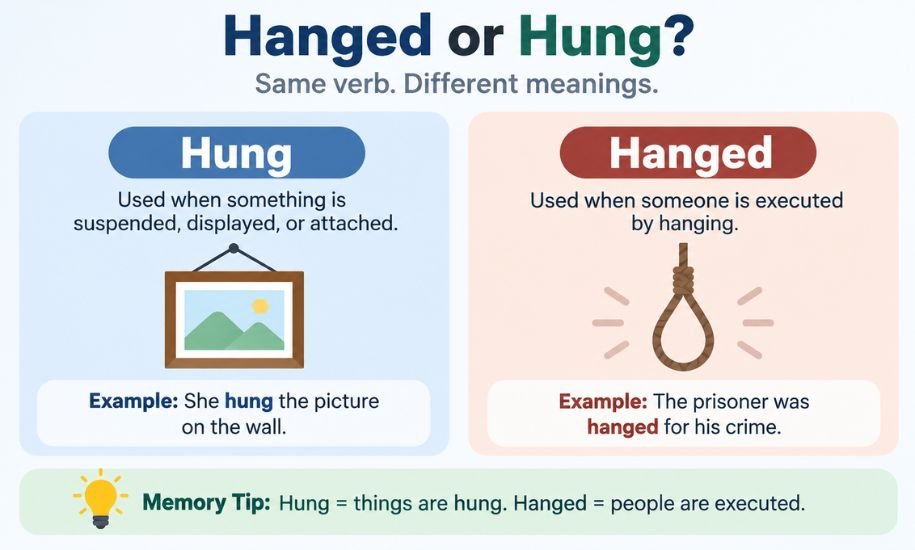
Choosing between hanged and hung can be confusing because both forms come from the verb hang. The difference, however, is quite clear once you know what hang means in a particular sentence. Hung is normally used when something is suspended, displayed, or attached somewhere, while hanged is traditionally used when someone is executed by hanging. The distinction becomes especially important in past-tense sentences, where choosing the wrong form can change the meaning or make the sentence sound incorrect.
Hung is the usual past tense and past participle of hang when something is suspended or displayed. Hanged is traditionally used when hang means to execute someone by hanging. So, you hung a picture on the wall, but a prisoner was hanged as a form of execution.
Hanged or Hung: The Basic Difference
Both hung and hanged are real words. Neither is simply a misspelling of the other.
The key difference is the meaning of the verb:
| Form | Main use | Example |
|---|---|---|
| hung | Suspended, displayed, or attached | She hung the painting above the sofa. |
| hanged | Executed by hanging | The prisoner was hanged for his crime. |
In ordinary situations, use hung.
We hung the decorations in the hallway.
He hung his jacket by the door.
When the sentence refers specifically to execution by hanging, use hanged in careful standard English.
The condemned prisoner was hanged at dawn.
This is why the simple rule “things are hung, people are hanged” can be useful as a starting point, but it is not completely accurate. The actual distinction depends on what the verb means, not simply whether the subject is a person or an object.
What Does “Hung” Mean?
Hung is the past tense and past participle of hang for most ordinary meanings.
It is used when something is:
- attached to a wall or another surface
- suspended from something
- displayed
- placed somewhere by hanging
- left suspended in the air
For example:
She hung a new mirror in the bedroom.
We hung the curtains before the guests arrived.
The children hung their coats near the entrance.
Several photographs were hung along the staircase.
A person can also be hung when the meaning is simply that the person was suspended rather than executed.
The actor was hung from a safety harness during the stunt.
Here, hung is appropriate because the sentence describes suspension, not execution.
What Does “Hanged” Mean?
Hanged is the traditional past tense and past participle used when hang means to execute someone by hanging.
Examples include:
The prisoner was hanged after being convicted of murder.
The historical account says that the rebel was hanged.
Several prisoners were hanged following the trial.
This specialized use is the main reason English has two different past forms of hang.
It is worth remembering that hanged is not simply a more formal version of hung. The two forms traditionally serve different meanings.
Why Are the Two Forms Confused?
The confusion comes from the fact that hang has more than one meaning and uses two past forms.
Most irregular verbs have one standard past form:
- go → went
- take → took
- see → saw
But hang developed a specialized form, hanged, for the execution sense. For ordinary meanings, hung is used.
This creates sentences that look very similar grammatically but require different forms:
The portrait was hung in the gallery.
The prisoner was hanged in the prison yard.
The first sentence describes displaying something. The second describes an execution.
Is It “Hang” or “Hung”?
If you are deciding between hang and hung, the answer usually depends on the tense.
Hang is the present/base form:
I hang my coat here every day.
Hung is normally the past form:
I hung my coat here yesterday.
You can also use hung after have, has, or had:
She has hung the picture in the living room.
They had hung the decorations before the party began.
However, when hang refers to execution, the past form is traditionally hanged:
The criminal was hanged.
So the basic pattern is:
| Meaning | Present/Base | Past | Past Participle |
|---|---|---|---|
| Suspend or display | hang | hung | hung |
| Execute by hanging | hang | hanged | hanged |
This is why “I hung the painting” is correct, while “I hanged the painting” is not standard usage.
Hanging or Hung: Which One Should You Use?
Hanging and hung are different grammatical forms, so they cannot normally be substituted for one another.
Hanging is the present participle or gerund:
The picture is hanging on the wall.
She is hanging new curtains.
They spent the afternoon hanging decorations.
Hung is generally the past tense or past participle:
She hung the curtains yesterday.
The picture was hung above the fireplace.
Compare these sentences:
- Present/ongoing: She is hanging the picture.
- Past: She hung the picture yesterday.
- Past participle: She has hung the picture carefully.
The ending -ing tells you that hanging is being used as a present participle or gerund, while hung is used for completed actions in the relevant ordinary senses.
Hung or Hanged: Examples in Sentences
Seeing the distinction in context makes it easier to remember.
Use “hung” for ordinary suspension
Correct:
We hung the painting in the dining room.
Incorrect:
We hanged the painting in the dining room.
Correct:
She hung her dress in the closet.
Incorrect:
She hanged her dress in the closet.
Correct:
The banners were hung across the street.
Incorrect:
The banners were hanged across the street.
Use “hanged” for execution
Correct:
The prisoner was hanged after his conviction.
Not the traditional standard form:
The prisoner was hung after his conviction.
The second sentence can occasionally be encountered, particularly in informal or nonstandard usage, but hanged is the established form when referring specifically to execution.
What About a Person Who Is Suspended?
This is where the shortcut “people are hanged” can cause problems.
A person can be hung when they are suspended rather than executed.
For example:
The climber was hung over the edge by a safety rope.
The performer was hung from a wire for the scene.
In these sentences, hang means to suspend, so hung is appropriate.
Therefore, the better rule is:
Execution → hanged
Ordinary suspension → hung
This rule works more reliably than trying to decide based only on whether the subject is a person.
Is It “Hanged or Hung Themselves”?
When the sentence describes someone dying by hanging, hanged themselves is the traditional formal construction.
For example:
The historical record states that the man hanged himself.
The same grammatical principle applies to plural subjects:
The report stated that the prisoners hanged themselves.
Because this subject involves a sensitive topic, it is generally better to use the construction only when it is necessary to explain the grammar or accurately discuss a historical or factual account.
You may also encounter hung himself/herself/themselves in real-world writing. However, when hang specifically means execution or death by hanging, hanged remains the traditional form used in careful standard English.
Common Mistakes to Avoid
1. Using “hanged” for pictures
A picture is hung, not hanged.
Correct: She hung the picture above the desk.
2. Assuming every person must be “hanged”
The subject being a person does not automatically require hanged.
The actor was hung from a wire.
Here, the meaning is suspension, so hung is appropriate.
3. Using “hanged” for everyday hanging actions
Incorrect: He hanged his coat on the hook.
Correct: He hung his coat on the hook.
4. Using “hanged out”
The phrasal verb hang out means to spend time relaxing or socializing. Its past form is hung out.
We hung out at the park yesterday.
Not:
We hanged out at the park yesterday.
The execution-specific form does not apply to ordinary phrasal verbs such as hang out.
5. Treating “hanging” as the past tense
Incorrect: She hanging the curtains yesterday.
Correct: She hung the curtains yesterday.
Hanging is the -ing form, not the normal simple past form.
An Easy Way to Remember the Difference
A simple memory rule is:
Hung = suspended or displayed.
Hanged = executed.
Think about what happened:
- A picture is hung on a wall.
- A coat is hung on a hook.
- Decorations are hung from the ceiling.
- Someone executed by hanging is hanged.
The most important point is that the meaning of “hang” determines the form.
Frequently Asked Questions
Is “hanged” or “hung” correct?
Both are correct, but they are used in different circumstances. Hung is the normal past form for ordinary meanings of hang, such as suspending or displaying something. Hanged is traditionally used when hang refers specifically to execution by hanging.
Is “hung or hanged” the same distinction?
Yes. The order of the words does not change the rule. Use hung for ordinary suspension and hanged for the execution sense of the verb.
Is “hanging” the same as “hung”?
No. Hanging is the present participle or gerund, while hung is normally the past tense and past participle for ordinary meanings of hang. For example, “She is hanging the picture” describes an ongoing action, while “She hung the picture” describes a completed action.
Should I say “hang” or “hung” when talking about the past?
For ordinary meanings, use hung for the simple past: “I hung the picture yesterday.” Hang is the base or present form: “I hang pictures for a living.” When referring to execution, the traditional past form is hanged.
Is “hanged themselves” grammatically correct?
Yes. When hang refers specifically to dying by hanging, hanged themselves is the traditional formal construction. The form follows the same distinction between execution and ordinary suspension.
Can a person be “hung” without meaning execution?
Yes. If a person is suspended rather than executed, hung can be correct. For example, an actor may be hung from a wire during a stunt. The meaning is suspension, not execution.
The Bottom Line
Hung is the normal past form of hang when something is suspended, displayed, or attached somewhere. Hanged has the specialized traditional use of describing execution by hanging. The easiest rule is to focus on the meaning: ordinary suspension is “hung,” while execution is “hanged.”
Once that distinction is clear, most questions about these two forms become straightforward. For more practical explanations of confusing English words and grammar choices, Grammarifyr helps you know the difference and use the right words.
You may also Read : Smooth or Smoothe: Meaning and Correct Usage

One Comment