Ambiance or Ambience? Difference Explained Clearly
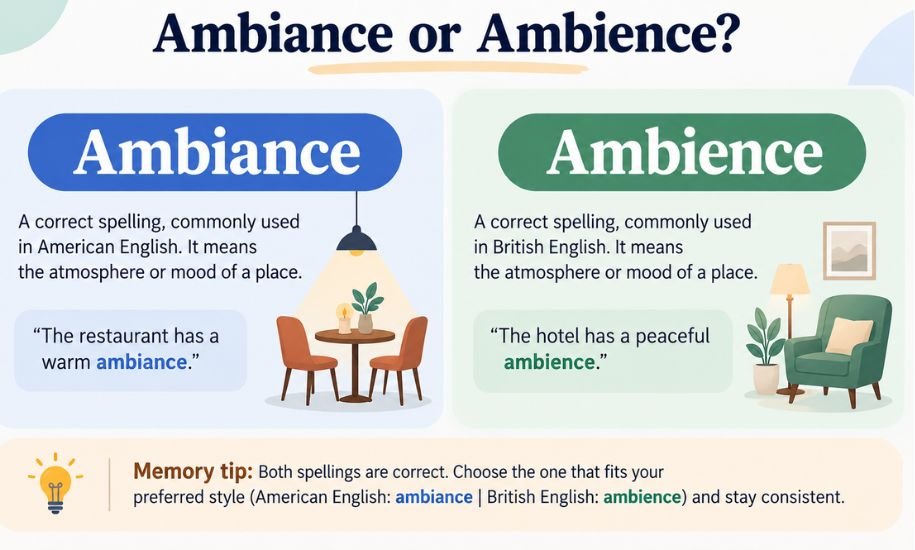
If you have ever hesitated between ambiance and ambience, you are not alone. The two spellings look almost identical, sound similar, and refer to the same basic idea: the atmosphere, character, or mood of a place. The good news is that you do not have to choose between a “correct” word and a “wrong” one. Both are accepted English spellings. The main difference lies in spelling preference, pronunciation in some varieties of English, and regional usage. Understanding these small distinctions can help you choose the form that best fits your audience and writing style.
Ambiance and ambience are both correct spellings. Both mean the atmosphere, character, mood, or overall feeling of a place or situation. Ambience is a common choice in British English, while ambiance is especially associated with American English, although both forms occur in both varieties.
Ambiance or Ambience: Which Is Correct?
The simplest answer is both.
Major dictionaries recognize ambience and ambiance as forms of the same noun. Oxford lists ambiance as an alternative to ambience, defining the word as the “character and atmosphere of a place.”
Cambridge also lists ambiance as an alternative spelling of ambience and defines the word as the character of a place or the quality it seems to have.
So these sentences are both correct:
- The restaurant has a relaxing ambience.
- The restaurant has a relaxing ambiance.
There is no difference in the basic meaning.
Quick comparison
| Feature | Ambience | Ambiance |
|---|---|---|
| Correct spelling? | Yes | Yes |
| Part of speech | Noun | Noun |
| Basic meaning | Atmosphere, character, mood | Atmosphere, character, mood |
| British English | Common | Also accepted |
| American English | Accepted | Commonly used |
| Plural | Ambiences | Ambiances |
The most important point is that neither spelling should automatically be treated as a misspelling.
What Does “Ambience” Mean?
Ambience is a noun referring to the character, atmosphere, or overall feeling of a place or environment.
Oxford defines it as the character and atmosphere of a place, while Cambridge describes it as the character of a place or the quality it seems to have.
For example, when you say that a restaurant has a pleasant ambience, you are talking about the overall feeling created by things such as its:
- lighting
- music
- decoration
- furniture
- colors
- layout
- noise level
- surroundings
Examples
The soft lighting gives the restaurant a warm ambience.
The hotel is known for its peaceful ambience.
The café has a relaxed ambience that makes it popular with students.
The music contributed to the festive ambience of the evening.
The word can also be used for broader environments, not just physical rooms or buildings. Cambridge provides examples involving the character of a city and even the atmosphere surrounding a particular period or situation.
What Does “Ambiance” Mean?
Ambiance has essentially the same meaning as ambience.
Collins defines ambiance as the mood, character, quality, tone, or atmosphere of an environment and lists ambience as an alternative.
For example:
The restaurant has an elegant ambiance.
Candlelight creates a romantic ambiance.
The hotel combines modern design with a comfortable ambiance.
The outdoor garden gives the event a relaxed ambiance.
In other words, if you replace ambience with ambiance in most ordinary sentences, the meaning stays the same.
Is There a Difference Between the Two?
For most writers, there is no meaningful difference in definition or grammatical function.
Both words are nouns and both describe the atmosphere or distinctive character of a place or situation.
The most noticeable distinction is the spelling:
ambience → ends in -ence
ambiance → ends in -ance
This difference can make the words look as though they have different meanings, but dictionaries treat them as alternative forms rather than separate concepts. Oxford and Cambridge both recognize the two forms.
Compare these sentences
The café has a cozy ambience.
The café has a cozy ambiance.
Both mean that the café creates a cozy atmosphere.
So if you are asking, “Is it ambiance or ambience?”, the answer is that either spelling can be correct.
Ambiance or Ambience Pronunciation
Pronunciation is slightly more interesting because major dictionaries show regional differences.
Cambridge gives the British pronunciation of ambience as:
/ˈæm.bi.əns/
and the US pronunciation as:
/ˌɑːm.biˈɑːns/.
Oxford similarly gives ambience as /ˈæmbiəns/ and recognizes the alternative form ambiance. Its American dictionary also records more than one pronunciation.
This means pronunciation can vary with the speaker’s variety of English.
For English learners, the important lesson is not to assume that the -ence versus -ance spelling alone determines a completely different pronunciation. Regional pronunciation patterns matter.
The French-origin pronunciation may also be encountered, particularly in contexts where speakers are consciously preserving a French pronunciation. Collins records both English and French-influenced pronunciations.
American English vs British English
A useful way to approach the two spellings is to consider your audience.
British English
Ambience is a familiar and natural spelling in British English:
The hotel has a sophisticated ambience.
American English
Ambiance is particularly familiar in American English:
The hotel has a sophisticated ambiance.
However, it would be misleading to say that ambience is exclusively British or that ambiance is exclusively American. American dictionaries also recognize ambience, and British dictionaries recognize ambiance.
For example, Oxford’s American English entry explicitly gives ambience (also ambiance).
Which one should you choose?
The best practical rule is consistency.
If you are writing primarily for a British audience, ambience is a natural choice. If your content follows American English conventions, ambiance may fit more naturally.
But using the other accepted spelling does not automatically make your writing incorrect.
Ambiance or Ambience Meaning in Everyday English
Both forms can describe the feeling created by an environment.
Consider a restaurant.
Its ambience or ambiance might be:
- quiet and intimate
- bright and energetic
- formal and elegant
- casual and welcoming
- rustic and traditional
The word is therefore broader than simply saying a place is “nice.”
For instance:
The restaurant was beautiful.
This describes the restaurant generally.
The restaurant had a warm ambience.
This specifically describes the atmosphere or feeling created by the surroundings.
Cambridge’s learner dictionary similarly explains the word as the qualities of a place and the way those qualities make you feel.
Examples in Sentences
Here are some natural examples using both spellings.
Using “ambience”
- The dim lighting created a peaceful ambience.
- We enjoyed the relaxed ambience of the seaside café.
- The hotel has a sophisticated ambience.
- The music added to the festive ambience.
- The city’s lively ambience attracts visitors.
Using “ambiance”
- The restaurant has a romantic ambiance.
- The candles give the room a warm ambiance.
- The hotel offers a luxurious ambiance.
- Soft music helped create a calming ambiance.
- The café’s casual ambiance makes it a comfortable place to work.
Notice that the grammatical structure is the same. The spelling changes, but the meaning does not.
Ambience vs Atmosphere: Are They the Same?
Ambience and atmosphere are often interchangeable, especially when describing a place.
For example:
The restaurant has a relaxed atmosphere.
The restaurant has a relaxed ambience.
Both sentences describe the overall feeling of the restaurant.
However, atmosphere is the more general and widely used word. Ambience can sound somewhat more descriptive or literary when discussing the distinctive character of a setting.
Other related words include:
- mood — emphasizes emotional feeling
- vibe — informal and conversational
- setting — focuses more on surroundings or context
- character — emphasizes distinctive qualities
- feel — informal and broad
Collins lists atmosphere, feel, setting, and air among synonyms or related terms for ambience.
Why Are the Words Confused?
The confusion is understandable because the two forms are nearly identical.
They:
- have the same basic meaning;
- perform the same grammatical role;
- differ by only one letter in their endings;
- are both accepted by major dictionaries;
- are associated with regional and stylistic variation.
There is also a connection with the word ambient, which means relating to the surrounding area or conditions. Oxford traces ambience to ambient and/or French ambiance.
That shared history helps explain why the spellings are so similar.
Common Mistakes to Avoid
1. Treating one spelling as automatically wrong
Incorrect assumption:
“Ambiance is a misspelling of ambience.”
Better understanding:
Both are recognized English forms.
2. Assuming they have different meanings
There is no standard meaning distinction between the two forms. In ordinary English, both refer to the atmosphere or character of a place or situation.
3. Mixing regional styles unnecessarily
If an article otherwise follows British English conventions, consistently using ambience may make the writing feel more uniform.
Likewise, American English content can consistently use ambiance.
4. Confusing “ambience” with “ambient”
These words are related but have different grammatical roles.
Ambience/ambiance is a noun:
The restaurant has a relaxing ambience.
Ambient is generally an adjective:
The restaurant uses soft ambient lighting.
Oxford defines ambient as relating to the surrounding area and also uses it for things such as ambient lighting and ambient music.
Easy Way to Remember the Difference
You do not need to memorize a complicated spelling rule because there is no meaning-based distinction to remember.
Instead, remember:
Ambience and ambiance are two accepted spellings for the same basic word.
If you prefer British English, ambience is a natural choice.
If you are following American English conventions, ambiance is a natural choice.
Most importantly, choose one spelling and use it consistently within the same piece of writing.
Frequently Asked Questions
Is “ambiance” a correct word?
Yes. Ambiance is a correct English noun. Major dictionaries recognize it as an alternative form of ambience. It refers to the atmosphere, mood, character, or quality of a place or environment.
Is “ambience” British or American?
Ambience is especially familiar in British English, but it is also accepted in American English. Oxford’s American English dictionary explicitly lists ambience and ambiance as alternative forms.
Which is more appropriate in formal writing?
Both are appropriate. The better choice depends mainly on your preferred variety of English and editorial style. The key is to use your chosen spelling consistently rather than switching between forms without a reason.
Do ambiance and ambience have the same pronunciation?
Not necessarily. Pronunciation can vary by English variety. Cambridge records different UK and US pronunciations for ambience, so regional pronunciation should be considered rather than assuming one universal pronunciation.
What is the plural of ambience?
The plural is ambiences. For ambiance, the plural is ambiances. In ordinary writing, however, the word is frequently used as a singular or uncountable-style noun when discussing the overall atmosphere of a place.
Final Verdict: Ambiance or Ambience?
Ambiance and ambience are both correct. They function as nouns and describe the atmosphere, character, mood, or overall feeling of a place or situation. Ambience is particularly natural in British English, while ambiance is especially common in American English, but the forms overlap across varieties. Choose the spelling that matches your preferred style and remain consistent. For more clear explanations of confusing English words, Grammarifyr helps you know the difference and use the right words.
You may also Read : Burnt or Burned: Meaning and Usage Explained
One Comment