Disgard or Discard: Correct Spelling Explained
It is easy to hesitate between disgard and discard, especially because the two spellings look and sound similar. However, there is a clear distinction: one is the standard English word, while the other is a spelling error. Knowing the correct form also helps with related words such as discarded and discarding. If you have ever wondered whether to write “disgard” in a sentence, the answer is simple: use discard.
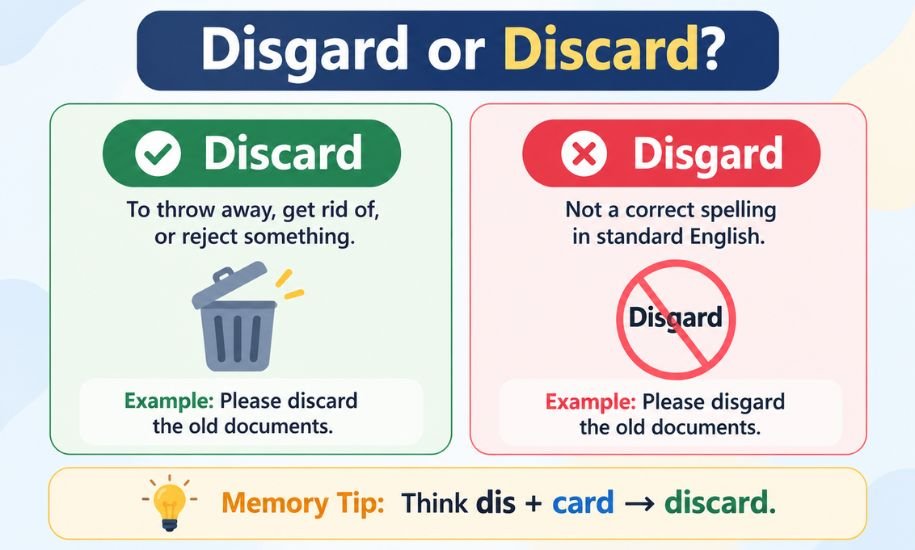
Discard is the correct standard spelling. Disgard is a misspelling and should not be used in standard English. The correct related forms are discarded and discarding.
Disgard or Discard: Which Is Correct?
The correct spelling is discard.
Discard is a standard English verb meaning to throw something away, get rid of it, or reject it. It can refer to physical objects, information, ideas, plans, choices, and more.
Disgard, on the other hand, is not the standard spelling of this word. If you mean “throw away” or “get rid of,” write discard.
| Feature | Discard | Disgard |
|---|---|---|
| Standard English spelling? | ✅ Yes | ❌ No |
| Part of speech | Verb and noun | — |
| Meaning | Throw away, get rid of, or reject | No standard meaning as a spelling variant |
| Past tense | Discarded | ❌ Disgarded |
| -ing form | Discarding | ❌ Disgarding |
| Example | Please discard the receipt. | Please disgard the receipt. ❌ |
The important point is that this is not a case of two acceptable English spellings. Unlike color and colour, there is no standard British-versus-American distinction here.
What Does “Discard” Mean?
Discard is primarily a verb. It means to get rid of something because it is unwanted, unnecessary, unsuitable, or no longer useful.
For example:
- Please discard the empty package.
- She discarded her old notes.
- The editor discarded the weaker proposal.
- We should not discard the idea without considering it.
- He discarded the damaged cards.
The word can describe getting rid of something physical, but it can also describe rejecting an idea, possibility, suggestion, or option.
Discard as a noun
Discard can also be used as a noun in certain contexts. For example:
The pile contained several discards from the previous round.
In card games, a discard can refer to a card that a player gets rid of or places into the discard pile.
Is “Disgard” a Real Word?
In standard modern English, disgard is not the correct spelling for the verb discard.
It is best treated as a misspelling, rather than as an alternative word with its own definition.
For example:
Incorrect:
Please disgard these documents.
Correct:
Please discard these documents.
The same correction applies when the word changes grammatical form.
Incorrect:
The company disgarded the proposal.
Correct:
The company discarded the proposal.
If you see disgard in an informal message or an online post, the intended word is usually clear from context, but the spelling should still be corrected in formal or edited writing.
Discarded or Disgarded: Which Form Is Correct?
The correct past-tense and past-participle form is discarded.
The verb follows this pattern:
discard → discarded
Not:
disgard → disgarded
Here are some natural examples:
- She discarded the broken cup.
- The team discarded the original design.
- Several outdated files were discarded.
- He discarded the first draft and started again.
The spelling remains based on discard, so the c stays in the word.
What About “Discarding”?
The same rule applies to the -ing form.
The correct spelling is:
discarding
Not:
disgarding
Examples:
- They are discarding unnecessary materials.
- She is discarding old paperwork.
- The program automatically removes data that users are discarding.
The basic word remains discard, and the normal -ing ending is added:
discard + ing = discarding
Why Do People Write “Disgard”?
The confusion is understandable because discard and disgard are visually and phonetically similar.
The incorrect version replaces the c in discard with g, producing disgard. Someone who is spelling the word based primarily on how it sounds may make this substitution.
There is also a potentially confusing relationship with words such as disregard. Disregard is a completely different word meaning to ignore or pay no attention to something. That similarity can make the spelling of discard less intuitive for some writers.
The safest approach is simply to remember the spelling of the standard word:
dis + card = discard
An Easy Way to Remember the Spelling
A useful memory trick is to notice the word card inside discard:
dis + CARD = discard
Think of a card game. When you no longer want a card, you discard it.
This gives you a simple visual reminder:
disCARD ✅
disGARD ❌
Remembering the final part as card makes it much easier to avoid the common misspelling.
Discard vs. Disregard
Although these words look somewhat similar, their meanings are different.
Discard means to throw away, get rid of, or reject something.
The store discarded the damaged products.
Disregard means to ignore something or treat it as unimportant.
The driver disregarded the warning sign.
Compare them:
| Word | Meaning | Example |
|---|---|---|
| Discard | Get rid of or reject | She discarded the old plan. |
| Disregard | Ignore or pay no attention to | She disregarded the warning. |
You can discard an object or discard an idea. You can disregard advice, a warning, a rule, or a comment.
Understanding this distinction can prevent both spelling and word-choice errors.
Correct and Incorrect Examples
Seeing the difference in context makes the rule easier to remember.
Example 1
Correct:
Please discard the empty bottle.
Incorrect:
Please disgard the empty bottle.
Example 2
Correct:
The committee discarded the proposal.
Incorrect:
The committee disgarded the proposal.
Example 3
Correct:
They are discarding outdated records.
Incorrect:
They are disgarding outdated records.
Example 4
Correct:
Don’t discard the idea just because it needs some changes.
Here, discard is being used figuratively. The idea is not a physical object, but it can still be rejected.
Example 5
Correct:
The player decided to discard the card.
This illustrates the word’s familiar use in card games.
Common Mistakes to Avoid
1. Using “disgard” as an alternative spelling
There is no standard spelling variation here.
Use: discard
Avoid: disgard
2. Writing “disgarded”
The past tense must retain the spelling of the base word:
discard → discarded
Not:
disgard → disgarded
3. Writing “disgarding”
The correct -ing form is:
discarding
Not:
disgarding
4. Confusing “discard” with “disregard”
These words have different meanings.
If you mean get rid of, use discard.
If you mean ignore, use disregard.
5. Treating it as a US/UK spelling difference
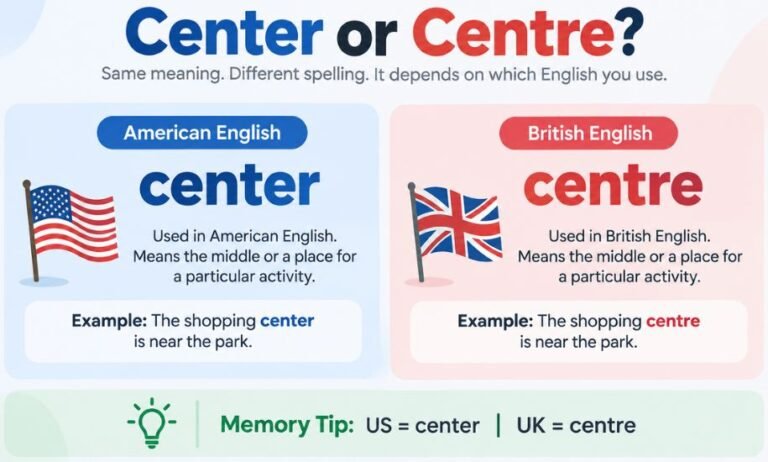
Discard is not like color/colour or center/centre. The standard spelling is discard in both American and British English.
How to Use “Discard” Correctly
A few sentence patterns can help you become comfortable with the word.
To throw something away
Please discard the packaging after opening the product.
To get rid of something unwanted
We discarded the damaged equipment.
To reject an idea or possibility
The researchers discarded the first explanation after finding contradictory evidence.
In a card game
She chose to discard one of her cards.
As an adjective-like participle
The discarded papers were collected for recycling.
These examples show why discard is more versatile than simply meaning “throw something in the trash.”
Frequently Asked Questions
Is “disgard” or “discard” correct?
Discard is correct. Disgard is a misspelling and is not the standard spelling of the English word meaning “to throw away,” “get rid of,” or “reject.”
Is “disgarded” or “discarded” correct?
Discarded is correct. It is the past tense and past participle of discard. The form disgarded is a misspelling.
Is “disgarding” a correct spelling?
No. The correct -ing form is discarding. For example, “They are discarding the damaged materials.”
Is “discard” a verb or a noun?
It can be both. As a verb, it means to get rid of or reject something. As a noun, it can refer to something that has been discarded, particularly in contexts such as card games.
Is “discard” different in American and British English?
No. Discard is the standard spelling in both American and British English. It is not a regional spelling pair such as color and colour.
How can I remember how to spell “discard”?
Think of dis + card. The word contains card, so remember disCARD, not disGARD. This simple association can help prevent the spelling error.
Final Verdict: Disgard or Discard?
When you mean to throw away, get rid of, or reject something, the correct spelling is discard. The related forms are discarded and discarding. Disgard, disgarded, and disgarding are incorrect spellings in standard English. For more straightforward explanations of confusing English words and spelling choices, Grammarifyr helps you know the difference and use the right words.
You may also Read : Personel or Personnel: Correct Spelling Explained
One Comment