Alum or Alumni: Meaning and Correct Usage
If you are unsure whether to say alum or alumni, the key question is simple: are you talking about one former student or more than one? Both forms are used in English, but they do not serve exactly the same grammatical purpose. Alum is an informal singular term for a graduate or former student, while alumni is traditionally a plural noun. The confusion often comes from the related words alumnus and alumna, which have more specific traditional meanings. Knowing the difference makes it much easier to choose the right form in everyday and formal writing.
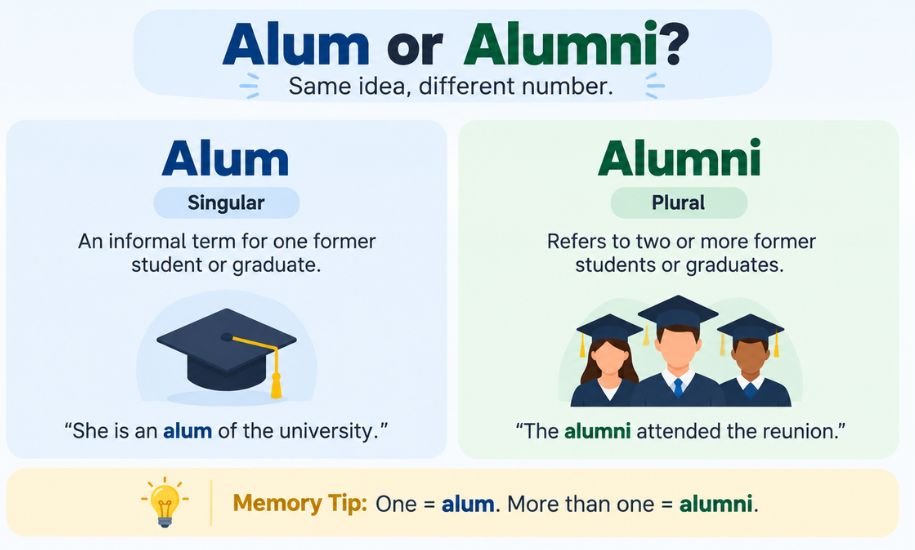
Alum is the informal singular form, while alumni is traditionally plural. You can say “I’m an alum of the university,” but “I’m an alumni” is not standard English. For formal writing, alumnus or alumna may also be used for one person.
Alum or Alumni: What’s the Difference?
The basic distinction is number:
| Term | Number | Meaning | Example |
|---|---|---|---|
| alum | Singular | One former student or graduate | “She is an alum of Yale.” |
| alumni | Plural | More than one former student or graduate | “The alumni attended the reunion.” |
| alumnus | Singular | Traditionally, one male former student or graduate | “He is an alumnus of Yale.” |
| alumna | Singular | Traditionally, one female former student or graduate | “She is an alumna of Yale.” |
| alumnae | Plural | Traditionally, a group of female graduates | “The alumnae organized the event.” |
| alums | Plural | Informal plural of alum | “Several alums returned to campus.” |
So, if you are referring to one person, alum is appropriate in informal English. If you are referring to two or more people, alumni is the traditional plural.
What Does “Alum” Mean?
Alum is an informal noun meaning a person who attended or graduated from a school, college, university, or other educational institution.
It is a shortened form of alumnus or alumna. Unlike those traditional forms, alum does not specify gender.
For example:
- “I’m an alum of the University of Michigan.”
- “She is a Harvard alum.”
- “He became an alum after graduating in 2020.”
- “My sister is an alum of that college.”
Because alum is relatively informal, it is especially common in conversation and casual writing. Some institutions prefer more traditional terms in formal publications, while others use alum as an inclusive, straightforward alternative.
Is “Alum” Singular?
Yes. In standard usage, alum is singular.
You can therefore use an article such as a or an before it:
“She is an alum of the university.”
The plural informal form is alums:
“Several alums attended the ceremony.”
What Does “Alumni” Mean?
Alumni is traditionally a plural noun referring to former students or graduates.
For example:
- “The university invited its alumni to the reunion.”
- “Thousands of alumni support the school.”
- “The association connects alumni around the world.”
- “Several distinguished alumni attended the celebration.”
Traditionally, alumni is the plural of alumnus. In modern English, it is also commonly used for groups containing people of different genders.
The important point is that alumni is plural in standard grammatical usage.
Therefore, this sentence is not standard:
“I am an alumni.”
A better choice is:
“I am an alum.”
Or, in traditional terminology:
“I am an alumnus.”
“I am an alumna.”
Is It “Alum” or “Alumni” for One Person?
For one person, use alum, alumnus, or alumna, depending on the level of formality and terminology you want.
For example:
Informal:
“I’m an alum of Boston University.”
Traditional masculine form:
“I’m an alumnus of Boston University.”
Traditional feminine form:
“I’m an alumna of Boston University.”
For multiple people:
“We are alumni of Boston University.”
This is why “am I an alumni or alum?” has a straightforward answer: if you are talking about yourself as one former student, “I am an alum” is grammatically appropriate.
Alum, Alumni, or Alumnus?
These terms are related, but their grammatical roles are different.
Alum
Alum is the informal, gender-neutral singular term.
“Maria is an alum of Stanford.”
Alumnus
Alumnus is the traditional singular form for a male former student or graduate.
“David is an alumnus of Stanford.”
Alumna
Alumna is the traditional singular form for a female former student or graduate.
“Maria is an alumna of Stanford.”
Alumni
Alumni is traditionally the plural of alumnus and is commonly used for a group of graduates or former students.
“David and Maria are alumni of Stanford.”
Alumnae
Alumnae is traditionally the plural form of alumna, referring specifically to a group of women.
“The alumnae returned for the annual celebration.”
In contemporary general writing, alumni is widely used as a plural term for groups regardless of gender, although individual institutions may have their own editorial preferences.
Why Are These Words Confused?
The confusion comes largely from the fact that alum, alumnus, alumna, and alumni are closely related.
Someone may remember seeing alumni used in connection with graduates and then assume that the word can describe a single person. However, the traditional grammatical pattern distinguishes singular and plural forms.
Compare:
- One person: “She is an alum.”
- Several people: “They are alumni.”
The phrase “an alumni” can sound familiar because alumni is strongly associated with former students, but grammatically it does not function as the ordinary singular noun in standard English.
Correct and Incorrect Examples
Seeing the forms side by side makes the distinction easier.
When referring to one person
Correct:
“I am an alum of the university.”
Correct:
“He is an alumnus of the college.”
Correct:
“She is an alumna of the college.”
Not standard:
“I am an alumni of the university.”
When referring to multiple people
Correct:
“The alumni gathered for the reunion.”
Correct:
“Many alumni continue to support the school.”
Informal:
“Several alums attended the event.”
The choice between alumni and alums depends partly on the desired level of formality.
Do I Say “Alum” or “Alumni” About Myself?
If you are describing yourself as one graduate or former student, say:
“I am an alum.”
You can also use alumnus or alumna if that terminology fits your preferred style.
Avoid:
“I am an alumni.”
For example:
“I’m an alum of the University of Texas, and I still attend its annual events.”
Here, alum is singular because the speaker is referring to one person: themselves.
If several former students are speaking collectively, alumni is appropriate:
“We are alumni of the same university.”
Is “Alumni” Always the Right Plural?
Not necessarily. Alums is also a plural form of alum and is used in informal English.
For example:
“The college invited former alums to a networking event.”
More naturally, you could simply say:
“The college invited several alums to a networking event.”
In formal university writing, however, an institution may prefer alumni, alumnae, alumnus, or alumna. Editorial preferences vary, so if you are writing for a particular school or organization, its style guide should take priority.
A Simple Rule to Remember
A useful way to remember the distinction is:
One = alum
More than one = alumni
For more traditional terminology:
One man = alumnus
One woman = alumna
Multiple people = alumni
Multiple women = alumnae
You do not need to memorize every Latin-derived form to communicate clearly. In ordinary modern English, alum provides a convenient singular option, while alumni works naturally for a group.
Common Mistakes to Avoid
1. Saying “an alumni”
❌ “I am an alumni of the college.”
Use:
✅ “I am an alum of the college.”
2. Treating “alumni” as singular
Because alumni refers to graduates, some writers use it as though it means “a graduate.” In traditional standard usage, it is plural.
❌ “An alumni spoke at the event.”
Better:
✅ “An alum spoke at the event.”
3. Assuming “alum” is incorrect
Alum is a legitimate informal English noun. It is not simply a mistake for alumnus or alumna.
Whether it is appropriate depends on the context and the style expected by the organization.
4. Using “alumnus” for every individual
Alumnus is a traditional singular form, but alum can be used when you want a concise, gender-neutral term.
5. Confusing “alums” and “alumni”
Both can be plural, but they differ in style and origin:
- alums = informal plural of alum
- alumni = traditional plural form associated with alumnus
Frequently Asked Questions
Is it “I am an alum” or “I am an alumni”?
The standard choice is “I am an alum.” Alum is singular, while alumni is traditionally plural. You can also say “I am an alumnus” or “I am an alumna” using the traditional singular forms.
Is “alum” a proper word?
Yes. Alum is an established informal term for a graduate or former student. It is a shortened form related to alumnus and alumna. It is widely understandable, although some organizations may prefer the longer traditional forms in formal writing.
Can “alumni” refer to one person?
In standard English, alumni is traditionally plural, so it should not normally be used with a or an to describe one person. For an individual, use alum, alumnus, or alumna instead.
Is “alums” the plural of “alum”?
Yes. Alums is an informal plural of alum. For example, “Several alums returned to campus.” In formal institutional writing, however, an organization may prefer alumni or another traditional form.
Should I use “alumnus” or “alum”?
For an individual, either may be appropriate depending on context. Alum is shorter, informal, and gender-neutral. Alumnus is the traditional singular form associated with a male graduate. Always consider the style guide of the institution you are writing for.
Is “alumni” singular or plural?
Alumni is traditionally plural. It refers to multiple former students or graduates. For one person, alum, alumnus, or alumna is more appropriate.
Final Verdict: Alum or Alumni?
The easiest rule is one person = alum; multiple people = alumni. If you need a traditional singular form, use alumnus or alumna, while alumni remains the familiar plural term for graduates. For clear explanations of similar English word and grammar choices, Grammarifyr follows the same principle: Know the Difference. Use the Right Words.
You may also Read : Forth or Fourth: Meaning and Usage Explained