Busing or Bussing: Meaning and Correct Usage
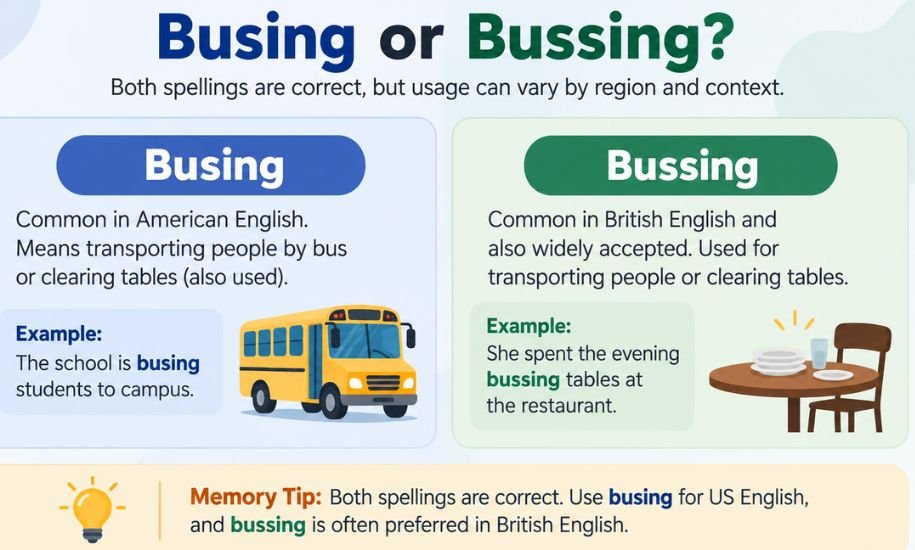
If you have ever wondered whether the correct form is busing or bussing, you are not alone. Both spellings appear in dictionaries, but their use can vary by region and context. The confusion is especially noticeable in phrases such as busing students, bussing tables, and busing tables. The good news is that you do not always have to choose one spelling and call the other wrong. Both busing and bussing are established forms of the verb bus, although American and British English can show different preferences.
Both busing and bussing are correct forms of bus. In American English, busing is a common spelling, while bussing is also accepted. In restaurant contexts, both busing tables and bussing tables can be used, although bussing tables is a very familiar form.
Busing vs. Bussing: What’s the Difference?
The main difference is spelling preference rather than meaning. Both forms can function as the present participle of bus.
| Form | Correct? | Common context |
|---|---|---|
| busing | Yes | Transporting people; restaurant work |
| bussing | Yes | Transporting people; restaurant work |
| bused | Yes | Past tense/past participle, especially common in US English |
| bussed | Yes | Past tense/past participle, especially common in British English |
Oxford lists both busing and bussing as -ing forms of bus, along with bused and bussed as past forms.
So, if you see bussing in one publication and busing in another, that does not automatically mean one writer made a spelling mistake.
What Does “Busing” Mean?
Busing is the present participle of the verb bus. In transportation contexts, it means taking people somewhere by bus.
For example:
- The school is busing students to a nearby campus.
- The company is busing employees to the conference.
- Volunteers helped with busing visitors from the parking area.
- The students were busing to another school each morning.
In American English, busing is particularly well established. Oxford’s American English dictionary gives busing as a form of bus and defines bus as transporting someone by bus.
The noun busing can also refer to a system of transporting students by bus, particularly in discussions of school integration in the United States. Oxford identifies this as a North American usage and lists bussing as an alternative.
What Does “Bussing” Mean?
Bussing is also a legitimate present participle of bus.
It can mean transporting people by bus:
The children were bussing to school every morning.
It can also occur in restaurant language:
She spent the evening bussing tables.
Cambridge identifies bussing as the present participle of bus and provides examples involving transportation. Its dictionary also gives examples of bussing tables in restaurant work.
Oxford likewise lists bussing as an accepted -ing form and specifically notes busing as another North American form.
Is It Busing or Bussing in American English?
For American English, busing is a standard and very useful choice, especially when you mean transporting people.
For example:
The district is busing students to schools outside their neighborhood.
However, bussing is not automatically incorrect in American English. Major dictionaries recognize it as an alternative form.
This means that the statement “bussing is wrong in American English” would be too strong. The spelling bussing is documented in American English, including in restaurant expressions.
Cambridge’s American Dictionary, for example, gives busing in the definition of bus and also records bussing in examples and related forms.
What About British English?
Regional preference becomes more noticeable in British English.
Cambridge’s Learner’s Dictionary gives bussing as the mainly British present participle and busing as the US form:
- UK: bussing
- US: busing
It also gives bussed as the past form.
Oxford, however, records both forms more broadly and labels busing as North American while recognizing bussing in British and North American English.
Therefore, if you are writing specifically for a British audience, bussing may be the more natural choice. If your audience primarily uses American English, busing is a straightforward default.
The important point is to maintain consistency with the variety of English you are using.
Bussing or Busing Tables: Which One Is Correct?
This is where the spelling question becomes particularly interesting.
In restaurant terminology, to bus tables means to remove used dishes, glasses, trays, and other items from tables.
Both forms can occur:
- bussing tables
- busing tables
For example:
Maria got a summer job bussing tables at a local restaurant.
And:
Maria spent the evening busing tables after customers left.
Both are understandable and supported by dictionary evidence. Oxford defines bus in North American English as taking dirty plates and similar items off restaurant tables and gives the example “He buses tables.”
Cambridge also provides examples of bussing tables and describes the restaurant meaning of bus. Its American Dictionary uses busing in the example “I started out busing tables” in its entry for the verb.
So, is “bussing tables” correct?
Yes.
Is “busing tables” correct?
Yes.
Neither should automatically be treated as a spelling error.
Why Are the Two Spellings Confusing?
The confusion largely comes from the unusual-looking spelling of the short verb bus.
When English adds -ing to some short verbs ending in a consonant, the final consonant may be doubled:
- run → running
- sit → sitting
- stop → stopping
That pattern can make bussing look like the obvious choice.
At the same time, busing is a well-established form in English, particularly in American usage. Modern dictionaries therefore recognize both forms rather than forcing a single universal spelling. Oxford explicitly lists busing and bussing as alternative -ing forms.
This is one reason it is better to learn the established forms rather than try to create the spelling solely from a general consonant-doubling rule.
Busing, Bussing, Bused, and Bussed
The same variation appears in the past tense and past participle.
Both of these forms are documented:
- bused
- bussed
Examples:
The students were bused to another school.
The students were bussed to another school.
Oxford lists both bused and bussed, as well as busing and bussing, in its verb-form table.
Cambridge likewise identifies bussed as the past simple and past participle of bus.
In American English, bused is particularly common, while bussed is also an accepted form.
Examples of Correct Usage
Transportation
Busing:
The school is busing students to a different campus.
Bussing:
The school is bussing students to a different campus.
Both forms can express the idea of transporting students by bus.
Restaurant work
Busing tables:
He works part-time busing tables at a restaurant.
Bussing tables:
She was bussing tables during the dinner rush.
Both refer to clearing used dishes and other items from restaurant tables.
Past tense
The school bused students to the event.
The school bussed students to the event.
Again, both forms are recognized.
Common Mistakes to Avoid
1. Assuming “bussing” is always wrong
It is not. Dictionaries recognize bussing as an established form of bus.
2. Assuming “busing” only means transporting students
The verb bus has a restaurant meaning too. In North American English, someone can bus tables, meaning to clear used dishes and similar items.
3. Treating “bussing tables” as incorrect
Bussing tables is a well-established expression. Cambridge provides examples of the phrase in actual English usage.
4. Mixing regional conventions unnecessarily
If you are writing for an American audience, busing may be the natural default. For British English, bussing may fit better. The important thing is to use your chosen variety consistently.
An Easy Way to Remember the Difference
There is no need to memorize a complicated rule because both forms are correct.
A practical approach is:
US English → busing is a common default
UK English → bussing is a common choice
But remember that this is a preference, not an absolute rule. Both spellings appear across dictionaries and varieties of English.
For restaurant writing, remember the phrase bus tables. From that verb, both busing tables and bussing tables can be formed.
Frequently Asked Questions
Is busing or bussing the correct spelling?
Both busing and bussing are correct. They are recognized as forms of the verb bus. American English commonly uses busing, while bussing is also established and is particularly associated with British usage and some restaurant contexts.
Is it busing or bussing in the US?
Busing is a common American English form, especially for transporting people by bus. However, bussing is also accepted in American English, so it should not automatically be marked as incorrect.
Is it bussing or busing tables?
Both bussing tables and busing tables can be used. The expression means removing used dishes, glasses, trays, or other items from restaurant tables. Cambridge and Oxford both document the restaurant use of bus.
Is “bussing tables” grammatically correct?
Yes. Bussing tables is grammatically correct. It uses bussing as the present participle of the verb bus, with tables as its object.
Is “busing” a real word?
Yes. Busing is a standard English word. It can be the present participle of bus and can also function as a noun referring to transportation by bus in certain contexts. Oxford lists it as a North American English noun as well as an -ing form of the verb.
Is “bussing” a real word?
Yes. Bussing is a real and accepted English word. It is the present participle of bus, and dictionaries document it in both transportation and restaurant contexts.
Final Verdict: Busing or Bussing?
Busing and bussing are both correct. The choice often depends on regional preference and context rather than correctness. For American English, busing is a natural default, while bussing is also legitimate. In restaurant language, both busing tables and bussing tables are acceptable.
If you want more clear explanations of easily confused English forms, Grammarifyr helps you understand the difference and choose the right word for your context.
You may also Read : Alum or Alumni: Meaning and Correct Usage