Dryer or Drier: Meaning and Correct Usage
The words dryer and drier look almost identical, so it is easy to mix them up. The confusion becomes especially noticeable when talking about clothes, hair, weather, or anything becoming less wet. The good news is that both spellings are legitimate English words, but they usually serve different purposes. Drier is normally the comparative form of dry, while dryer is most commonly a noun for a machine or device that removes moisture. Context tells you which one belongs in your sentence.
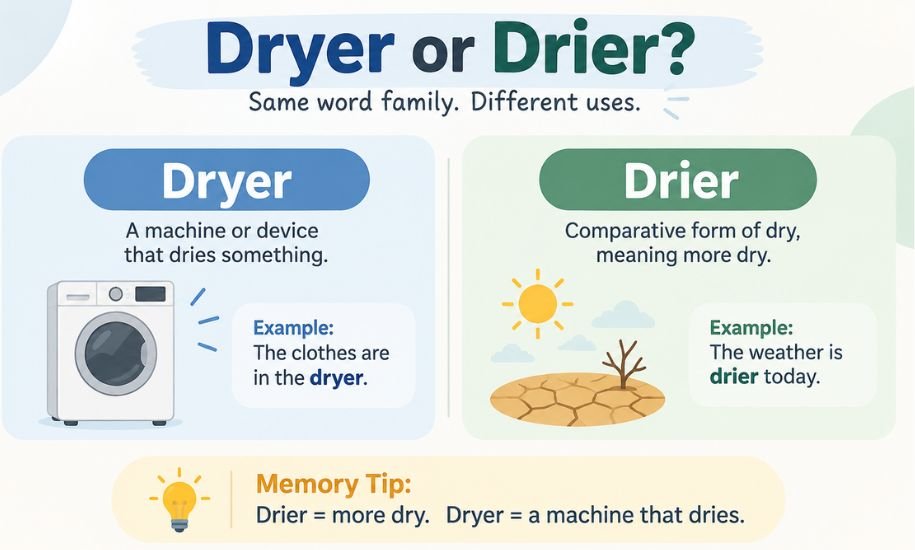
Drier usually means “more dry,” as in “The weather is drier today.” Dryer usually refers to a machine or device that dries something, such as a clothes dryer or hair dryer. Although drier can also appear as a noun for a drying device, dryer is the usual spelling for the appliance.
Dryer or Drier: What’s the Difference?
The easiest way to distinguish these words is to look at what you are trying to say.
| Word | Typical role | Meaning | Example |
|---|---|---|---|
| drier | Comparative adjective | More dry; containing less moisture | The air is drier today. |
| dryer | Noun | A machine or device used for drying | The dryer is running. |
| drier | Noun, less commonly | A drying device; variant of dryer | The old drier needs replacing. |
In ordinary writing, use drier when comparing dryness and dryer when naming an appliance or drying device.
Compare:
- The towel is drier now.
- Put the towel in the dryer.
The first sentence describes the towel. The second identifies the machine.
What Does “Drier” Mean?
Drier is normally the comparative form of the adjective dry.
The basic forms are:
dry → drier → driest
Use drier when one thing has less moisture than another or when something becomes less wet.
Examples
- This towel is drier than the one on the floor.
- The air feels drier in winter.
- The soil became drier after several weeks without rain.
- My hands are drier after using that soap.
The spelling follows the familiar pattern for adjectives ending in -y. For example:
- happy → happier
- easy → easier
- busy → busier
- dry → drier
So if you mean “more dry,” drier is the standard choice.
What Does “Dryer” Mean?
Dryer is most commonly a noun for something that dries another object.
The word is especially common when referring to appliances and equipment.
Examples include:
- clothes dryer
- hair dryer
- hand dryer
- tumble dryer
For example:
The clothes are still in the dryer.
I need to buy a new hair dryer.
The bathroom has an automatic hand dryer.
Here, dryer is not describing something as “more dry.” It is the name of the object doing the drying.
Clothes Drier or Dryer?
If you mean the appliance used to dry clothing, clothes dryer is the most familiar spelling, particularly in American English.
I put the wet clothes in the clothes dryer.
The clothes dryer stopped working.
However, clothes drier is not simply a meaningless spelling error. Major dictionaries recognize drier as a noun that can refer to a drying device or serve as a variant of dryer.
For everyday writing, product descriptions, instructions, and general communication, clothes dryer is the clearer and more conventional choice.
The important distinction is:
drier clothes = clothes that are more dry
clothes dryer = an appliance that dries clothes
That small change in spelling can change the grammatical function of the word.
Clothes Dryer or Drier: Which Should You Use?
If you’re writing about the appliance, choose clothes dryer in most situations.
Correct and natural
We bought a new clothes dryer last month.
Also found in English
We bought a new clothes drier last month.
The second version can be found in dictionaries and real-world usage, but dryer is generally the more recognizable spelling for the appliance.
Now compare it with the adjective:
These clothes are drier than they were this morning.
Here, drier is clearly the comparative form of dry, not the name of an appliance.
Is It “Dryer” or “Drier” When Comparing Things?
When you are comparing how dry two things are, drier is the standard form.
For example:
This shirt is drier than that one.
The climate here is drier than it is near the coast.
The towel became drier after sitting in the sun.
The same principle applies when something becomes less moist:
The ground is getting drier.
My skin feels drier in cold weather.
In these sentences, dryer would normally not be the preferred spelling because the word is functioning as a comparative adjective.
Hair Dryer or Hair Drier?
The usual spelling for the appliance is hair dryer.
She packed her hair dryer before the trip.
My hair dryer isn’t working.
The spelling hair drier can occur because drier has noun usage as a variant, but hair dryer is the conventional form most readers will expect.
The same general pattern applies to other drying devices:
- hair dryer
- hand dryer
- clothes dryer
Meanwhile, when you are comparing the dryness of something, use drier:
My hair is drier after swimming.
Notice how the grammatical role changes.
Why Are These Words So Easy to Confuse?
The confusion comes mainly from the fact that dryer and drier are closely related in spelling, pronunciation, and meaning.
Both are connected to the word dry, but English uses them in different ways.
The spelling also creates a potential trap. When dry becomes comparative, the y changes to i:
dry → drier
But when -er is used to form the noun for a device that performs an action, we get:
dry + er → dryer
This is similar to the distinction between a descriptive comparative and an agent or instrument noun.
So:
The climate is drier.
describes a condition.
But:
The machine is a dryer.
names an object.
Drier and Dryer in Example Sentences
Seeing the two words side by side makes the difference easier to remember.
Using “drier”
- The towels outside are drier now.
- The desert has a much drier climate.
- This room feels drier than the kitchen.
- The soil becomes drier during the summer.
- My skin is drier when the air is cold.
Using “dryer”
- The dryer is making a strange noise.
- Please put the clothes in the dryer.
- I bought a compact hair dryer.
- The hotel has a wall-mounted hand dryer.
- Our old clothes dryer needs repair.
Common Mistakes to Avoid
1. Using “dryer” for the normal comparative
If you mean more dry, use drier in standard writing.
Preferred:
The air is drier today.
2. Assuming “drier” can never be a noun
This is too strict. Dictionaries recognize drier as a noun as well as the comparative adjective. It can refer to a drying device and is also used as a variant of dryer.
Therefore, it is more accurate to say that dryer is the usual spelling for the appliance, rather than claiming that drier is always incorrect.
3. Confusing “drier clothes” with “clothes dryer”
These expressions mean different things:
The clothes are drier now.
The clothes have less moisture.
The clothes dryer is running.
The sentence refers to the machine.
4. Assuming every word ending in “-er” follows the same spelling pattern
The -er in drier is part of the comparative form, while dryer functions primarily as a noun for a drying device. Looking at the word’s role in the sentence is more reliable than simply looking at the letters.
An Easy Way to Remember the Difference
Use this simple rule:
Drier = more dry
Dryer = a machine that dries
Think of two examples:
The weather is drier.
The clothes are in the dryer.
If you can replace the word with “more dry,” choose drier.
If you can replace it with “drying machine” or “drying device,” choose dryer in most everyday contexts.
This rule won’t cover every dictionary-recognized use, but it works well for ordinary writing.
What About “Drier” as a Noun?
There is one important qualification to the simple rule.
Drier is a real noun. Major English dictionaries recognize it as a noun referring to something used for drying, and it can function as an alternative spelling of dryer.
That means a statement such as “drier is always wrong when referring to a machine” would be inaccurate.
Instead, think of dryer as the usual modern spelling for common appliances such as a clothes dryer or hair dryer, while recognizing that drier has legitimate noun usage too.
This distinction is particularly useful if you encounter drier in older texts, specialized contexts, or different varieties of English.
Frequently Asked Questions
Is “dryer” or “drier” correct?
Both are correct, but they normally have different uses. Drier is the standard comparative form of dry, meaning “more dry,” while dryer is commonly a noun for a machine or device that dries something.
Is it “clothes drier” or “clothes dryer”?
Clothes dryer is the conventional spelling for the appliance, especially in American English. Clothes drier is also found because drier can function as a noun and is recognized as a variant of dryer.
Is “drier” a real word?
Yes. Drier is the normal comparative form of dry, as in “This towel is drier.” It is also recognized as a noun referring to a drying device or as a variant spelling of dryer.
Is “hair dryer” or “hair drier” correct?
Hair dryer is the usual modern spelling for the appliance. Hair drier is possible because drier has noun usage, but hair dryer is the more familiar form.
Should I write “the weather is drier” or “the weather is dryer”?
Use drier when you mean that the weather has become more dry or has less moisture. For example: “The weather is drier this year.”
How can I remember the difference?
Remember “drier = more dry” and “dryer = machine.” If you’re comparing dryness, choose drier. If you’re naming an appliance such as a clothes or hair appliance, dryer is usually the natural choice.
Final Verdict: Dryer or Drier?
The simplest distinction is drier = more dry and dryer = a device that dries. Write “The climate is drier” when comparing dryness, but “The clothes are in the dryer” when referring to the appliance. Although drier can also be used as a noun, dryer is generally the clearest choice for common appliance names. For more clear explanations of confusing English words, Grammarifyr helps you know the difference and use the right words.
You may also Read : Shined or Shone: Meaning and Usage Explained