Shined or Shone: Meaning and Usage Explained
If you are unsure whether the past tense of shine should be shined or shone, you are not alone. Both forms are legitimate English words, but they are not always used in exactly the same situations. The traditional distinction is fairly simple: shone is commonly used when something gives off or reflects light, while shined is especially common when someone polishes an object. There is also some variation, particularly in American English, when shine means directing a light at something.
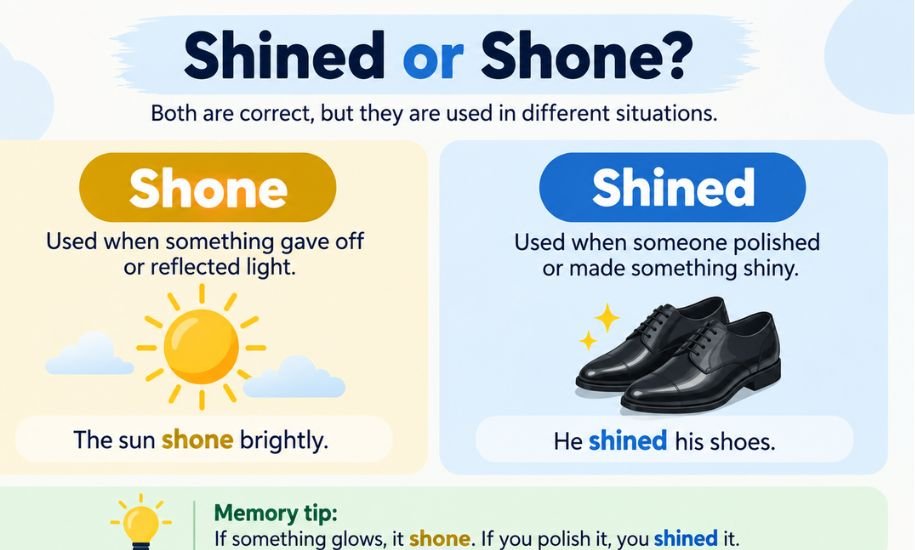
Both shined and shone are correct past forms of shine. Use shone when something gave off or reflected light, as in “The moon shone brightly.” Use shined especially when someone polished something, as in “He shined his shoes.” In some uses involving directing a light, both forms are found.
Shined or Shone: What’s the Difference?
The choice depends largely on what shine means in your sentence.
| Form | Typical use | Example |
|---|---|---|
| shone | Gave off or reflected light | The sun shone through the clouds. |
| shined | Polished or made something shiny | She shined her shoes. |
| shone | Light appeared or was visible | His eyes shone with happiness. |
| shined / shone | Directed a light at something | He shined/shone a flashlight into the room. |
The easiest traditional rule is:
Light shines → it shone.
Someone polishes something → they shined it.
This rule works very well in many ordinary sentences, although modern English allows some variation.
What Does “Shone” Mean?
Shone is a past-tense and past-participle form of shine. It is most commonly used when something gave off light, reflected light, or appeared bright.
For example:
- The sun shone all afternoon.
- The moon shone through the bedroom window.
- The stars shone above the lake.
- Her eyes shone with excitement.
- The lighthouse shone across the water.
Here, the subject is producing or reflecting light rather than deliberately polishing another object.
“Shone” in sentences
The morning sun shone through the trees.
His face shone with happiness.
The silver surface shone under the bright lights.
In these examples, shone is the natural traditional choice.
What Does “Shined” Mean?
Shined is also a correct form of shine. One of its clearest uses is when someone polishes something or makes it shiny.
For example:
- I shined my shoes before the interview.
- She shined the silverware until it looked bright.
- He shined his boots for the ceremony.
- The cleaner shined the brass handles.
Notice that shine has a direct object in these examples: shoes, silverware, boots, and brass handles.
This is why shined is strongly associated with the meaning “polished.”
“Shined” in sentences
He shined his shoes before leaving home.
She shined the silver with a soft cloth.
The children shined their boots for the parade.
Here, replacing shined with shone would not be the usual choice when the intended meaning is “polished.”
Shine, Shone, or Shined?
The three forms can be confusing because shine has more than one accepted past form.
| Verb form | Example |
|---|---|
| shine | The stars shine at night. |
| shines | The sun shines brightly. |
| shone | The sun shone yesterday. |
| shined | He shined his shoes yesterday. |
| shining | She is shining a flashlight outside. |
So if you are asking about shine, shone, or shined, remember that shone and shined are both established forms. They simply tend to appear in different contexts.
When Should You Use “Shone”?
Choose shone when the subject itself is giving off or reflecting light.
Examples
The moon shone brightly over the ocean.
The moon is producing or reflecting light, so shone fits naturally.
The stars shone above the mountains.
Again, the stars are visible as sources of light.
Her eyes shone with joy.
Here, shone is being used figuratively to describe a bright or expressive appearance.
The polished floor shone in the sunlight.
The floor is reflecting light rather than being polished in the sentence itself.
A useful way to think about these examples is:
Something is bright or gives off light → shone.
When Should You Use “Shined”?
Use shined particularly when someone polished an object or deliberately made it shiny.
Examples
He shined his shoes before the wedding.
The shoes are the object being polished.
She shined the brass until it gleamed.
The action is deliberately making the brass shiny.
I shined my boots before the ceremony.
The meaning is clearly “polished.”
This is the clearest situation in which shined is preferable.
What About a Flashlight?
The flashlight example is where the simple rule becomes less straightforward.
You may encounter both:
He shone a flashlight into the basement.
and:
He shined a flashlight into the basement.
Both forms are found in English, although preferences can differ by region and style.
Traditional British usage tends to favor shone in this type of construction, while shined is also established in American English for some transitive uses of shine.
Therefore, it would be misleading to claim that one form is universally correct and the other universally incorrect.
If you are writing for a broad international audience, shone is a safe traditional choice for a sentence about a light being directed somewhere. If you are following American usage, shined may also be entirely natural.
Is “Shined” or “Shone” More Correct?
Neither is simply the “correct” form in every situation.
The traditional distinction is based on meaning:
- shone → gave off or reflected light
- shined → polished or made something shiny
However, actual usage is broader than this simple rule. Dictionaries recognize shined and shone as past forms of shine, and the preferred form can depend on the particular meaning and variety of English.
For example:
The sun shone through the clouds. ✓
He shined his shoes. ✓
But:
She shined a flashlight into the hallway. ✓
and
She shone a flashlight into the hallway. ✓
can both be encountered.
The important point is to consider what the verb means in your sentence, rather than assuming that shined is always wrong.
Shone or Shined: Correct Usage Examples
Here are some examples showing the distinction clearly.
Use “shone” for light
The moon shone brightly over the village.
The morning sun shone through the curtains.
The stars shone above us.
His eyes shone with excitement.
Use “shined” for polishing
Maria shined her shoes before the meeting.
I shined my boots yesterday.
He shined the silver until it looked new.
The attendant shined the customer’s shoes.
Both can occur with directed light
She shone the flashlight toward the doorway.
She shined the flashlight toward the doorway.
The second pair illustrates why context and regional usage matter.
Common Mistakes to Avoid
1. Assuming “shined” is always wrong
This is probably the biggest mistake.
Shined is a genuine English word and is especially appropriate when shine means polish.
He shined his shoes. ✓
2. Using “shone” when you mean “polished”
If someone physically polished an object, shined is the clearer choice.
She shined her boots. ✓
Rather than:
She shone her boots. ✗
3. Treating the traditional rule as absolute
The “shone for light, shined for polishing” rule is useful, but it does not cover every modern usage. Directed-light constructions can use either form depending on dialect and context.
4. Thinking “shine” has only one past form
Unlike many regular verbs, shine has more than one accepted past form. Knowing both shone and shined prevents unnecessary corrections.
An Easy Way to Remember the Difference
Use this simple memory aid:
If something glowed, it shone.
If you polished it, you shined it.
For example:
The moon shone.
The moon gave off or reflected light.
He shined his shoes.
He polished the shoes.
When a flashlight is involved, remember that the traditional rule is less strict and regional preferences can affect the choice.
Is It “Shined or Shone” in Formal Writing?
Both forms can appear in formal writing, provided they fit the intended meaning.
For polished or professional writing, use shone naturally for light and shined for polishing. If you are directing a flashlight or another light source, choose the form that matches your preferred variety of English and maintain consistency.
For example:
The moon shone through the clouds.
is suitable for formal writing.
Likewise:
The officer shined his shoes before the ceremony.
is perfectly acceptable when the meaning is “polished.”
There is no need to replace every occurrence of shined with shone simply because shone may sound more familiar.
Frequently Asked Questions
Is “shined” a correct word?
Yes. Shined is a correct past-tense and past-participle form of shine. It is particularly common when shine means to polish or make something shiny, as in “He shined his shoes.”
Is “shone” the past tense of shine?
Yes. Shone is an established past-tense and past-participle form of shine. It is especially common when something gives off or reflects light, as in “The sun shone brightly.”
Should I say “I shined my shoes” or “I shone my shoes”?
Use “I shined my shoes.” When shine means to polish an object, shined is the usual form.
Is “shined” American English and “shone” British English?
That is an oversimplification. Both forms are used in different varieties of English. Shone is strongly established for light-related meanings, while shined is especially common for polishing and also occurs more broadly in American usage.
Is it “the sun shined” or “the sun shone”?
For standard traditional usage, say “the sun shone.” The sun gives off or appears to produce light, so shone is the natural choice.
Can I say “shined a flashlight”?
Yes. Shined is used in some varieties of English when someone directs a flashlight at something. Shone a flashlight is also established, particularly in traditional British usage.
Final Verdict: Shined or Shone?
Both “shined” and “shone” are correct, but they often serve different purposes. Use shone when something gave off or reflected light, such as “The sun shone through the window.” Use shined especially when someone polished something, as in “He shined his shoes.” With directed light such as a flashlight, both forms can occur, depending on regional usage. For more clear explanations of confusing English forms, Grammarifyr helps you choose the right word with confidence.
You may also Read : Worshiped or Worshipped: American or British English?
2 Comments