Tries or Trys: Correct Spelling and Grammar
It is easy to hesitate over the spelling of tries, especially because the base verb is try and many English verbs simply take -s in the third-person singular. However, this word follows a different spelling pattern. The correct standard-English form is tries, while trys is not the standard spelling. The same form is also used as the plural of the noun try, so you would write “two tries,” not “two trys.” Understanding the simple consonant + y → ies rule makes the choice much easier.
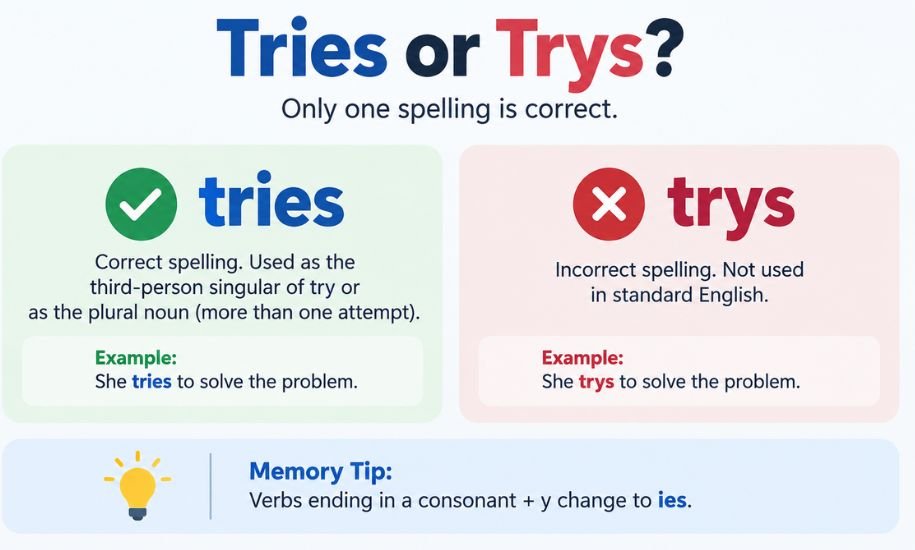
Tries is the correct standard-English spelling. Trys is a misspelling and should not be used in standard writing. Use tries as the third-person singular form of try and as the plural noun for more than one attempt.
Tries or Trys: Which Is Correct?
The correct spelling is tries.
| Form | Standard English? | Use |
|---|---|---|
| tries | Yes | Third-person singular of try; plural noun |
| trys | No | Nonstandard spelling/misspelling |
For example:
- She tries to arrive on time.
- He tries a different approach.
- I gave the puzzle two tries.
- The player needed three tries.
You should not write:
- She trys to arrive on time.
- I gave the puzzle two trys.
The spelling changes because try ends in a consonant followed by y.
Why Does “Try” Become “Tries”?
When a verb ends in a consonant + y, the y usually changes to i before the appropriate ending is added.
For try, the process is:
try → tries
The final y becomes i, and -es is added.
The same pattern appears in several other common verbs:
- carry → carries
- study → studies
- worry → worries
- reply → replies
- copy → copies
- hurry → hurries
So if you remember the spelling of study → studies, you can apply the same pattern to try → tries.
What about words ending in vowel + y?
This rule does not apply when the y follows a vowel.
For example:
- play → plays
- stay → stays
- enjoy → enjoys
- employ → employs
So the useful pattern is:
consonant + y → ies
vowel + y → ys
That distinction explains why tries is correct rather than trys.
What Does “Tries” Mean?
Tries has two main grammatical uses.
1. The third-person singular form of “try”
As a verb, tries is used with a singular third-person subject such as he, she, it, or a singular noun.
Examples:
- She tries to stay calm.
- He tries to solve the problem.
- The computer tries to reconnect.
- My brother tries a new recipe every weekend.
In these sentences, tries describes an action performed by a singular third-person subject.
2. The plural of “try”
Try can also be a noun meaning an attempt or effort. Its plural form is tries.
Examples:
- I needed two tries to get the answer right.
- She passed the test after three tries.
- We had several tries before the machine worked.
- Give it a few tries before giving up.
This is why 2 tries is correct.
Is “Trys” a Real Word?
In standard modern English, trys is not the accepted spelling of the ordinary verb or noun.
It is generally produced by applying the regular add -s pattern incorrectly to try. Because many verbs form their third-person singular simply by adding -s, it can seem logical to write trys. English spelling, however, requires tries for this word.
So:
Correct: He tries again.
Incorrect: He trys again.
And:
Correct: She solved it in two tries.
Incorrect: She solved it in two trys.
There is no need to give trys a separate meaning. In ordinary standard English, it is simply the form to avoid.
When Should You Use “Try” Instead of “Tries”?
Although tries is correct in certain situations, it does not replace try everywhere.
Use try with I, you, we, and they in the simple present:
- I try to exercise regularly.
- You try your best.
- We try to help.
- They try different methods.
Use tries with a singular third-person subject:
- He tries to help.
- She tries again.
- It tries to connect.
- The company tries to reduce waste.
There is another important point: after a modal verb such as can, should, will, or might, use the base form try, not tries.
Correct: She can try again.
Incorrect: She can tries again.
Likewise:
Correct: He should try harder.
Incorrect: He should tries harder.
“2 Tries or Trys”?
The correct expression is 2 tries or two tries.
Here, tries is the plural noun meaning multiple attempts.
Examples:
- You have 2 tries remaining.
- I solved the problem in two tries.
- The game gives each player three tries.
- It took her two tries to open the package.
For formal writing, spelling out a small number as two tries may be preferable depending on the style guide, but the spelling of the noun remains tries.
Singular and plural
The pattern is straightforward:
- one try
- two tries
- three tries
- several tries
Never change the plural to trys.
Tries, Tried, and Trying
The different forms of try can also cause confusion.
| Form | Function | Example |
|---|---|---|
| try | Base form/present | I try to help. |
| tries | Third-person singular present or plural noun | She tries again. |
| tried | Past tense/past participle | He tried yesterday. |
| trying | Present participle/gerund | They are trying again. |
Consider this sequence:
- I try to understand.
- She tries to understand.
- She tried to understand yesterday.
- She is trying to understand now.
A particularly common spelling mistake is writing tryed instead of tried. The past tense also follows a spelling change involving the final y, but the result is -ied, not -yes.
Examples of Correct Usage
Here are several natural examples showing how the correct form works.
As a verb
Maria tries to read for thirty minutes every evening.
The application tries to reconnect when the connection is interrupted.
James tries a different method when the first one fails.
The student tries to answer every question carefully.
As a plural noun
I gave the lock three tries before asking for help.
The athlete had two tries to complete the challenge.
After several tries, she finally solved the puzzle.
You have five tries to enter the correct code.
Incorrect examples
❌ He trys to fix the problem.
✅ He tries to fix the problem.
❌ I gave it two trys.
✅ I gave it two tries.
❌ She trys again after making a mistake.
✅ She tries again after making a mistake.
Why Do People Write “Trys”?
The mistake is understandable because many English verbs form the third-person singular by adding -s:
- run → runs
- read → reads
- work → works
- help → helps
Someone may therefore assume:
try + s = trys
But English spelling has a special pattern for verbs ending in consonant + y. The y changes to i, followed by -es:
try → tries
This is a spelling rule rather than a change in the basic meaning of the word.
An Easy Way to Remember the Spelling
Think of try as belonging to the same group as study and carry:
- study → studies
- carry → carries
- try → tries
A quick memory rule is:
Consonant + Y? Change Y to I before ES.
So:
TRY → TRIES
You can also remember the plural:
one try → two tries
If you see trys in ordinary English writing, check whether tries is what you need.
Common Mistakes to Avoid
1. Writing “trys” instead of “tries”
❌ The team trys again.
✅ The team tries again.
2. Using “tries” after a modal verb
❌ He can tries again.
✅ He can try again.
The modal can is followed by the base form of the verb.
3. Using “try” with a singular third-person subject
❌ She try to help.
✅ She tries to help.
4. Spelling the plural as “trys”
❌ I made three trys.
✅ I made three tries.
5. Confusing “tried” with “tryed”
❌ He tryed several times.
✅ He tried several times.
The past tense is tried.
FAQ
Is it “trys or tries”?
Tries is correct in standard English. Trys is a misspelling. Use tries for the third-person singular present form of try and for the plural noun meaning more than one attempt.
Is it “tries or trys” in formal writing?
Use tries. It is the standard spelling and is appropriate for formal, academic, professional, and everyday writing. Trys should be avoided.
Is “2 tries” grammatically correct?
Yes. Two tries or 2 tries is correct when tries means two attempts. For example, “I solved the puzzle in two tries.”
What is the plural of “try”?
The plural of try is tries. The spelling changes from y to i before -es, giving tries.
Is “tries” a verb or a noun?
It can be either. In “She tries again,” it is a verb. In “He had three tries,” it is a plural noun referring to three attempts.
Is “trys” an alternative spelling?
No. Trys is not the standard spelling of the ordinary English verb or noun. The correct form is tries.
The Bottom Line
When choosing between the two spellings, use tries. It is the correct third-person singular form of try and the plural form of the noun try. The spelling trys results from treating try like a regular verb that simply takes -s, but words ending in consonant + y follow the y → i + es pattern. Once you remember try → tries, phrases such as “two tries” become easy to spell correctly. For more clear explanations of confusing English forms, Grammarifyr helps you Know the Difference. Use the Right Words.
You may also Read : Saviour or Savior: British and American English