Saviour or Savior: British and American English
If you have ever wondered whether to write saviour or savior, you are dealing with a British-versus-American spelling difference rather than two words with different meanings. Both forms are correct, and both refer to someone who saves or rescues another person. The main distinction is regional: saviour is the standard spelling in British English, while savior is the usual spelling in American English. The same distinction can appear in religious writing, where the word may refer to Jesus Christ.
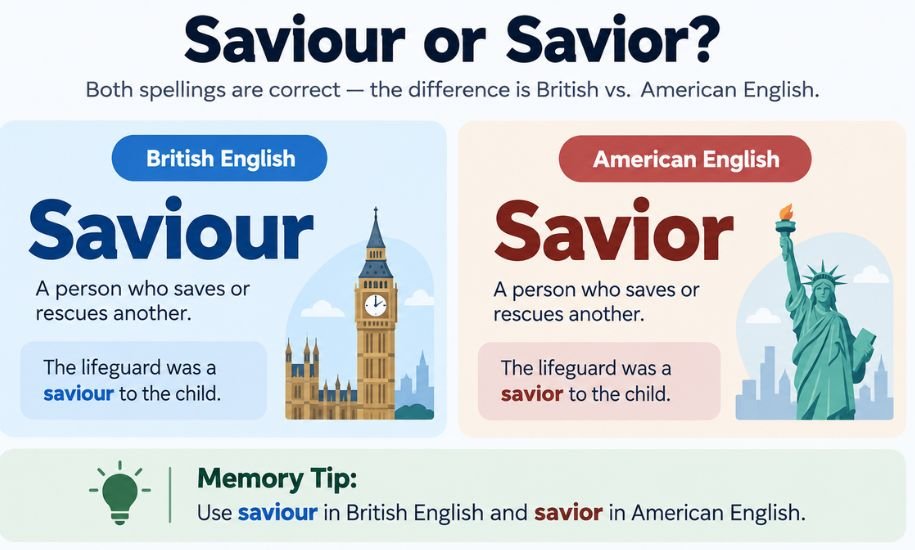
Both saviour and savior are correct spellings. Saviour is preferred in British English, while savior is standard in American English. They have the same meaning and are pronounced essentially the same way.
Saviour or Savior: What’s the Difference?
There is no difference in meaning between the two spellings. The difference is mainly a matter of regional English conventions.
| Feature | Saviour | Savior |
|---|---|---|
| Correct spelling? | Yes | Yes |
| Main usage | British English | American English |
| Meaning | A person who saves or rescues | A person who saves or rescues |
| Part of speech | Noun | Noun |
| Religious use | May refer to Jesus Christ | May refer to Jesus Christ |
| Pronunciation | Essentially the same | Essentially the same |
The easiest rule is to match the spelling to your audience. If you are writing in British English, choose saviour. If you are following American English, choose savior.
For example:
- British English: The firefighter was hailed as a saviour.
- American English: The firefighter was hailed as a savior.
Neither sentence changes the underlying meaning.
What Does “Saviour” Mean?
Saviour is a noun meaning someone who saves another person from danger, difficulty, harm, or destruction. It can be used literally or figuratively.
In British English, the spelling with -our is standard, just as in words such as favour, colour, and honour.
Examples:
- The rescue worker became a saviour to the stranded hikers.
- Many fans considered the goalkeeper the saviour of the team.
- The new treatment was described as a potential saviour for the struggling project.
- The child regarded the lifeguard as her saviour after the accident.
The word does not have to be religious. A person who provides crucial help can be described as a saviour in ordinary English.
What Does “Savior” Mean?
Savior has the same meaning as saviour. It is the standard American spelling.
It describes someone who rescues or saves another person, group, organization, or situation.
Examples include:
- The lifeguard was called a savior after rescuing the swimmer.
- The late goal made the striker the team’s savior.
- She became the savior of the failing business.
- The rescue dog was treated as a savior by the family.
The American spelling follows a broader pattern in which many British -our spellings appear as -or in American English.
For example:
- colour → color
- favour → favor
- honour → honor
- behaviour → behavior
- neighbour → neighbor
- saviour → savior
Saviour or Savior in the Bible
Both spellings can occur in Christian writing, but the form you see often depends on the English variety or Bible translation being used.
In Christianity, Saviour or Savior is used as a title for Jesus Christ. In this religious sense, the word is often capitalized because it functions as a title or name.
For example:
- Christians refer to Jesus as the Saviour in British English contexts.
- American Christian writing commonly uses Savior.
- A particular Bible translation may use one spelling consistently according to its editorial conventions.
The spelling itself does not create a different theological meaning. If you compare two English Bible translations and find Saviour in one and Savior in another, the difference may simply reflect their spelling conventions.
It is also important to distinguish the religious use from the ordinary noun. In a sentence such as “The firefighter was a saviour,” the word simply means a person who saved someone. In “Jesus is the Saviour,” it functions as a Christian title.
Why Are the Two Spellings Different?
The difference comes from the broader spelling conventions of British and American English.
British English traditionally retains the u in a number of words ending in -our, while American English commonly uses -or.
That gives us pairs such as:
- colour / color
- humour / humor
- labour / labor
- favour / favor
- honour / honor
- saviour / savior
This does not mean that one spelling is a misspelling of the other. Both belong to established varieties of standard English.
The important point for writers is consistency. If an article is written in British English, using saviour alongside predominantly British spellings is appropriate. If the article follows American English, savior is the natural choice.
Is It Savior or Saviour in Formal Writing?
Both can be appropriate in formal writing, provided the spelling matches the variety of English you are using.
For a British audience:
The volunteers were described as the saviours of the community.
For an American audience:
The volunteers were described as the saviors of the community.
Neither form is inherently more formal. The choice depends on the intended style of English.
If you are writing for an international audience, either form can work, but maintaining one spelling convention throughout the document makes the writing more polished.
How to Spell Savior or Saviour Correctly
A simple way to remember the difference is to connect the spelling to the familiar -our / -or pattern.
British English:
saviour
American English:
savior
Think of colour/color or favour/favor. The same general spelling pattern applies.
You should also remember that the plural changes accordingly:
- British: saviours
- American: saviors
For example:
The rescuers were celebrated as saviours of the community.
The rescuers were celebrated as saviors of the community.
Common Mistakes to Avoid
1. Treating one spelling as universally wrong
It is incorrect to assume that saviour is always wrong because American English uses savior, or vice versa. They are regional variants.
2. Mixing spelling conventions unnecessarily
A piece of writing can look inconsistent if it uses British spellings in some places and American spellings in others.
For example, if your article consistently uses colour, favour, and honour, switching to savior may be inconsistent with the chosen spelling system.
3. Assuming the meanings are different
There is no general semantic distinction between saviour and savior. The spelling changes, but the basic meaning does not.
4. Forgetting the plural spelling
The plural follows the same regional pattern:
- saviour → saviours
- savior → saviors
5. Assuming the religious spelling is a separate word
In Christian contexts, Saviour and Savior are variant spellings of the same religious title. The capitalization and translation may vary depending on the text.
Saviour vs Savior in Sentences
Here are some side-by-side examples:
British English:
The doctor was regarded as a saviour after helping the injured passengers.
American English:
The doctor was regarded as a savior after helping the injured passengers.
British English:
The supporters called the manager the club’s saviour.
American English:
The supporters called the manager the club’s savior.
British English:
The hymn describes Jesus as the Saviour.
American English:
The hymn describes Jesus as the Savior.
The meaning remains the same in each pair. Only the regional spelling changes.
How to Choose the Right Form
Use the following rule when editing or writing:
Choose “saviour” if:
- You are following British English.
- Your publication uses British spelling conventions.
- Your surrounding vocabulary uses spellings such as colour, favour, and honour.
Choose “savior” if:
- You are following American English.
- Your publication uses American spelling conventions.
- Your surrounding vocabulary uses spellings such as color, favor, and honor.
The key is not to ask which spelling is universally correct. Instead, ask which English variety your writing follows.
Frequently Asked Questions
Is “saviour” or “savior” correct?
Both are correct. Saviour is the standard British spelling, while savior is the standard American spelling. They have the same basic meaning: someone who saves or rescues another person.
Is “savior” American or British?
Savior is the standard American spelling. British English generally uses saviour, although British readers will understand the American form.
Is “saviour” British English?
Yes. Saviour is the conventional British English spelling. It follows the same general -our pattern found in words such as colour, favour, and honour.
Which spelling is used in the Bible?
That depends on the Bible translation and its editorial conventions. Saviour and Savior can both be found in English Christian texts. The word is commonly used as a title for Jesus Christ.
Are “saviour” and “savior” pronounced differently?
No significant pronunciation difference is normally intended. The extra u in the British spelling does not normally produce a different pronunciation.
What is the plural of saviour or savior?
The British plural is saviours, while the American plural is saviors. The regional spelling pattern remains the same.
The Bottom Line
Saviour and savior are both correct. The choice is primarily determined by regional spelling: use saviour in British English and savior in American English. Both words mean a person who saves or rescues someone, and both can be used in religious contexts to refer to Jesus Christ. For more clear explanations of easily confused English words, Grammarifyr helps readers know the difference and use the right words.
You may also Read : Till or Til: Correct Spelling and Usage