Ageing or Aging: British and American English
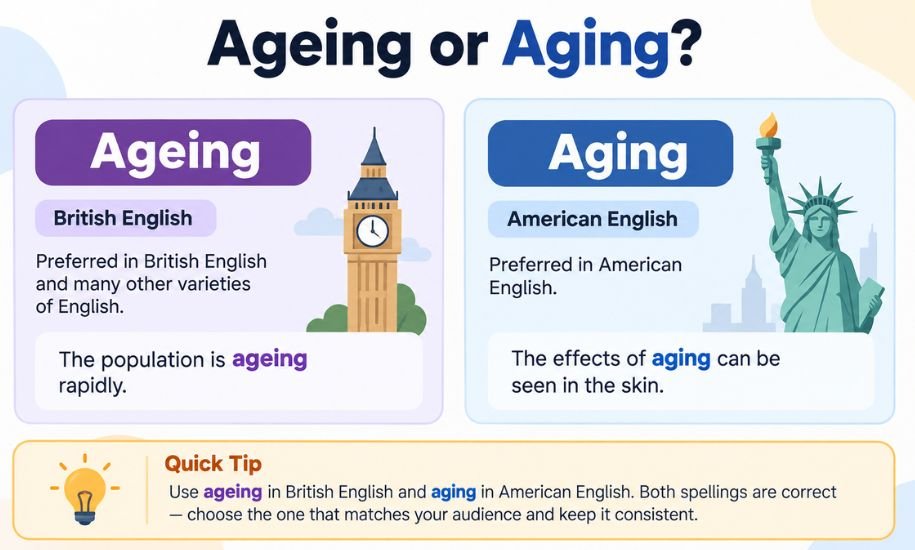
If you have ever wondered whether ageing or aging is the correct spelling, you are not alone. Both forms are used in standard English, but they are associated with different regional conventions. Ageing is the usual spelling in British English, while aging is the standard spelling in American English. The meaning is the same in both cases: the process of becoming older or developing characteristics associated with age. The choice usually depends on which variety of English you are writing.
Both “ageing” and “aging” are correct. “Ageing” is preferred in British English, while “aging” is standard in American English. They have the same meaning, so choose the spelling that matches the variety of English you are using and remain consistent.
Ageing vs Aging: The Quick Difference
The easiest way to understand the distinction is to think of it as a British English vs American English spelling difference, rather than a difference in meaning.
| Feature | Ageing | Aging |
|---|---|---|
| Correct spelling? | Yes | Yes |
| Main usage | British English | American English |
| Meaning | Becoming older | Becoming older |
| Part of speech | Usually a verb form or noun | Usually a verb form or noun |
| Example | The population is ageing. | The population is aging. |
Neither spelling is a misspelling when it is used according to the relevant regional convention.
For example:
- British English: The population is ageing rapidly.
- American English: The population is aging rapidly.
The sentence means the same thing in both varieties.
What Does “Ageing” Mean?
Ageing is the standard British English spelling of the present participle and gerund form of age.
As a verb, ageing describes the process of becoming older or causing something to become older.
Examples:
- My parents are ageing gracefully.
- The country’s population is ageing.
- The building is ageing but remains structurally sound.
- Researchers are studying how the human body changes while ageing.
It can also function as a noun in expressions such as the ageing process or healthy ageing.
British publications and organisations commonly use this spelling, so it is the natural choice when following British English conventions.
What Does “Aging” Mean?
Aging has exactly the same basic meaning but is the spelling generally preferred in American English.
Examples:
- The population is aging rapidly.
- Scientists are researching the aging process.
- She is interested in healthy aging.
- The company is concerned about its aging infrastructure.
American English normally removes the final e from age before adding -ing, producing aging.
This does not make the British form incorrect. It simply reflects a difference in spelling conventions.
Why Are They Spelled Differently?
The difference comes from established British and American spelling conventions.
The base word is age. When the -ing ending is added, British English commonly retains the e:
age → ageing
American English generally uses:
age → aging
You can see similar regional differences in some other words, although the exact spelling pattern is not universal across English.
The important point is that ageing is not an error simply because American English uses aging, and aging is not inherently wrong simply because British English generally uses ageing.
When Should You Use “Ageing”?
Use ageing when you are writing in British English or following a style guide that prefers British spelling.
It is particularly appropriate for writing intended for audiences in the United Kingdom and for publications that consistently use British conventions.
Examples:
- The report examines the effects of an ageing population.
- Regular exercise can support healthy ageing.
- The company must replace its ageing equipment.
- Researchers are investigating the biology of ageing.
If the rest of your article uses spellings such as colour, centre, organise, and favour, then ageing will normally fit that style.
When Should You Use “Aging”?
Use aging when writing in American English or when following an American style guide.
Examples:
- The country has an aging population.
- Researchers are studying healthy aging.
- The company needs to replace its aging infrastructure.
- The study examines the effects of aging on memory.
If your writing uses color, center, organize, and favor, then aging will generally be the more consistent choice.
Common Expressions With Both Spellings
The difference appears in many phrases. The meaning remains unchanged; only the regional spelling differs.
Ageing population / Aging population
British English:
The government is preparing for an ageing population.
American English:
The government is preparing for an aging population.
Healthy ageing / Healthy aging
British:
The programme promotes healthy ageing.
American:
The program promotes healthy aging.
Ageing process / Aging process
British:
Scientists are studying the ageing process.
American:
Scientists are studying the aging process.
Ageing parents / Aging parents
British:
She provides care for her ageing parents.
American:
She provides care for her aging parents.
Premature ageing / Premature aging
British:
Excessive sun exposure can contribute to premature ageing of the skin.
American:
Excessive sun exposure can contribute to premature aging of the skin.
These pairs demonstrate why the two forms can sometimes appear interchangeable: they are different regional spellings of the same word.
Ageing or Aging in Accounting and Finance
You may also encounter both spellings in financial contexts.
For example, an accounts receivable ageing report can show how long outstanding invoices have remained unpaid. American financial writing more commonly uses accounts receivable aging report.
Examples:
- British-style usage: The finance team prepared an accounts receivable ageing report.
- American-style usage: The finance team prepared an accounts receivable aging report.
Here, the spelling difference does not create a different accounting concept. The surrounding terminology and style of the document determine which form is appropriate.
This is why a British financial document may use ageing, while an American financial document may use aging.
Is “Aging” the UK Spelling?
Not usually. Ageing is the conventional British English spelling.
However, seeing aging in British contexts does not necessarily mean the writer has made a serious language error. English-language publications can use different style conventions, and American spelling is sometimes used internationally.
If your goal is to produce consistently British English, however, ageing is the safer choice.
Likewise, if you are specifically following American English, aging is the conventional form.
Is “Ageing” the American Spelling?
Aging is the standard American spelling, so it is much more common in American English.
That does not mean ageing is an invented or meaningless form. It is a legitimate spelling used especially in British English and other varieties influenced by British conventions.
The important distinction is therefore regional preference, not correct word versus incorrect word.
Correct and Incorrect Usage Examples
Because both forms are valid, the issue is usually one of consistency rather than absolute correctness.
British English
Correct:
The country is experiencing an ageing population.
Less consistent for a British-English article:
The country is experiencing an aging population.
The second sentence is understandable, but it introduces the American spelling into a British-style text.
American English
Correct:
The country is experiencing an aging population.
Less consistent for an American-English article:
The country is experiencing an ageing population.
Again, the second form is a legitimate English spelling, but it does not match the usual American convention.
Common Mistakes to Avoid
1. Treating “ageing” as a misspelling
It is not. Ageing is a standard British English spelling.
2. Treating “aging” as universally wrong
It is not. Aging is standard American English.
3. Mixing regional spellings unnecessarily
A document can look inconsistent if it uses ageing in one paragraph and aging in another without a reason.
4. Assuming the meaning changes
The two forms do not have different basic definitions. The difference is primarily regional spelling.
5. Changing only this word while ignoring the rest of the style
If you are deliberately writing British English, consistency should extend beyond this single word. Your other spelling choices should generally follow the same variety.
An Easy Way to Remember the Difference
A simple memory trick is:
British English keeps the “e”: ageing.
American English drops the “e”: aging.
Think of the pair as:
UK → ageing
US → aging
If you know which English variety your article follows, choosing the appropriate spelling becomes much easier.
Which Form Should You Choose?
Choose according to your intended audience and the style of the rest of your writing.
Use ageing if:
- You are writing British English.
- Your publication follows British spelling.
- Your audience is primarily in the UK.
- Your style uses spellings such as colour and centre.
Use aging if:
- You are writing American English.
- Your publication follows American spelling.
- Your audience is primarily in the United States.
- Your style uses spellings such as color and center.
If you are writing for an international audience, either form can work. The most important thing is to choose one spelling system and use it consistently.
Frequently Asked Questions
Is ageing or aging correct?
Both are correct. Ageing is the usual British English spelling, while aging is the standard American English spelling. They have the same meaning and are used in the same grammatical contexts.
Is “ageing” British or American?
Ageing is primarily the British English spelling. American English generally uses aging without the second “e.”
Is “aging” a UK spelling?
Aging can certainly be understood and encountered in the UK, but ageing is the conventional British spelling. If you are deliberately following British English style, ageing is the better choice.
Is “ageing” grammatically correct?
Yes. Ageing is grammatically correct and is the standard British form of the present participle and gerund of age. For example: “The population is ageing.”
Which should I use in formal writing?
Use the spelling required by your chosen style. For British English, use ageing; for American English, use aging. In either case, maintain consistency throughout the document.
How can I remember the difference?
Remember: UK = ageing and US = aging. The British spelling keeps the e, while the American spelling normally drops it before -ing.
The Bottom Line
There is no need to choose between a “correct” and “incorrect” word here. Ageing and aging are both legitimate spellings with the same meaning. The main distinction is regional: ageing is preferred in British English, while aging is preferred in American English. For clear, polished writing, choose the version that matches your audience and keep your spelling consistent. That practical approach is at the heart of Grammarifyr: know the difference and use the right words.
You may also Read : Seperate or Separate: Correct Spelling Explained