Adviser or Advisor: Spelling, Meaning and Examples
If you have ever hesitated between adviser or advisor, you are not alone. The two spellings look slightly different, but the good news is that this is not a case of one being correct and the other being wrong. Both adviser and advisor are accepted English spellings for a person who gives advice. The choice often depends on personal preference, an organization’s official title, or the style being followed. Understanding how each form works can help you choose the most natural spelling for your writing.
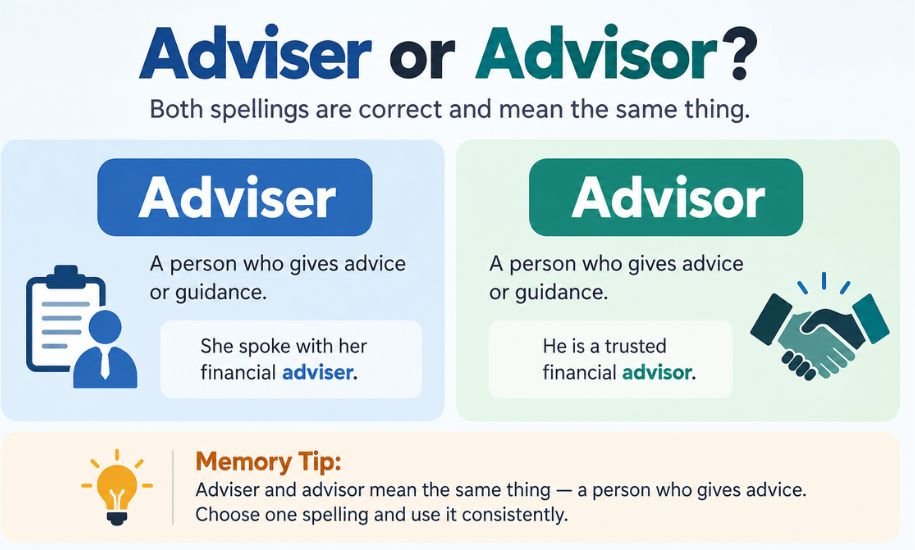
Both adviser and advisor are correct spellings. They have the same basic meaning: a person who gives advice or guidance. “Adviser” is a widely used general form, while “advisor” is also standard and frequently appears in professional and official titles.
Adviser or Advisor: Which Is Correct?
The short answer is both.
Adviser and advisor are nouns that refer to someone who gives advice, particularly someone with knowledge or expertise in a particular area. Major dictionaries recognize the two forms as alternatives. Cambridge lists advisor as another form of adviser, while Oxford also gives advisor as an alternative spelling.
| Feature | Adviser | Advisor |
|---|---|---|
| Correct spelling? | Yes | Yes |
| Part of speech | Noun | Noun |
| Meaning | A person who gives advice | A person who gives advice |
| Plural | Advisers | Advisors |
| Common examples | financial adviser, legal adviser | financial advisor, academic advisor |
| Main difference | Spelling | Spelling |
So, if you write “She is my financial adviser” or “She is my financial advisor,” the meaning is essentially the same.
What Does “Adviser” Mean?
Adviser is a noun for someone who provides advice, recommendations, or guidance. The person may have professional expertise in a particular subject, such as finance, education, law, politics, careers, or business.
Oxford defines an adviser as a person who gives advice, especially someone who knows a lot about a particular subject.
Here are some natural examples:
- I spoke with my financial adviser before making the investment.
- The president appointed a new economic adviser.
- Your academic adviser can help you choose the right courses.
- She works as a legal adviser for the company.
In each sentence, adviser identifies the person who provides guidance or expert recommendations.
What Does “Advisor” Mean?
Advisor has the same basic meaning as adviser. It is not a different profession or a different grammatical form. It is simply an alternative spelling of the noun.
Cambridge’s dictionary entry for advisor directs readers to adviser and gives examples involving investment, career, policy, and other types of advisors.
For example:
- My advisor helped me prepare for the meeting.
- She is a trusted financial advisor.
- The university assigned each student an academic advisor.
- He served as a special advisor to the committee.
These sentences are perfectly acceptable in standard English.
The Key Difference Between Adviser and Advisor
There is no important difference in meaning between the two words.
The difference is primarily their spelling:
adviser = advisor
Both describe a person who gives advice.
You may encounter preferences for one form in particular organizations, publications, professions, or official job titles. However, it would be misleading to claim that one spelling is universally American and the other universally British.
Both forms occur in English varieties on both sides of the Atlantic. Cambridge, for example, recognizes advisor as an alternative to adviser, while Oxford lists both forms as well.
Adviser or Advisor Spelling: Why Are There Two Forms?
English has several nouns ending in -er and -or, and adviser/advisor is one example where both spellings have become established.
The important point for everyday writing is that you do not need to treat advisor as a spelling mistake simply because it ends in -or.
For example:
Correct: The company hired a financial adviser.
Also correct: The company hired a financial advisor.
Likewise:
Correct: She met with her academic adviser.
Also correct: She met with her academic advisor.
The spelling you choose should generally be guided by the context and by consistency.
Financial Advisor or Adviser: Which One Should You Use?
Both financial adviser and financial advisor are correct.
Cambridge specifically lists financial adviser and identifies financial advisor as an alternative. It defines the term as a person whose work involves giving people advice about money and investments.
For example:
- We arranged a meeting with a financial adviser.
- We arranged a meeting with a financial advisor.
- A good financial adviser should understand a client’s goals.
- A good financial advisor should understand a client’s goals.
There is no grammatical error in either spelling.
One practical exception is an official professional or company title. If a person’s organization officially uses Financial Advisor as the job title, it makes sense to preserve that spelling when referring to the title.
In other words, if a company calls someone a Senior Financial Advisor, you generally should not change the title to Senior Financial Adviser just because you personally prefer the -er spelling.
Advisers or Advisors: What Is the Plural?
The plural forms are straightforward:
- adviser → advisers
- advisor → advisors
Both are correct.
For example:
The government consulted several advisers.
The government consulted several advisors.
Notice that you simply add -s to the singular form.
The same principle applies to compounds:
- financial advisers
- financial advisors
- legal advisers
- legal advisors
- academic advisers
- academic advisors
- political advisers
- political advisors
The main rule is consistency. If you choose adviser in a document, use advisers when you need the plural rather than switching unnecessarily between the two spelling systems.
Is It Advisor or Adviser in American English?
Both spellings are used in American English.
It is therefore inaccurate to say that advisor is the only American spelling. Similarly, adviser should not automatically be labeled a British-only form.
American readers will understand both:
She spoke to her academic advisor.
She spoke to her academic adviser.
The same applies to professional terms such as financial advisor/adviser and legal advisor/adviser.
If you are writing for an American publication, company, university, or organization, check its preferred style or official terminology. If there is no specific requirement, either spelling can be used.
Is It Adviser or Advisor in British English?
Again, both forms can be found in British English, although adviser is a particularly established form.
Cambridge’s British English entry uses adviser as the main dictionary headword and identifies advisor as another form.
So it is better to think of the distinction as alternative spellings, rather than a strict British-versus-American rule.
For formal writing, consistency matters more than trying to force one spelling based solely on the country of your audience.
Adviser, Advisor, Advice, and Advise
One source of confusion is that adviser and advisor are closely related to advice and advise, but these words have different grammatical functions.
Advice
Advice is a noun meaning a recommendation, suggestion, or guidance.
She gave me useful advice.
Advise
Advise is a verb meaning to give advice or recommend something.
I would advise you to wait.
Adviser / Advisor
Both are nouns referring to the person who gives the advice.
My adviser helped me understand the contract.
My advisor helped me understand the contract.
A simple way to separate them is:
advise = action
advice = information or recommendation
adviser/advisor = person
Cambridge identifies advise as a verb meaning to give advice, while advice is the corresponding noun.
Examples of Correct Usage
Here are some examples showing how the two spellings work naturally.
With “adviser”
The company’s legal adviser reviewed the agreement.
I asked my career adviser for guidance.
The minister met with several senior advisers.
She became an independent financial adviser.
With “advisor”
The company’s legal advisor reviewed the agreement.
I asked my career advisor for guidance.
The minister met with several senior advisors.
She became an independent financial advisor.
The meanings remain the same. The only change is the spelling.
Common Mistakes to Avoid
1. Treating “advisor” as a misspelling
Advisor is not simply a typo for adviser. It is an established alternative spelling recognized by major dictionaries.
2. Assuming one is always American and the other always British
There is no simple rule that makes advisor exclusively American or adviser exclusively British. Both forms are used across English varieties.
3. Mixing the spellings without a reason
Switching between adviser and advisor within the same document can make your writing look inconsistent.
For example, if your article begins with financial adviser, it is usually cleaner to continue with advisers rather than suddenly switching to financial advisors.
4. Confusing “adviser” with “advice”
An adviser is a person.
Advice is what that person gives.
The adviser gave me helpful advice.
5. Confusing “advise” with “advice”
Advise is a verb:
I would advise you to compare the options.
Advice is a noun:
Her advice was helpful.
How to Choose the Right Spelling
If both forms are correct, how do you decide?
A simple three-step approach works well.
First, follow an official title. If a university, company, government department, or professional organization spells a position advisor, preserve that spelling.
Second, follow your style guide. A publication, employer, or academic institution may have a preferred spelling.
Third, be consistent. If no external rule applies, choose either adviser or advisor and use it consistently throughout your document.
For general-purpose writing, adviser is a perfectly safe choice. But choosing advisor is not an error.
Easy Way to Remember
There is no complicated grammar rule to memorize:
Adviser and advisor mean the same thing.
Just remember that both spellings describe a person who advises.
If you are talking about the action, use advise:
I advise you to check the details.
If you are talking about the recommendation, use advice:
Thank you for your advice.
If you are talking about the person, use adviser or advisor:
I spoke with my adviser.
I spoke with my advisor.
Frequently Asked Questions
Is “adviser” or “advisor” correct?
Both are correct. Adviser and advisor are alternative spellings of the same noun and refer to someone who gives advice. Your choice can depend on an organization’s preferred terminology, a style guide, or personal preference.
Is “advisor” a misspelling of “adviser”?
No. Advisor is an established English spelling, not a misspelling. Major dictionaries, including Cambridge and Oxford, recognize it as an alternative form of adviser.
Which is better: financial advisor or financial adviser?
Both are grammatically correct. Cambridge lists financial adviser and also recognizes financial advisor. If a financial professional or organization uses one spelling in its official title, follow that form.
Are advisers and advisors both correct?
Yes. Advisers is the plural of adviser, while advisors is the plural of advisor. Both plural forms are standard.
Is “adviser” British and “advisor” American?
Not strictly. Both spellings are used in British and American English. Although adviser is especially well established in British English, advisor is also a recognized form, so the distinction should not be treated as a rigid regional rule.
How do I remember adviser, advice, and advise?
Think of the grammatical role: adviser/advisor is a person, advice is a noun meaning a recommendation, and advise is a verb meaning to give advice. For example: “My adviser gave me advice, and I advise you to listen.”
Final Verdict: Adviser or Advisor?
There is no need to worry about choosing between two supposedly competing words: adviser and advisor are both correct. They have the same basic meaning, and the main difference is spelling. Choose the form required by an official title or style guide when one exists; otherwise, pick one and use it consistently. For more clear explanations of tricky English choices, Grammarifyr helps you Know the Difference. Use the Right Words.
You may also Read : Whos or Whose: Examples and Grammar Rules
One Comment