Flier or Flyer: Meaning and Correct Usage
If you are unsure whether to write flier or flyer, you are not alone. Both spellings are legitimate English words, and the right choice often depends on what you mean and which style guide you follow. The distinction is especially useful when talking about a person who flies versus a printed piece of advertising. Although the two forms overlap in some contexts, flyer is widely preferred for a promotional leaflet, while flier has traditionally been used for someone or something that flies. Understanding the context makes the choice much easier.
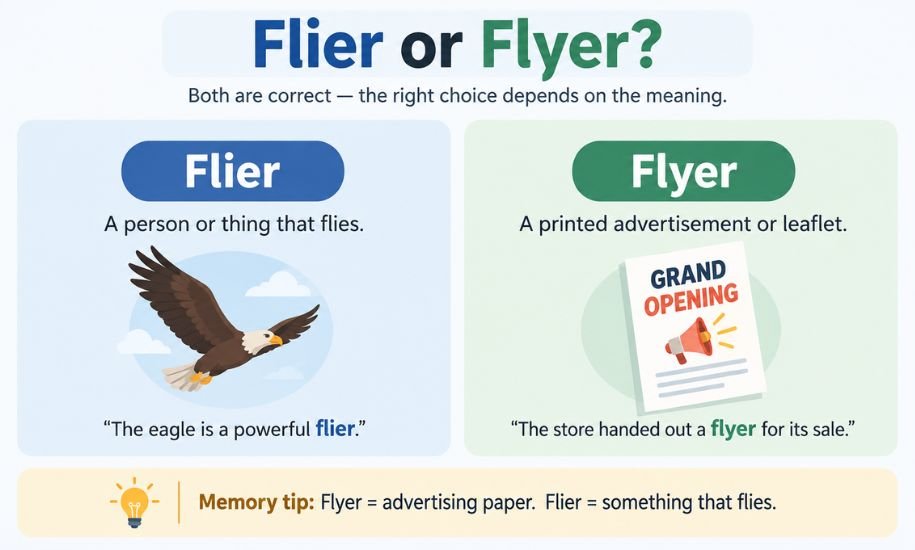
Flier and flyer are both correct English spellings. Use flyer when referring to a printed advertisement or leaflet; flier can refer to a person or thing that flies. However, “flyer” is also widely accepted for someone who travels by air, so context and style guide matter.
Flier vs. Flyer: The Key Difference
The easiest way to understand these words is to look at their most common uses.
| Word | Common meaning | Example |
|---|---|---|
| flyer | A leaflet, handbill, or promotional advertisement | The store distributed a flyer for its sale. |
| flier | A person or thing that flies | She is an experienced flier. |
| flyer | A person who travels by aircraft | He is a frequent flyer. |
| flier | A risk or speculative attempt in “take a flier” | She decided to take a flier on the new company. |
The distinction is not absolute. Major English style guides differ in some recommendations, and flyer has become very common in aviation expressions such as frequent flyer.
So, if you are wondering which is correct, flier or flyer, the answer is that both are correct. Your intended meaning determines which form is more natural.
What Does “Flyer” Mean?
Flyer is a noun with several established meanings.
The most familiar use is for a printed sheet used to advertise or promote something. A flyer might announce a concert, advertise a sale, promote a business, or provide information about an event.
For example:
- The gym handed out flyers advertising its new membership plans.
- I found a flyer for the community festival.
- She designed a flyer for the charity event.
- The restaurant placed flyers in nearby neighborhoods.
In this sense, flyer is generally the preferred spelling in modern standard usage.
The word can also refer to someone who flies, especially someone who travels by airplane. This is why frequent flyer is such a familiar expression.
For example:
- She is a frequent flyer because of her international job.
- The airline offers rewards to frequent flyers.
What Does “Flier” Mean?
Flier is also a genuine English word. Traditionally, it refers to a person or thing that flies.
For example:
- The eagle is a powerful flier.
- He became an experienced flier after years of aviation training.
- The butterfly is a surprisingly agile flier.
- She is a confident flier who enjoys long-distance travel.
The spelling flier is particularly useful when following a style that distinguishes it from flyer.
However, it is important not to assume that flier is the only correct spelling for a person who flies. Flyer is also widely accepted in this meaning, particularly in expressions involving air travel.
Is “Flyer” or “Flier” Used for Paper?
If you mean a piece of paper containing advertising or information, flyer is generally the safer and more familiar choice.
For example:
The company printed 1,000 flyers for its grand opening.
You could encounter flier in some publications, but flyer is widely recognized for this meaning.
The distinction is therefore easy to apply in many everyday situations:
Advertising paper → flyer
Person or thing that flies → flier when your preferred style makes that distinction.
That said, the aviation meaning can also use flyer, as in frequent flyer.
Why Are These Words So Often Confused?
The confusion is understandable because the words are almost identical in spelling and are closely related in meaning.
Both forms developed from the verb fly, and both can be used in connection with flying. Over time, flyer became strongly established for advertising material and also gained widespread use in aviation terminology.
As a result, readers may encounter both:
- frequent flyer
- frequent flier
- advertising flyer
- advertising flier
This does not mean that one spelling is automatically a mistake in every situation. Usage depends partly on context, region, and editorial style.
Which Spelling Should You Use in Formal Writing?
For formal writing, consistency is more important than trying to impose a universal rule.
If you are referring to an advertising leaflet, flyer is a clear and widely accepted choice:
Please distribute the event flyer to all participants.
If you are describing a person or animal that flies and your style distinguishes the two forms, flier may be appropriate:
The eagle is a skilled flier.
For air travelers, frequent flyer is extremely well established:
The airline offers special benefits to frequent flyers.
If your workplace, publication, school, or organization follows a particular style guide, follow its preferred spelling.
Examples: Correct Usage in Sentences
Here are some examples showing how the two spellings can work in different contexts.
Using “flyer”
- The bakery created a flyer announcing its weekend special.
- I picked up a flyer for the local theater production.
- The school sent a flyer home with every student.
- He is a frequent flyer who travels several times a month.
Using “flier”
- The hawk is an excellent flier.
- She became a skilled flier after years of training.
- He is an experienced flier who enjoys flying small aircraft.
- The investor decided to take a flier on the young company.
When both may be acceptable
For someone who travels by plane, both forms can appear:
- She is a frequent flyer.
- She is a frequent flier.
The first is particularly familiar in contemporary English, but the second is an established variant.
“Take a Flier” or “Take a Flyer”?
The expression take a flier means to take a risk or chance on something.
For example:
The investor decided to take a flier on the new technology company.
You may also see take a flyer, particularly in American English.
So this is another situation where the two spellings overlap.
If you are following a specific editorial style, check its preferred form rather than assuming that one spelling is universally required.
How to Spell “Flier” or “Flyer” Correctly
If you are trying to remember which spelling to use, start with the context rather than pronunciation.
For a promotional sheet, advertisement, or handbill, flyer is a useful default:
fly + er → flyer
For a person or thing that flies, flier can help preserve the traditional distinction:
fly + er → flier
But remember that this is a practical usage guide, not an absolute grammatical rule. English dictionaries and style guides recognize both spellings, and flyer is also standard in many references to air travelers.
Common Mistakes to Avoid
1. Treating “flier” as a misspelling
It is not a misspelling. Flier is a legitimate English word.
2. Assuming “flyer” is always wrong for a person
It is not. Frequent flyer is a standard and extremely common expression.
3. Assuming “flier” is always wrong for advertising material
Some publications use flier for a leaflet. However, flyer is generally the clearer choice for promotional paper.
4. Mixing styles unnecessarily
If you are writing a formal document, choose a consistent convention. Switching between forms without a reason can make your writing look inconsistent.
5. Thinking one style guide represents all English
Usage guides do not always agree on this pair. A dictionary or style manual may recommend one form in a particular context while another accepts both.
An Easy Way to Remember the Difference
A simple practical rule is:
Flyer = think “advertising paper.”
If you are talking about something you can print, hand out, or post on a noticeboard, flyer is usually the natural choice.
Flier = think “something that flies.”
If you are describing a person, bird, insect, or another living thing that flies, flier can be used when making that traditional distinction.
There is one important exception to keep in mind: frequent flyer is the familiar modern expression for an air traveler.
Frequently Asked Questions
Is “flier” or “flyer” correct?
Both flier and flyer are correct English words. Flyer is commonly preferred for a promotional leaflet, while flier is traditionally used for a person or thing that flies. However, flyer is also widely accepted for air travelers.
Is it “flyer” or “flier” for a piece of paper?
For a promotional piece of paper, flyer is generally the preferred spelling. For example, The company distributed a flyer advertising its new service.
Is “frequent flier” correct?
Yes. Frequent flier is an established spelling, although frequent flyer is extremely common and widely accepted. The preferred form may depend on the style guide being followed.
How do you spell flyer or flier?
Both spellings are correct: flyer and flier. The choice depends mainly on meaning and editorial preference.
Which is correct: flier or flyer?
Neither is universally wrong. Use flyer as the usual choice for an advertising leaflet, while flier can be used for someone or something that flies. In aviation, flyer is also very common.
The Bottom Line
Flier and flyer are both correct spellings, but they are often used in slightly different contexts. For an advertising leaflet or promotional piece of paper, flyer is generally the safest choice. Flier can describe a person or thing that flies, while flyer is also widely accepted for air travelers. When a particular style guide applies, follow its preference. For more clear explanations of confusing English words and spelling choices, Grammarifyr helps you know the difference and use the right words.
You may also Read : Tomatos or Tomatoes: The Correct Spelling Explained