Yea or Yeah: What’s the Difference?
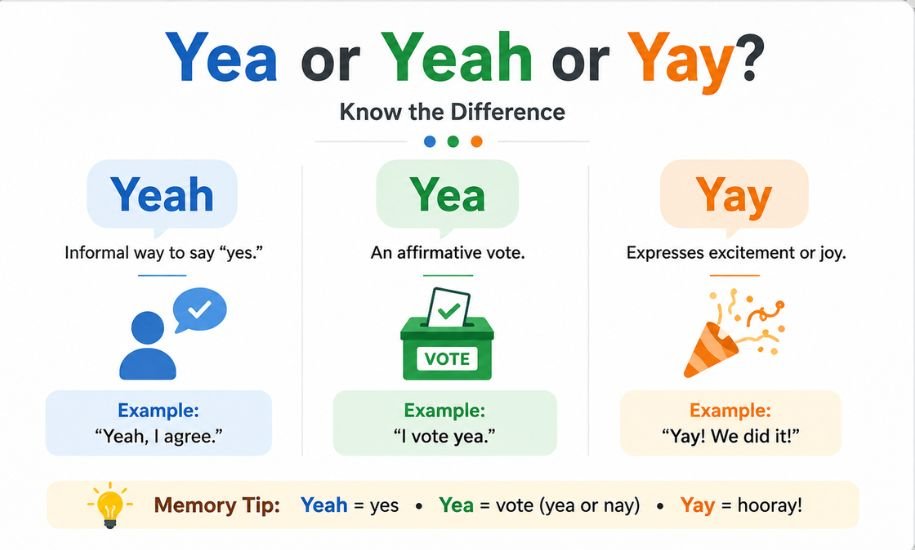
If you have ever wondered whether to write yea or yeah, you are not alone. The two words look similar, and both can be connected with the idea of saying “yes.” However, they are not normally interchangeable in modern English. Yeah is the everyday, informal way to say “yes,” while yea is most commonly used for an affirmative vote or in older and literary expressions. There is also a third word, yay, which sounds similar but expresses excitement or happiness rather than agreement.
Yeah is the usual spelling when you mean the informal form of “yes.” Yea is also a correct word, but it is mainly used for an affirmative vote or in older expressions. Yay is different again: it expresses excitement or joy.
Yea vs. Yeah vs. Yay at a Glance
| Word | Meaning | Typical use | Example |
|---|---|---|---|
| Yeah | Informal “yes” | Casual speech, writing, and dialogue | “Yeah, I agree.” |
| Yea | An affirmative “yes” or vote | Voting and traditional expressions | “I vote yea.” |
| Yay | An expression of happiness or excitement | Celebrating or showing enthusiasm | “Yay! We won!” |
The easiest way to distinguish them is to focus on what you are trying to express. If you are casually agreeing with someone, use yeah. If you are casting an affirmative vote, use yea. If you are celebrating something, use yay.
What Does “Yeah” Mean?
Yeah is an informal word meaning yes. It is extremely common in conversation, text messages, informal correspondence, and dialogue.
It can be used as a simple answer:
- “Are you ready?” — “Yeah.”
- “Did you call Sarah?” — “Yeah, I called her this morning.”
- “Do you want to come with us?” — “Yeah, that sounds good.”
It can also express agreement or confirmation:
- Yeah, you’re right.
- Yeah, I understand what you mean.
- Yeah, that’s the one I was talking about.
Because yeah is informal, yes is usually preferable in formal writing when you simply need an affirmative response.
For example:
Formal: Yes, I understand the instructions.
Informal: Yeah, I understand the instructions.
Neither yeah nor yes is inherently more correct; the appropriate choice depends on tone and context.
What Does “Yea” Mean?
Yea is a real English word, but its most recognizable modern use is in voting.
When people vote on a proposal, motion, or resolution, yea means an affirmative vote. Its traditional opposite is nay, meaning a negative vote.
Examples include:
- I vote yea on the proposal.
- The committee recorded 12 yeas and 5 nays.
- Members were asked to vote yea or nay.
- The yeas have it.
In this context, yea is pronounced like “yay,” not like the casual yeah.
The word can also appear in older or literary expressions. For example, yea can sometimes mean “indeed” or introduce an even stronger statement:
The task was difficult, yea, almost impossible.
This use is uncommon in ordinary modern conversation and may sound formal, poetic, or archaic.
Why Are These Words Confused?
The confusion comes mainly from their similar spelling and their connection to yes.
Historically, yea is an old English word associated with affirmative answers. Yeah developed as an informal form associated with yes. Their meanings overlap enough that it is easy to assume they are simply alternative spellings.
There is also a pronunciation trap. Yea is generally pronounced like yay, which makes it especially easy to confuse with the third word in this comparison.
So although the three words look and sound related, they perform different jobs in contemporary English.
When Should You Use “Yeah”?
Use yeah when you want an informal equivalent of yes.
Examples
- Yeah, I’ll be there at six.
- Yeah, I remember that movie.
- “Do you need help?” “Yeah, please.”
- She said yeah when I asked her.
- Yeah, that’s exactly what I meant.
It is particularly natural in dialogue:
“Did you finish the report?”
“Yeah, I sent it this morning.”
In formal documents, academic writing, business reports, or professional correspondence, yes will often be a better choice when an affirmative answer is required.
When Should You Use “Yea”?
Use yea primarily when referring to an affirmative vote.
Examples
- The senator voted yea.
- The motion passed with 20 yeas and 8 nays.
- The board members could vote yea or nay.
- There were more yeas than nays.
A useful distinction is:
yea ↔ nay
This pairing is strongly associated with voting.
You generally would not write:
“Yea, I’ll meet you after work.”
If you simply mean “Yes, I’ll meet you after work,” yeah or yes is the natural choice.
Yea or Yeah: Which One Is Correct?
Both yea and yeah are legitimate English words. The correct choice depends on the meaning.
If you are asking whether someone agrees with you:
Yeah, I agree.
If you are recording someone’s affirmative vote:
She voted yea.
If you are writing a formal response:
Yes, I agree.
Therefore, there is no universal rule saying that one spelling is always correct and the other is always wrong. They have different typical functions.
Is It “Yea” or “Yeah” When Saying Yes?
If you mean the casual spoken form of yes, the answer is yeah.
Correct:
“Are you coming with us?”
“Yeah.”
Not normally appropriate:
“Are you coming with us?”
“Yea.”
The second version can look like a spelling mistake because modern readers commonly associate yea with voting or older English.
If the situation is formal, simply use yes:
“Are you available for the meeting?”
“Yes.”
This gives you a practical three-level distinction:
- Yes — standard and suitable for formal situations
- Yeah — informal and conversational
- Yea — affirmative vote or traditional/literary use
Yea or Yeah or Yay?
Adding yay makes the distinction even clearer.
Yeah = yes
Yeah, I’d like to go.
This expresses agreement or confirmation.
Yea = affirmative vote
I vote yea.
This indicates support in a voting context.
Yay = excitement
Yay! We finished the project!
This expresses happiness, enthusiasm, or celebration.
Consider these sentences:
- Yeah, we finished the project. — You are confirming it.
- Yea, I support the proposal. — You are casting an affirmative vote.
- Yay, we finished the project! — You are excited about the result.
The meanings are quite different even though the words can sound similar.
Common Mistakes to Avoid
1. Using “yea” as the everyday spelling of “yeah”
❌ Yea, I know what you mean.
✅ Yeah, I know what you mean.
For casual agreement, yeah is the normal modern spelling.
2. Using “yeah” for a formal vote
❌ The members recorded 15 yeahs and 4 nays.
✅ The members recorded 15 yeas and 4 nays.
The traditional voting terms are yea and nay.
3. Confusing “yea” with “yay”
❌ Yea! We won!
✅ Yay! We won!
When you are expressing excitement, yay is the appropriate word.
4. Assuming “yea” and “yeah” have the same pronunciation
Yea is generally pronounced like yay, while yeah is pronounced like the informal affirmative yes. This distinction is useful when identifying the words in speech.
An Easy Way to Remember the Difference
Remember the pairs:
Yeah = yes
Yea = nay
Yay = hooray
The first pair connects yeah with ordinary agreement. The second connects yea with its traditional voting opposite, nay. The third connects yay with excitement.
If you are still unsure, ask yourself what the sentence is doing:
- Agreeing? → yeah
- Voting? → yea
- Celebrating? → yay
That simple test will handle most everyday situations.
Examples Side by Side
| Situation | Correct word | Example |
| Casual agreement | Yeah | “Yeah, I think you’re right.” |
| Answering informally | Yeah | “Yeah, I’ll call you later.” |
| Formal affirmative answer | Yes | “Yes, I received your email.” |
| Affirmative vote | Yea | “I vote yea.” |
| Vote count | Yea | “The motion received 18 yeas.” |
| Excitement | Yay | “Yay! We get to leave early.” |
This comparison also explains why searching for yeah or yea can be confusing: both words are correct, but they normally belong in different contexts.
Is “Yea” Outdated?
Not entirely. Yea is still a standard word, particularly in voting terminology. However, some of its older uses are uncommon in everyday modern English.
For ordinary conversation, writing yea when you mean “yeah” can make the sentence appear archaic or incorrect. In a voting context, however, yea remains completely appropriate.
So it is better to think of yea as specialized rather than simply obsolete.
Frequently Asked Questions
Is “yea” a correct word?
Yes. Yea is a legitimate English word. It is especially common when describing an affirmative vote, as in “yea or nay” or “the yeas have it.” It also has some older and literary uses.
Is “yeah” a correct spelling?
Yes. Yeah is a standard informal word meaning “yes.” It is common in conversation, dialogue, texting, and other casual contexts. In formal writing, yes may be more appropriate.
Is it “yea or yeah” when you mean yes?
If you mean the informal spoken form of yes, use yeah. If you are referring to an affirmative vote, use yea. In formal writing, yes is usually the safest choice for a straightforward affirmative response.
Is “yay” the same as “yea”?
No. Yay expresses happiness, excitement, or celebration, while yea generally refers to an affirmative vote or an older affirmative expression. For example, “Yay! We won!” expresses excitement, whereas “I vote yea” records a vote.
Can “yea” and “yeah” be used interchangeably?
They can overlap in some historical or dialectal usage, but they are not normally interchangeable in standard contemporary writing. Yeah is the natural informal form of “yes,” while yea has a more specialized voting or traditional use.
Which is better for formal writing: “yea” or “yeah”?
Usually neither. If you simply mean “yes,” use yes in formal writing. Use yea when the context specifically concerns an affirmative vote or when an established traditional expression calls for it.
Final Verdict: Yea or Yeah?
Choose yeah for casual agreement, yea for an affirmative vote, and yay for excitement. If you need a neutral or formal way to say “yes,” simply use yes. Keeping these three meanings separate will make your writing clearer and more natural. That is exactly the kind of practical word distinction Grammarify aims to make easier.
You may also Read : Burned or Burnt: Meaning and Usage Explained
One Comment