Gage or Gauge: Meaning, Usage, and Examples
If you have ever paused over gage or gauge, you are not alone. The two spellings are pronounced the same and can refer to measurement in some contexts, which makes the choice surprisingly easy to second-guess. The good news is that there is a simple rule for everyday writing: gauge is generally the preferred spelling when you mean a measuring device, a measurement, or the act of assessing something. However, gage is not simply a spelling mistake. It is a legitimate word with historical meanings and is also used as an alternative spelling in some technical contexts.
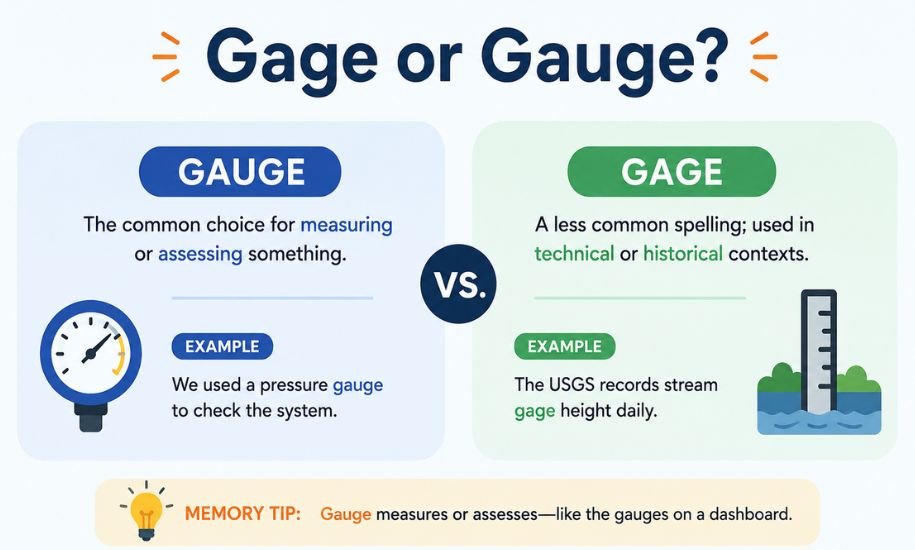
Gauge is the standard choice in most modern English when you mean a measuring instrument, a measurement, or “to assess.” Gage is also a real word, but it is less common and can have specialized or historical meanings. For phrases such as “___ interest,” use gauge interest.
Gage or Gauge: What’s the Difference?
The two forms are pronounced the same, but they do not have exactly the same history or range of use.
| Word | Main use | Example |
|---|---|---|
| gauge | Measurement, measuring instrument, or assessing something | Check the pressure gauge. |
| gage | Historical meanings; also an alternative technical spelling of gauge | The USGS uses gage in its water-measurement terminology. |
For ordinary writing, gauge is the safest choice. Dictionaries recognize gage as an alternative, particularly in technical usage, but gauge is the more broadly familiar spelling. Oxford, for example, lists gage as a US English form and gauge as the corresponding British and North American form.
What Does “Gauge” Mean?
Gauge can be a noun or a verb.
As a noun, it commonly means a device used to measure or display something, such as pressure, temperature, fuel level, or another quantity. It can also mean a standard or measurement itself.
Examples:
- The mechanic checked the pressure gauge.
- The fuel gauge says the tank is nearly empty.
- What gauge of wire should we use?
- The train runs on standard railway gauge.
As a verb, gauge means to measure, estimate, assess, or judge.
Examples:
- We need to gauge the size of the problem.
- She watched his expression to gauge his reaction.
- The survey helped the company gauge customer satisfaction.
- It is difficult to gauge how much time remains.
This verb meaning explains why gauge interest is the normal expression.
What Does “Gage” Mean?
Gage is a genuine English word, so it is inaccurate to say that it is always wrong.
It has an older meaning related to a pledge, security, or token, including the historical use of an object offered as a challenge. Dictionary.com also records gage as a technical variant of gauge.
For example, in older or historical writing, you may encounter gage referring to a pledge or challenge.
More importantly for modern readers, gage is sometimes used instead of gauge in technical terminology. Oxford lists gage for instruments used to measure quantities, while noting gauge as the alternative form.
So:
- gage can be correct.
- gage is not usually the best general-purpose spelling for measurement.
- gauge is normally the clearer choice for everyday and general professional writing.
Why Does “Gage” Appear in Technical Writing?
One of the best-known examples is the U.S. Geological Survey (USGS).
The USGS intentionally uses gage in terms such as stream gage and gage height. According to the agency, it has used this spelling for more than a century. The USGS explains that its adoption of gage dates back to the work of Frederick Haynes Newell in the late 19th century, who favored what he considered an older Saxon spelling.
That means you may see:
- stream gage
- gage height
- stream gaging station
in USGS material.
This is an example of an established technical convention, not evidence that gauge is incorrect.
If you are writing for a specific organization or technical field, follow that field’s established terminology. Otherwise, gauge is usually the better choice.
Gages or Gauges?
When you use gauge as the noun meaning a measuring device or measurement, the normal plural is:
gauge → gauges
Examples:
- The dashboard contains several gauges.
- Check all the pressure gauges before operating the machine.
- The laboratory uses highly accurate measuring gauges.
Dictionary.com lists gauges as the plural of gauge.
But if a technical organization deliberately uses gage, its plural can be gages.
For example, a document that consistently uses gage might refer to several gages. This follows the same spelling convention rather than creating a new grammatical rule.
So the practical rule is:
Use gauges with gauge, and gages with gage when that spelling is intentionally being used.
For general writing, gauges is the form most readers will expect.
Gauge Interest or Gage Interest?
The standard expression is gauge interest.
Here, gauge is a verb meaning to assess or estimate someone’s level of interest. Collins specifically lists gauge interest as a natural word combination.
Examples:
- We conducted a survey to gauge interest in the new product.
- The teacher asked a few questions to gauge interest in the topic.
- Before organizing the event, they wanted to gauge interest.
- The company is trying to gauge interest among potential customers.
Gage interest may occasionally appear where a writer or organization uses gage as a technical variant, but it is not the preferred general expression.
If you mean “find out how interested people are,” choose:
gauge interest ✓
not:
gage interest ✗ in ordinary standard usage.
Gauge, Gauged, and Gauging
The verb forms can also cause spelling questions.
The standard forms are:
| Form | Example |
| Present | gauge |
| Third-person singular | gauges |
| Past | gauged |
| Present participle | gauging |
For example:
- We gauge customer reactions.
- She gauges the temperature carefully.
- They gauged the situation incorrectly.
- He is gauging public interest.
The present participle is gauging, not gaugeing. Dictionary.com lists gauging as the standard form.
Technical writing that intentionally uses gage can instead use forms such as gages, gaged, and gaging. Dictionary.com records these forms for the technical noun/verb gage.
Correct and Incorrect Examples
When referring to a measuring device
Correct:
The pressure gauge is showing a high reading.
Less common but possible in specialized usage:
The pressure gage is showing a high reading.
For general readers, gauge is the clearer choice.
When meaning “assess”
Correct:
We need to gauge her reaction.
Not the usual general-English choice:
We need to gage her reaction.
When talking about interest
Correct:
The organizer called attendees to gauge interest in the workshop.
Not preferred in ordinary writing:
The organizer called attendees to gage interest in the workshop.
In an established technical convention
Correct within the USGS convention:
The scientist recorded the gage height.
The USGS deliberately uses gage in this terminology.
Is “Gage” a Misspelling of “Gauge”?
Not necessarily.
If you are talking about measuring something, gage can be an accepted variant, particularly in specialized technical contexts. Oxford lists gage as a US English form for an instrument used for measurement, while Dictionary.com also identifies a technical sense of gage meaning gauge.
However, calling gage the default spelling in general English would also be misleading.
For most readers, this is the easiest rule:
General writing → gauge
Established technical terminology → follow the field’s preferred spelling
There is another reason to be careful: gage has historical meanings unrelated to measurement, including a pledge or challenge.
How to Choose the Right Spelling
When you are unsure, ask what you mean.
If you mean “measure” or “assess”
Use gauge.
- gauge the temperature
- gauge the pressure
- gauge the situation
- gauge someone’s reaction
- gauge interest
If you mean a measuring device
Use gauge in ordinary writing.
- fuel gauge
- pressure gauge
- temperature gauge
- depth gauge
If you are following a technical organization’s terminology
Check its established style.
For example, the USGS intentionally uses gage in its water-measurement terminology.
If you encounter “gage” in an older text
Do not automatically correct it. It may have an older meaning or reflect an established variant spelling.
An Easy Way to Remember
For everyday English, remember:
Gauge = measure or assess.
Think of a gauge on a dashboard: it gives you a measurement.
The same word works as a verb:
A gauge measures something → to gauge means to measure or assess.
That gives you:
- gauge the pressure
- gauge the temperature
- gauge the reaction
- gauge interest
If you see gage, pause and ask whether you are dealing with a specialized technical term or an older/historical use. If not, gauge is usually the safer choice.
Common Mistakes to Avoid
1. Treating “gage” as always wrong
It is not always wrong. It is a legitimate word and an established technical variant.
2. Writing “gage interest” in ordinary prose
When gauge means “assess,” use gauge interest.
3. Writing “gaugeing”
The correct form is gauging.
4. Assuming every organization uses “gauge”
Specialized fields may intentionally use gage. The USGS is a well-known example.
5. Changing “gage” without checking the context
A technical document, historical text, or proper name may require the spelling gage. Context matters.
Frequently Asked Questions
Is it gage or gauge?
For most modern general-English contexts, gauge is the preferred spelling. It means a measuring instrument, a measurement, or the act of assessing something. Gage is also legitimate, particularly in technical usage, and has separate historical meanings.
Is it gauge or gage in American English?
Gauge is the normal general spelling in American English, but gage is also used, especially in certain technical contexts. Oxford lists gage as a US English form for a measuring instrument.
Should I write “gages” or “gauges”?
Use gauges when the base word is gauge. For example, “The car has several gauges.” Gages can be correct when an organization intentionally uses gage as its technical spelling.
Is “gauge interest” or “gage interest” correct?
Gauge interest is the standard expression. Here, gauge means “assess” or “estimate,” as in “We want to gauge interest in the proposal.”
Why does the USGS spell it “gage”?
The USGS has a long-standing institutional convention of using gage in its water-measurement terminology. The agency says it has used that spelling for more than 100 years.
How do you spell the verb form: “gauging” or “gaging”?
Gauging is the standard form of gauge in general English. Gaging is also found where the alternative spelling gage is deliberately used, particularly in technical contexts.
The Bottom Line
For everyday writing, gauge is the spelling to choose when you mean a measuring device, a measurement, or “to assess.” Use gauge interest, gauges, gauged, and gauging in ordinary contexts. Gage is not simply a mistake, though: it remains a legitimate variant in some technical settings and has older meanings of its own. When in doubt, gauge is the safest general-purpose choice. That practical distinction is exactly the kind of word choice Grammarifyr helps make clear: know the difference, then use the right word.
You may also Read : Yea or Yeah: What’s the Difference?

One Comment