Discrete or Discreet? Meaning, Examples and Usage
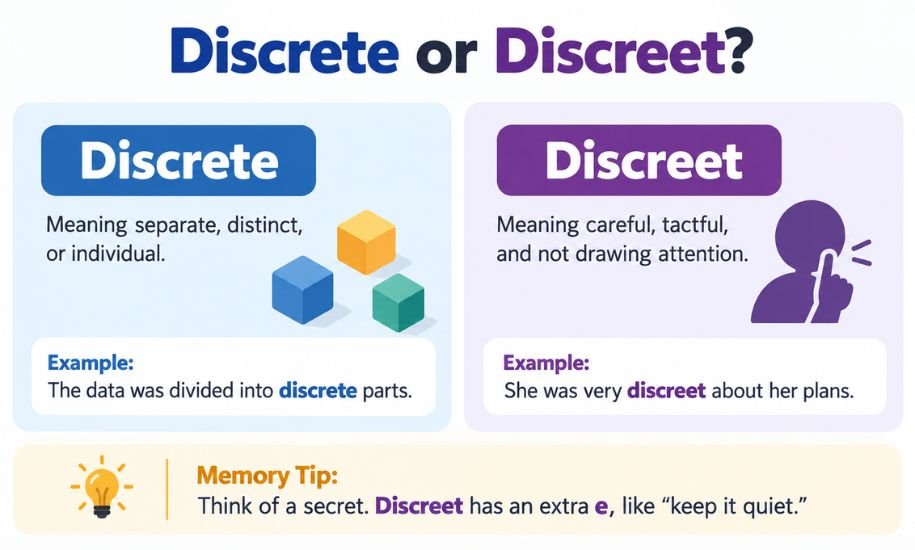
It is easy to confuse discrete and discreet because they look almost identical and are pronounced the same. However, they have different meanings and are used in very different situations. Discrete means separate, distinct, or individually different, while discreet means careful, tactful, private, or unobtrusive. Knowing which word fits depends on whether you are describing something that is separate from something else or someone who is trying not to attract attention or reveal information.
Both “discrete” and “discreet” are correct words. Discrete means separate, distinct, or individually identifiable. Discreet means careful about keeping something private or avoiding attention. For example, you can have discrete categories but make a discreet enquiry.
Discrete vs. Discreet at a Glance
| Feature | Discrete | Discreet |
|---|---|---|
| Main meaning | Separate or distinct | Tactful, private, or unobtrusive |
| Word type | Adjective | Adjective |
| Common contexts | Data, categories, units, objects, systems | People, behaviour, communication, privacy |
| Example | “The study used three discrete groups.” | “Please be discreet about the surprise.” |
| Common association | Separate | Confidential or careful |
| Pronunciation | /dɪˈskriːt/ | /dɪˈskriːt/ |
The spelling is different, but the pronunciation is the same. This makes the pair especially easy to mix up in conversation.
What Does “Discrete” Mean?
Discrete is an adjective meaning separate, distinct, or individually identifiable.
When things are discrete, they can be distinguished from one another rather than being part of one continuous or indistinguishable whole.
For example:
- The survey divided participants into four discrete groups.
- The machine has several discrete components.
- The report contains five discrete sections.
- The researchers examined three discrete categories.
- Each event was treated as a discrete occurrence.
The word is especially common in academic, scientific, mathematical, and technical writing. In mathematics and statistics, for example, discrete is often used when values are separate and countable rather than continuous.
Discrete in mathematics
A discrete variable has distinct, countable values.
For example, the number of children in a family could be 0, 1, 2, 3, or 4. You would not normally describe the number of children as 2.5.
By contrast, measurements such as height or temperature can vary continuously.
So in technical contexts, discrete can carry a more specific meaning than simply “separate.”
What Does “Discreet” Mean?
Discreet is an adjective meaning careful, tactful, private, or unobtrusive.
It often describes someone who knows when not to draw attention to a situation or when not to reveal information.
For example:
- Please be discreet about the planned celebration.
- She made a discreet enquiry about the position.
- He was discreet when discussing the confidential matter.
- The receptionist gave us a discreet signal.
- They chose a discreet location for the meeting.
A discreet person or action does not unnecessarily attract attention. The word can also suggest good judgment about information that should remain private.
Discreet and privacy
One of the easiest ways to understand discreet is to connect it with privacy.
If someone handles confidential information carefully, they are being discreet.
If someone asks a sensitive question without attracting attention, they can make a discreet enquiry.
If a product is sent in packaging that does not reveal its contents, the packaging can be described as discreet packaging.
The Key Difference
The simplest distinction is:
Discrete = separate
Discreet = careful or private
Consider these two sentences:
The experiment consisted of four discrete stages.
The stages are separate from one another.
The assistant made a discreet enquiry.
The assistant asked about something carefully and without attracting unnecessary attention.
Although the words sound identical, their meanings are completely different.
Why Are These Words So Often Confused?
The main reason is pronunciation. Discrete and discreet are homophones, meaning they have the same pronunciation but different spellings and meanings.
They are both pronounced approximately /dɪˈskriːt/.
When you hear someone say the word, you cannot determine from the sound alone which spelling they intend. You need to understand the context.
Their very similar spelling also contributes to the confusion. Both begin with discre-, and the difference comes down to the final vowel arrangement:
- discrete
- discreet
This is why careful context is particularly important when writing either word.
Discreet Packaging or Discrete Packaging?
A common question is whether the correct phrase is discreet packaging or discrete packaging.
When you mean packaging that is plain, private, or designed not to attract attention, the correct expression is:
discreet packaging
For example:
The company provides discreet packaging to protect customer privacy.
Here, discreet describes the unobtrusive nature of the packaging.
Discrete packaging can technically make sense in a different context if you mean separate or individually distinct packages. For example:
The products were placed in discrete packages rather than one large container.
However, that is a different meaning. If the intended idea is privacy or inconspicuous delivery, discreet packaging is the natural choice.
Discrete or Discreet in Relationships
The right word also depends on what you are trying to say about a relationship.
If you mean that something is private or not openly discussed, use discreet:
They wanted to keep the relationship discreet.
If you are describing separate categories of relationships, use discrete:
The researchers identified several discrete types of relationships.
The distinction remains the same: discreet relates to privacy or careful behaviour, while discrete relates to separation or distinct categories.
Examples in Sentences
Seeing the words side by side makes the distinction easier to remember.
Examples with “discrete”
- The programme is divided into several discrete modules.
- The researchers identified two discrete patterns in the data.
- The building consists of three discrete units.
- Each department operates as a discrete division.
- The questionnaire contains questions covering several discrete topics.
In each case, discrete means that something is separate, distinct, or individually identifiable.
Examples with “discreet”
- Please be discreet when discussing the matter.
- She made a discreet enquiry about the available position.
- The staff member gave him a discreet warning.
- They arranged a discreet meeting away from the main office.
- He was discreet about the confidential information.
In these examples, discreet relates to privacy, tact, caution, or avoiding unnecessary attention.
Correct and Incorrect Usage
Because both words are real, neither should automatically be treated as a misspelling. The mistake happens when the wrong word is selected for the intended meaning.
Correct:
The research participants were divided into three discrete groups.
The groups are separate.
Incorrect for that meaning:
The research participants were divided into three discreet groups.
This would suggest that the groups themselves were private or unobtrusive, rather than simply separate.
Correct:
Please be discreet about the confidential information.
The person should avoid revealing the information.
Incorrect for that meaning:
Please be discrete about the confidential information.
Discrete does not mean tactful or secretive.
Correct:
The company offers discreet packaging.
The packaging is designed to be unobtrusive.
Correct:
The database contains several discrete data sets.
The data sets are separate or distinct.
An Easy Way to Remember the Difference
A useful memory trick is:
Discrete = distinct
Both ideas begin with the idea of things being separate.
For example:
Discrete categories = distinct categories
For discreet, think about secrecy and privacy:
Discreet = keep it private
So if you are talking about keeping information quiet, avoiding attention, or behaving tactfully, choose discreet.
If you are talking about separate groups, units, categories, or things, choose discrete.
Another helpful association is:
Discrete → separate
Discreet → secret
The second is not a formal spelling rule, but it is a convenient memory aid.
Discrete and Discreet Synonyms
The best synonym depends on the intended meaning.
Synonyms for discrete
Depending on the context, alternatives include:
- separate
- distinct
- individual
- independent
- detached
- divided
- isolated
Example:
The project has four discrete stages.
You could say:
The project has four separate stages.
Synonyms for discreet
Depending on the context, alternatives include:
- tactful
- cautious
- diplomatic
- private
- unobtrusive
- inconspicuous
- reserved
- circumspect
Example:
She was discreet when discussing the situation.
You could use:
She was tactful when discussing the situation.
The synonyms are useful because replacing the word with a simpler alternative can often reveal which spelling you need.
Is There a Difference in UK and US English?
The distinction between discrete and discreet is not primarily a British-versus-American spelling difference. Both words are established in standard English in both varieties.
British and American writers generally use discrete for the meaning “separate or distinct” and discreet for the meaning “tactful, private, or unobtrusive.”
For example, British English:
The report contains several discrete sections.
American English:
The report contains several discrete sections.
Likewise:
Please be discreet about the matter.
The spelling does not normally change simply because the audience is British or American.
Common Mistakes to Avoid
1. Using “discreet” when you mean separate
If you are describing separate categories or components, use discrete.
The software contains several discrete components.
2. Using “discrete” when you mean private
If you are asking someone to keep information confidential, use discreet.
Please be discreet about the announcement.
3. Writing “discrete packaging” when you mean private packaging
For packaging that does not reveal its contents or attract attention, discreet packaging is the usual expression.
4. Assuming one word is simply the British spelling of the other
Neither is a British-only or American-only alternative. They are two different words with different meanings.
5. Choosing the spelling from pronunciation alone
Because both words sound the same, pronunciation cannot tell you which spelling to use. Think about the meaning first.
Frequently Asked Questions
Is “discrete” or “discreet” correct?
Both are correct words. Discrete means separate or distinct, while discreet means careful, tactful, private, or unobtrusive. The correct choice depends on the meaning of the sentence.
Are discrete and discreet pronounced the same?
Yes. They are homophones and are generally pronounced /dɪˈskriːt/. Their identical pronunciation is one reason writers frequently confuse their spellings.
Is it “discreet packaging” or “discrete packaging”?
Discreet packaging is the usual choice when you mean packaging that is private, plain, or designed not to attract attention. Discrete packaging could describe separate packages, but it conveys a different meaning.
What is a synonym for discrete?
Common synonyms include separate, distinct, individual, independent, and divided. The best choice depends on the sentence and the specific context.
What is a synonym for discreet?
Common synonyms include tactful, cautious, diplomatic, private, unobtrusive, and inconspicuous. These relate to careful behaviour, privacy, or avoiding unnecessary attention.
How can I remember the difference?
Think discrete = distinct because both relate to things being separate. For discreet, think about keeping something private or secret. This simple association can help you choose the correct spelling.
The Bottom Line
Use discrete when you mean separate, distinct, or individually identifiable. Use discreet when you mean private, tactful, cautious, or unobtrusive. They sound alike, but their meanings are different, so the context determines the spelling. For more clear explanations of easily confused English words, Grammarifyr helps you Know the Difference. Use the Right Words.
You may also Read : Writting or Writing: Grammar and Spelling Guide
One Comment