Writting or Writing: Grammar and Spelling Guide
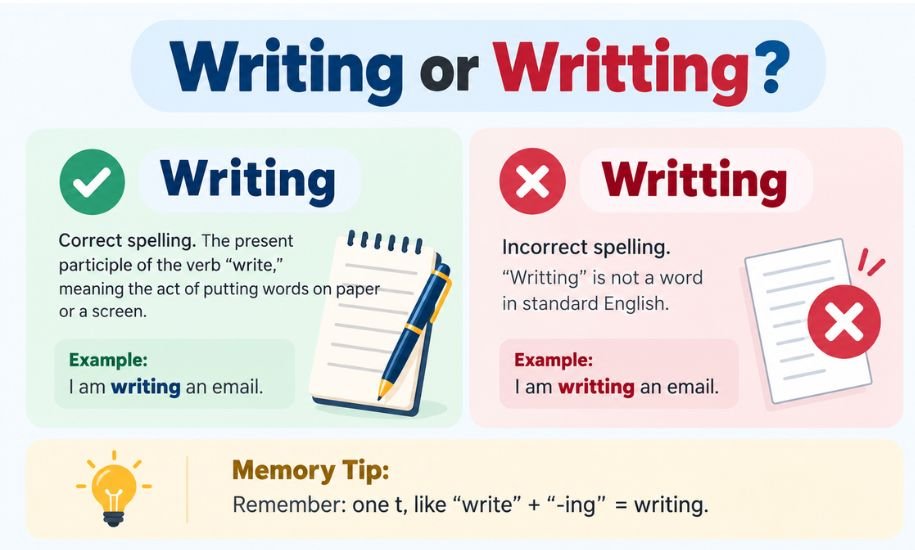
It is easy to hesitate between writting and writing, especially because English has many words in which a final consonant is doubled before -ing. However, the correct modern spelling is writing. It is the present participle and gerund form of the verb write. The form writting is a misspelling in standard English. Understanding why the extra t does not belong makes this spelling much easier to remember.
Writing is the correct spelling. Writting is a misspelling and should not be used in standard English. The correct form is write → writing, with the final silent e removed before adding -ing.
Writing vs. Writting: Quick Comparison
| Feature | Writing | Writting |
|---|---|---|
| Correct spelling? | Yes | No |
| Base word | Write | Write |
| Formation | Write + -ing → writing | Incorrectly formed |
| Word type | Verb form / noun | Misspelling |
| Example | She is writing a letter. | She is writting a letter. ❌ |
| Standard British English | Yes | No |
| Standard American English | Yes | No |
The key point is simple: writing is the standard spelling in both British and American English.
Why Is “Writing” Correct?
The word writing comes from the verb write.
When -ing is added to a verb ending in a silent e, that final e is normally removed:
- write → writing
- make → making
- take → taking
- hope → hoping
- use → using
- drive → driving
Therefore, write + ing does not become writting. It becomes writing.
The spelling can look slightly unusual because the pronunciation does not make the silent e obvious. The word write is pronounced with a long vowel sound, while writing retains that sound even though the final e disappears from the spelling.
Why Do People Write “Writting”?
The extra t in writting is usually caused by confusion with another English spelling pattern: consonant doubling.
Some short verbs double their final consonant before -ing:
- sit → sitting
- run → running
- stop → stopping
- swim → swimming
- plan → planning
Because learners see forms such as sitting and running, it can seem logical that write should become writting. But write follows a different spelling pattern.
The correct transformation is:
write → remove the final e → writing
Not:
write → double the t → writting
This distinction is especially useful when learning other verbs ending in silent e.
What Does “Writing” Mean?
Writing can refer to the act of producing words in written form, the words that have been produced, or a particular style of written expression.
For example:
- Writing takes practice.
- She enjoys writing short stories.
- His writing is clear and easy to understand.
- I am writing an email to my teacher.
- They spent the afternoon writing their reports.
The word can have different grammatical roles depending on the sentence.
“Writing” as a verb form
In:
She is writing a letter.
Writing is the present participle of write and forms part of the present continuous verb phrase is writing.
“Writing” as a noun
In:
Writing can be an effective way to communicate ideas.
Writing functions as a noun referring to the activity itself.
It can also refer to someone’s written work:
I really enjoy his writing.
“I Am Writing” or “I Am Writting”?
The correct expression is:
I am writing. ✅
Not:
I am writting. ❌
This is one of the most useful examples because the incorrect version can look plausible at first glance.
Here are some more examples:
- I am writing an article.
- She is writing in her notebook.
- He is writing a message.
- We are writing our final assignment.
- They are writing a report for the meeting.
The same spelling applies after other forms of be:
- She was writing.
- They were writing.
- He has been writing.
- We will be writing tomorrow.
Writing Examples in Sentences
Here are several examples showing how the correct form works in everyday English:
- I am writing a letter to my friend.
- She is writing a novel about her childhood.
- He spent the evening writing his assignment.
- We are writing down the instructions.
- They were writing when the teacher entered the room.
- My brother enjoys writing poetry.
- She has been writing articles for several years.
- Good writing takes time and practice.
- His writing style is simple and direct.
- I am writing an email to confirm the appointment.
Notice that writing works naturally in both verb and noun contexts.
Correct and Incorrect Examples
Seeing the two forms side by side makes the difference easy to spot.
Correct
She is writing a report.
Incorrect
She is writting a report. ❌
Correct
I am writing a message.
Incorrect
I am writting a message. ❌
Correct
He enjoys writing stories.
Incorrect
He enjoys writting stories. ❌
Correct
They are writing their answers.
Incorrect
They are writting their answers. ❌
In each case, replacing writting with writing fixes the spelling.
Is “Writting” a Real Word?
In modern standard English, writting is not the accepted spelling of the -ing form of write. It should therefore be treated as a spelling error in ordinary writing.
You may occasionally encounter unusual or historical spellings in old texts, dictionaries, or historical records, but that does not make writting an appropriate modern spelling.
For contemporary schoolwork, professional communication, articles, essays, and other standard writing, use writing.
Writing in British English
If you are wondering about writting or writing in British English, the answer is straightforward: writing is the standard spelling.
British English does not use writting as an alternative to the American spelling. Both British and American English use:
writing ✅
There are many genuine differences between British and American spelling, such as:
- colour / color
- centre / center
- organise / organize
- travelling / traveling
But writing is not one of those differences.
So whether you are writing for a British audience, an American audience, or an international audience, writing is the appropriate spelling.
A Simple Rule to Remember
A useful way to remember the spelling is:
Write loses the final e before -ing.
Think of the word as:
WRITE → WRIT + ING → WRITING
The final e disappears, but the t is not doubled.
Compare these examples:
- write → writing
- bite → biting
- ride → riding
- smile → smiling
- dance → dancing
This pattern helps distinguish writing from words such as sitting and running, where consonant doubling actually occurs.
Common Mistakes to Avoid
1. Adding an extra “t”
The most obvious error is:
writting ❌
Use:
writing ✅
2. Keeping the final “e”
Another possible mistake is:
writeing ❌
The final e is removed before -ing:
writing ✅
3. Confusing writing with written
Writing and written are different forms of the verb write.
- She is writing a letter.
- She has written a letter.
Writing is the present participle/gerund form, while written is the past participle.
4. Assuming British English uses “writting”
It does not. Writing is standard in British English as well as American English.
Writing vs. Written
Because these forms are sometimes confused, it is useful to distinguish them:
| Form | Use | Example |
|---|---|---|
| write | Base form | I write every day. |
| wrote | Simple past | I wrote yesterday. |
| written | Past participle | I have written a letter. |
| writing | -ing form | I am writing now. |
This also explains why writting does not belong in the verb’s standard conjugation.
How to Remember the Correct Spelling
The easiest memory trick is:
“Write drops e before -ing.”
So:
write + ing = writing
You can also remember that writing has only one t after the i:
writing
If you see writting, stop and check whether you have accidentally applied the consonant-doubling rule from words such as sitting or running.
Frequently Asked Questions
Is “writting” or “writing” correct?
Writing is correct. Writting is a misspelling in modern standard English. The correct -ing form of write is formed by removing the final silent e and adding -ing.
Is “I am writting” grammatically correct?
No. The correct sentence is “I am writing.” The word writing is the present participle of write and is used after am in the present continuous tense.
Is “writing” British or American English?
Writing is standard in both British and American English. There is no regional spelling difference between the two varieties for this word.
Why isn’t “write” changed to “writting”?
Because write follows the spelling pattern in which a final silent e is removed before -ing. Therefore, write → writing, rather than write → writting.
Is “writting” ever acceptable in formal writing?
No. In modern standard English, use writing in formal and informal writing. Writting should be corrected whenever it is being used as the -ing form of write.
What is the difference between “writing” and “written”?
Writing is the -ing form: “She is writing a letter.” Written is the past participle: “She has written a letter.” They are different grammatical forms of the same verb.
The Bottom Line
Writing is the correct spelling, while writting is a modern spelling error. The key rule is simple: when -ing is added to write, the final silent e is removed, giving us writing. Once you remember this pattern, you can avoid the extra t and use the correct form confidently. Grammarifyr helps make these small spelling distinctions easier to understand and apply in everyday English.
You may also Read : Starring or Staring: Spelling, Meaning and Examples
One Comment