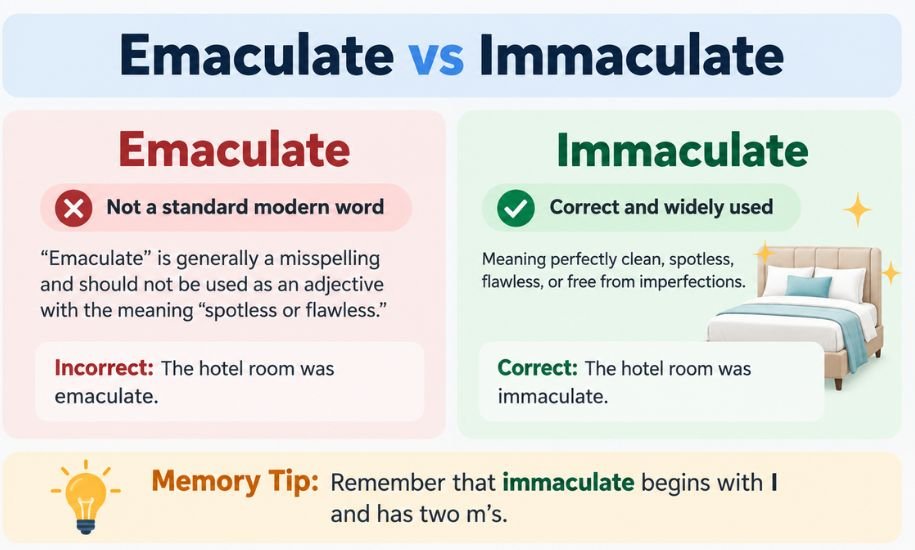
Emaculate vs Immaculate: Which Spelling Is Correct?
When writing in English, some words can be confusing because they look or sound almost identical. Emaculate vs immaculate is a good example of this spelling confusion. If you want to describe something perfectly clean, flawless, or free from imperfections, the correct word is immaculate. Although emaculate has a rare historical use, it is not a standard modern adjective. Understanding the difference can help you avoid spelling mistakes in essays, professional writing, and everyday communication. Knowing the meaning, pronunciation, and correct usage of immaculate will also help you use it confidently in different contexts.
Emaculate or Immaculate: What’s the Difference?
Immaculate is an established English adjective used to describe something without stains, flaws, or imperfections. Emaculate, on the other hand, is not an accepted modern alternative when describing something spotless or flawless.
| Feature | Immaculate | Emaculate |
|---|---|---|
| Standard spelling | Correct | Incorrect for the intended adjective |
| Part of speech | Adjective | Rare historical verb |
| Meaning | Spotless, flawless, or pure | Historically associated with removing blemishes |
| Modern usage | Common and accepted | Obsolete or nonstandard |
| Formal writing | Appropriate | Avoid as a substitute |
| Example | An immaculate room | An emaculate room (incorrect) |
The key distinction is that immaculate is the word to use in contemporary English when referring to exceptional cleanliness, appearance, or quality. While emaculate has appeared historically as a rare verb, it is not used as a standard adjective in modern writing.
What Does Immaculate Mean?
Immaculate is an adjective that means perfectly clean, exceptionally neat, flawless, or free from imperfections. It can describe physical objects, personal appearance, work, performance, and even someone’s reputation.
The word is commonly used in both literal and figurative contexts. For example, an immaculate house is exceptionally clean, while an immaculate performance is one without noticeable errors.
Examples of immaculate in sentences:
- The hotel room was immaculate when we checked in.
- She wore an immaculate white dress to the ceremony.
- The chef maintained an immaculate kitchen.
- The football team delivered an immaculate performance.
- His professional record remained immaculate throughout his career.
In each sentence, the word conveys a sense of perfection, cleanliness, or freedom from faults.
Is Emaculate a Real Word?
Emaculate is not a standard modern adjective meaning clean, spotless, or flawless. However, the spelling has a rare historical use as a verb meaning to remove stains or blemishes.
This historical usage is obsolete, so emaculate is not appropriate as a substitute for immaculate in contemporary everyday or formal writing.
For example:
- Incorrect: The hotel maintained an emaculate appearance.
- Correct: The hotel maintained an immaculate appearance.
The second sentence uses the accepted modern adjective to describe an exceptionally clean and well-maintained appearance.
If you encounter emaculate in older writing, its meaning may depend on the historical context. For modern communication, immaculate is the correct choice for the meaning discussed here.
Why Are These Spellings Confused?
The confusion largely comes from the similarity between the two spellings and the way immaculate sounds when spoken.
There are several possible reasons for the mistake:
- Similar pronunciation: The initial vowel in immaculate is unstressed, which can make it less distinct in natural speech.
- Incorrect vowel choice: Writers may mistakenly use e instead of i at the beginning of the word.
- Unfamiliar spelling: The double m in immaculate may be overlooked or forgotten.
- Typing mistakes: Writing quickly can lead to accidental spelling errors, particularly with less familiar words.
Remembering the correct initial vowel and double consonant can help you recognize and avoid the error.
How to Use Immaculate in Sentences
The word can describe different types of perfection depending on the context.
1. Cleanliness and Appearance
When referring to physical cleanliness, immaculate means completely clean, neat, and free from visible dirt or mess.
- The house was immaculate before the guests arrived.
- The gardener kept the lawn in immaculate condition.
- Every table in the restaurant was immaculate.
2. Clothing and Personal Presentation
The word can also describe someone who looks exceptionally neat, well-dressed, or carefully groomed.
- He looked immaculate in his formal suit.
- Her immaculate appearance suited the occasion.
- The presenter was always immaculately dressed.
3. Quality and Performance
In figurative contexts, immaculate describes something that is exceptionally well done or free from errors.
- The singer gave an immaculate performance.
- The architect produced an immaculate design.
- The student submitted an immaculate assignment.
These examples demonstrate how the adjective can describe both physical cleanliness and figurative perfection.
Immaculate Meaning, Pronunciation, and Word Forms
The word immaculate comes from the Latin immaculatus, meaning unstained or without a blemish. Its modern meaning includes both physical cleanliness and the absence of imperfections.
| Feature | Details |
|---|---|
| Word | Immaculate |
| Part of speech | Adjective |
| Pronunciation | ih-MAK-yuh-luht |
| IPA | /ɪˈmækjələt/ |
| Main stress | Second syllable |
| Meaning | Spotless, flawless, or pure |
| Adverb | Immaculately |
| Noun | Immaculateness |
Related word forms:
- Immaculate: Her bedroom was immaculate.
- Immaculately: The furniture was immaculately arranged.
- Immaculateness: The immaculateness of the room impressed everyone.
The adjective immaculate is the most frequently useful form when describing something clean, flawless, or unblemished.
Immaculate Synonyms
Several English words have meanings similar to immaculate. However, the most suitable synonym depends on what you are describing.
| Synonym | Meaning | Example |
|---|---|---|
| Spotless | Completely clean | The kitchen was spotless. |
| Flawless | Without imperfections | She delivered a flawless speech. |
| Pristine | In excellent, original condition | The car remained pristine. |
| Impeccable | Without faults | His manners were impeccable. |
| Unblemished | Free from marks or defects | The surface was unblemished. |
| Perfect | Without noticeable faults | The presentation was perfect. |
| Untarnished | Not damaged or diminished | She had an untarnished reputation. |
For physical cleanliness, spotless is often a natural alternative. For work, behaviour, or performance, flawless and impeccable may be more suitable.
What Is the Immaculate Conception?
The Immaculate Conception is a specific doctrine in Catholic theology concerning the Virgin Mary. It teaches that Mary was preserved from original sin from the first moment of her conception.
In this religious phrase, immaculate refers to purity rather than ordinary physical cleanliness. The phrase is a proper name for a theological concept and is distinct from the everyday use of the adjective.
Understanding this expression can help readers recognize why immaculate is sometimes used in religious, historical, and cultural contexts.
What Is the Immaculate Movie?
Immaculate is a 2024 psychological horror film starring Sydney Sweeney as Cecilia, an American nun who joins a convent in Italy. The film explores unsettling events surrounding her experiences at the convent.
In the movie’s title, Immaculate carries associations with religious purity, which contrast with the film’s horror themes. The title uses the correct standard spelling of the word.
This is a separate entertainment-related use of the term rather than a different spelling or grammatical form.
Easy Way to Remember the Correct Spelling
A simple way to remember immaculate is to focus on its first three letters: IMM.
The word starts with I, followed by two M letters. When you want to describe something perfectly clean, flawless, or pure, remember to use immaculate.
You can also connect the word with imperfection-free. Both immaculate and imperfection begin with the letter I, which can help you recall the correct initial vowel.
Common Mistakes to Avoid
Here are a few mistakes to watch for when using this word:
- Writing emaculate instead of immaculate: Use immaculate when describing something spotless or flawless.
- Using only one m: The correct spelling contains two consecutive m’s.
- Assuming it only refers to cleanliness: The word can also describe performance, quality, appearance, and reputation.
- Confusing immaculate with merely tidy: Immaculate suggests an exceptional level of cleanliness or perfection.
- Assuming a regional spelling difference: Immaculate is the standard spelling in both British and American English.
Being aware of these differences can make your writing more precise and natural.
Frequently Asked Questions
1. Is it emaculate or immaculate?
Immaculate is the correct standard spelling when describing something perfectly clean, flawless, or pure. Emaculate is not a standard modern adjective with this meaning, so it should be avoided in contemporary writing.
2. What is the meaning of immaculate?
Immaculate means perfectly clean, spotless, flawless, or free from imperfections. It can describe a physical space, a person’s appearance, excellent work, or an unblemished reputation.
3. Is emaculate an English word?
Emaculate has a rare historical use as a verb associated with removing stains or blemishes, but it is obsolete in modern English. It is not the accepted adjective for something clean or flawless.
4. What is a synonym for immaculate?
Common synonyms include spotless, flawless, pristine, impeccable, and unblemished. The best choice depends on the context. For example, spotless usually describes cleanliness, while impeccable often describes quality or behaviour.
5. How do you pronounce immaculate?
Immaculate is pronounced /ɪˈmækjələt/, with the main stress on the second syllable. The pronunciation is broadly consistent in standard British and American English.
6. Is immaculate spelled differently in British and American English?
No. Immaculate is spelled identically in British and American English. There is no regional spelling distinction between the two varieties.
Final Verdict: Emaculate or Immaculate?
Immaculate is the correct modern spelling when describing something exceptionally clean, flawless, or free from imperfections. Although emaculate has a rare historical use, it is not a standard modern adjective. Remember the initial I and double M to avoid this mistake. At Grammarifyr, understanding these small spelling distinctions helps you know the difference and use the right words with confidence.
You may also Read : Lieing or Lying: Meaning, Rules, and Examples
One Comment