Paid or Payed: Meaning, Difference, and Examples
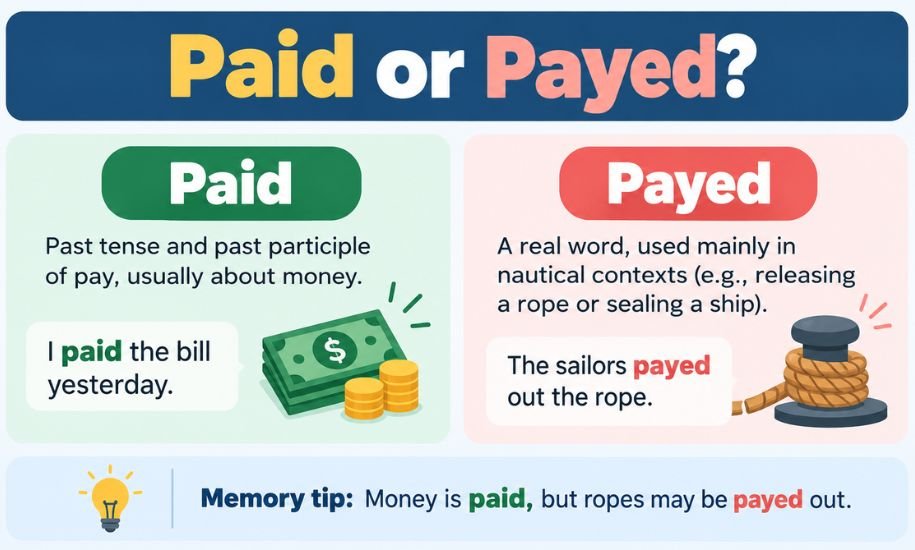
The words paid and payed look almost identical, so it is easy to confuse them when writing about money, bills, wages, or everyday activities. Although both are real English words, they are not interchangeable. Paid is the standard past tense and past participle of pay in everyday English, while payed is used mainly in specific nautical contexts, such as releasing a rope or sealing a ship. Understanding this difference will help you choose the correct spelling in emails, assignments, professional writing, and everyday conversations.
Quick Answer
Paid is the correct spelling when referring to giving or receiving money, settling a bill, or using expressions such as paid attention and paid off. Payed is also a real word, but it is used primarily in specialized nautical contexts, such as paying out a rope or applying protective material to a ship. For almost all everyday situations, use paid.
Paid or Payed: Which Is Correct?
Both spellings exist, but their meanings and uses are different. Paid is the irregular past tense and past participle of pay in standard everyday English. Payed is a specialized form associated mainly with certain maritime meanings of the verb.
| Feature | Paid | Payed |
|---|---|---|
| Correct English word | Yes | Yes |
| Standard past tense of pay | Yes | No |
| Past participle | Yes | Rare specialized use |
| Paying money | Correct | Incorrect |
| Paying a bill | Correct | Incorrect |
| Receiving a salary | Correct | Incorrect |
| Paying attention | Correct | Incorrect |
| Releasing a rope or cable | Sometimes used | Specialized use |
| Sealing a ship’s seams | Sometimes used | Specialized use |
| Everyday writing | Common | Rare |
For example, you should write, “I paid my electricity bill yesterday,” rather than “I payed my electricity bill yesterday.”
However, in nautical terminology, payed out can describe the action of gradually releasing a rope or cable. The correct choice depends on the intended meaning.
What Does Paid Mean?
Paid is the simple past tense and past participle of the verb pay. It generally refers to giving money in exchange for goods or services, settling a debt, or providing compensation. It can also be used in figurative expressions that do not directly involve money.
The verb pay is irregular, which means its past forms do not follow the usual pattern of adding -ed.
Its three main forms are:
| Verb form | Word | Example |
|---|---|---|
| Base form | Pay | I pay my rent monthly. |
| Past tense | Paid | I paid my rent yesterday. |
| Past participle | Paid | I have paid my rent. |
Examples of paid in sentences:
- Sarah paid for her new laptop using her savings.
- The company paid its employees at the end of the month.
- We have already paid the restaurant bill.
- He paid attention to the instructions before starting the task.
- Her dedication and hard work finally paid off.
The word can also function as an adjective, particularly when describing employment, services, or something that has been settled.
For example:
- She accepted a paid internship at a marketing agency.
- The customer received a paid subscription.
- The invoice has been marked as paid.
In all these situations, paid is the appropriate spelling.
What Does Payed Mean?
Payed is a legitimate but uncommon English word. It is mainly used in nautical language, where pay can refer to releasing a rope or cable gradually or applying a protective substance to a ship.
In maritime terminology, payed out may describe allowing a rope, line, or cable to run out from a vessel. Another specialized use refers to covering the seams of a ship with tar, pitch, or a similar substance to make them waterproof.
Examples of payed in sentences:
- The sailors payed out the anchor rope as the ship approached the harbour.
- The crew payed out additional cable during the operation.
- The workers payed the wooden vessel’s seams with tar.
- The captain ordered the crew to pay out the line slowly.
These examples illustrate the specialized use of the word. In ordinary writing, paid is generally the correct form, including in most sentences about releasing money or fulfilling an obligation.
It is important not to assume that payed is simply an alternative spelling of paid. The two forms have different grammatical and contextual uses.
Paid Attention or Payed Attention?
The correct expression is paid attention, not payed attention.
The phrase pay attention means to listen carefully, concentrate on something, or notice important details. Since it is the standard expression in English, its past tense uses paid.
Correct examples:
- The students paid attention during the science lesson.
- Please pay attention to the safety instructions.
- He paid close attention to the speaker’s explanation.
- I was not paying attention when the teacher gave the assignment.
Incorrect: She payed attention to the presentation.
Correct: She paid attention to the presentation.
Although attention is not something you purchase with money, the expression uses the established verb pay. The same spelling applies to related expressions such as paid respect, paid a visit, and paid tribute.
I Got Paid or Payed: Which Is Correct?
The correct phrase is “I got paid” when talking about receiving money for work, services, or another payment.
The expression uses paid because it is the standard past participle of pay in this context.
Examples include:
- I got paid for completing the website design.
- She got paid for working overtime.
- We got paid earlier than expected this month.
- He has not got paid for the last project yet.
In American English, “I got paid” is also a common way to describe receiving wages or compensation.
Writing “I got payed” in this context is incorrect in standard English because the sentence refers to a financial transaction, not a nautical activity.
Paid or Payed a Bill?
When referring to settling an invoice, rent, utility expense, or another financial obligation, paid a bill is the correct phrase.
Examples:
- I paid the internet bill this morning.
- She paid her credit card bill before the deadline.
- They have paid the outstanding medical bill.
- We paid the restaurant bill after dinner.
The same rule applies to other financial expressions, including paid the rent, paid the fees, paid the debt, and paid the invoice.
Use paid whether the payment was made in cash, by bank transfer, through a card, or by another method.
Paid or Payed: Examples in Sentences
The following examples show how to use each form correctly in different contexts.
| Sentence | Correct form |
|---|---|
| I ___ the electricity bill yesterday. | Paid |
| She has ___ for her new dress. | Paid |
| He ___ attention to the warning. | Paid |
| The company ___ all its employees. | Paid |
| The sailors ___ out the rope. | Payed |
| The workers ___ the ship’s seams with tar. | Payed |
| My hard work finally ___ off. | Paid |
| I got ___ for the assignment. | Paid |
Additional examples:
- The customer paid the full amount in advance.
- My parents have paid for my education.
- The manager paid the supplier on time.
- The crew payed out the cable carefully.
- The carpenter payed the seams of the wooden boat with a protective substance.
Remember that payed is appropriate only when the sentence uses one of its specialized meanings. If you are writing about an ordinary payment, use paid.
Common Mistakes to Avoid
Writers sometimes use payed because they assume that all past-tense verbs are formed by adding -ed. However, pay is an irregular verb in its ordinary meanings.
Here are some common mistakes and their corrections:
| Incorrect | Correct |
|---|---|
| I payed the rent. | I paid the rent. |
| She payed attention. | She paid attention. |
| I got payed yesterday. | I got paid yesterday. |
| He has payed the invoice. | He has paid the invoice. |
| Their efforts payed off. | Their efforts paid off. |
Another common mistake is using paid after the auxiliary verb did in a question or negative sentence.
Incorrect: Did you paid the bill?
Correct: Did you pay the bill?
When did is used as an auxiliary verb, the main verb returns to its base form, pay. The same rule applies to negative sentences, such as “I did not pay the bill.”
Easy Way to Remember the Difference
A simple way to remember the correct spelling is to associate paid with payment.
Think of the following pattern:
Everyday verb forms
Pay
Present
Paid
Past
Paid
Past participle
If you are talking about money, wages, bills, or attention, choose paid.
You can also remember this short rule: Money is paid, but ropes may be payed out.
This distinction will help you avoid most spelling mistakes involving these two words.
Frequently Asked Questions
Is payed ever correct?
Yes. Payed is a valid but rare word used mainly in nautical contexts. It can describe gradually releasing a rope or cable or applying a protective coating to a ship. It is not the standard spelling for ordinary financial payments.
Is paid the past tense of pay?
Yes. Paid is the standard simple past tense and past participle of pay in everyday English. For example, “I paid the bill yesterday” and “I have paid the bill” are both grammatically correct.
Is it paid or payed off?
The correct expression is paid off. It can mean that a debt has been fully settled or that an effort has produced a positive result. For example, “She paid off her loan” or “His hard work paid off.”
What is a synonym for paid?
Depending on the context, synonyms for paid include settled, compensated, reimbursed, remunerated, and disbursed. These words have slightly different meanings, so choose one that fits the particular sentence.
Is paid correct in British and American English?
Yes. Paid is the standard spelling in both British and American English when referring to ordinary financial transactions, wages, bills, and expressions such as paid attention. There is no regional spelling difference in this usage.
Why is payed sometimes used instead of paid?
Payed is sometimes used because writers mistakenly apply the regular -ed pattern to pay. However, it also has genuine specialized nautical meanings. For everyday writing, paid is the appropriate form.
The Bottom Line
Paid is the correct form when talking about money, wages, bills, attention, or results. Payed is a real word, but its use is largely restricted to specialized nautical contexts, such as releasing a rope or sealing a ship. Remembering the difference between these meanings will help you write accurately and confidently. At Grammarifyr, our goal is to help you understand such distinctions so you can know the difference and use the right words.
You may also Read : Girlies or Girlys: Meaning, Spelling and Usage

One Comment