Effect or Affect: What’s the Difference? Examples
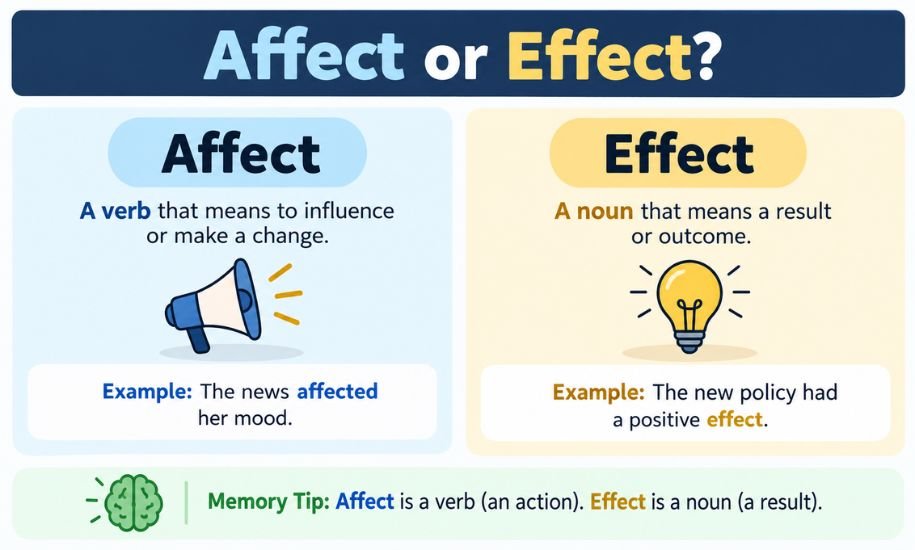
Have you ever wondered whether to write effect or affect in a sentence? These two words look and sound similar, which makes them easy to confuse, even for fluent English speakers. However, they have different meanings and grammatical functions. Affect is generally a verb that means to influence or change something, while effect is usually a noun that refers to a result or consequence. Understanding this simple distinction can help you avoid common writing mistakes, choose the correct word in everyday conversations, and improve your English grammar.
Quick Answer
Both affect and effect are correct English words, but they are used differently. Affect is usually a verb meaning to influence or change something, whereas effect is usually a noun meaning a result or outcome. For example, “Stress can affect your sleep” and “Stress can have an effect on your sleep.”
Effect or Affect: What’s the Difference?
The main difference between these words is their grammatical role. Affect generally describes an action or influence, while effect identifies the result of that influence.
| Feature | Affect | Effect |
|---|---|---|
| Common part of speech | Verb | Noun |
| Meaning | To influence or change | A result or consequence |
| Typical use | Describes an action | Describes an outcome |
| Example | Noise affects my concentration. | Noise has an effect on my concentration. |
| Memory tip | A for Action | E for End result |
For example, if heavy rain changes your travel plans, you can say, “The rain affected my journey.” If you want to describe the result, you can say, “The rain had an unexpected effect on my journey.”
Both sentences are grammatically correct. The right choice depends on whether you are describing the influence or its outcome.
What Does Affect Mean?
Affect is most commonly a verb meaning to influence, alter, or make a difference to someone or something. It is used when an action, event, or situation changes the condition, behaviour, feelings, or development of something else.
Examples of affect in sentences:
- Lack of sleep can affect your ability to concentrate.
- The sudden change in weather affected our outdoor plans.
- Her encouraging words affected his confidence.
- Rising prices affect household budgets.
- The teacher’s decision will affect the entire class.
In each sentence, affect describes an influence that produces or may produce a change.
Different forms of affect
Affect changes its form depending on the tense and grammatical structure of a sentence.
| Form | Example |
|---|---|
| Affect | Exercise can affect your mood. |
| Affects | Stress affects your performance. |
| Affected | The storm affected several towns. |
| Affecting | The new rules are affecting employees. |
Affect can also mean to pretend to have a particular feeling, manner, or quality, although this usage is less common.
For example:
- He affected an air of confidence during the meeting.
- The actor affected a cheerful expression.
In psychology, affect can also be a noun referring to a person’s observable emotional expression, as in “The patient displayed a flat affect.” This is a specialised use rather than the usual everyday meaning.
What Does Effect Mean?
Effect is generally a noun that refers to the result, outcome, or consequence of an action, event, or condition. It describes what happens because of something else.
Examples of effect in sentences:
- The new routine had a positive effect on my productivity.
- The medicine produced an unexpected effect.
- Regular exercise can have a beneficial effect on your health.
- The teacher’s advice had a lasting effect on her students.
- The storm had a serious effect on local businesses.
In these examples, effect identifies the result or impact of an event or action.
Different forms of effect
| Form | Example |
|---|---|
| Effect | The decision had an immediate effect. |
| Effects | The effects of pollution are widespread. |
| Effective | This is an effective solution. |
| Effectively | She effectively communicated her ideas. |
Although effect is usually a noun, it can also function as a verb meaning to bring about, accomplish, or make something happen.
For example:
- The organisation hopes to effect meaningful change.
- The new management effected several improvements.
- The government introduced reforms to effect long-term progress.
In formal writing, effect change means to bring about change, while affect change means to influence change that already exists.
Affect vs. Effect in a Sentence
Looking at both words in similar sentences is one of the easiest ways to understand their difference. The meaning often becomes clearer when the sentence structure changes.
| Affect (influence) | Effect (result) |
|---|---|
| The noise affected my sleep. | The noise had an effect on my sleep. |
| The news affected her mood. | The news had an emotional effect on her. |
| Poor diet affects your health. | Poor diet has an effect on your health. |
| The decision affected the employees. | The decision had an effect on the employees. |
| The weather affects traffic. | The weather has an effect on traffic. |
Here are a few more examples in everyday contexts:
At school:
- The difficult exam affected the students’ confidence.
- The difficult exam had a noticeable effect on their confidence.
At work:
- The new policy affects the company’s operations.
- The new policy has a significant effect on the company’s operations.
In daily life:
- Your attitude can affect your relationships.
- Your attitude can have a positive effect on your relationships.
The key is to identify whether the sentence needs a verb describing an influence or a noun describing a result.
Is It Side Effect or Side Affect?
The correct expression is side effect, not side affect, when referring to an additional or unintended result of a medicine, treatment, action, or event.
A side effect is something that happens in addition to the intended outcome. The phrase is particularly common in medical contexts, but it is also used in everyday situations.
Correct examples:
- Drowsiness is a possible side effect of this medicine.
- The treatment may cause temporary side effects.
- One side effect of the new schedule was increased stress.
- The decision had an unexpected side effect on the team.
Incorrect: The medication caused several side affects.
Correct: The medication caused several side effects.
The word effect is a noun here because it identifies the consequences of an action or treatment.
“I Have That Effect on Someone” or “Affect”?
The correct expression is “I have that effect on someone.” In this sentence, effect is a noun referring to the influence or impact one person has on another.
Examples include:
- I seem to have that effect on people.
- She has a calming effect on her friends.
- He has a positive effect on everyone around him.
- You have a wonderful effect on my mood.
The usual grammatical structure is have an effect on someone or something.
However, when describing the act of influencing another person, use affect instead.
- My words affect the way people think.
- Her behaviour affects everyone in the room.
- Does my attitude affect your feelings?
Both forms are correct in their respective contexts. Use effect after expressions such as “have an” when describing an impact, and affect when describing the act of influencing.
Why Are Affect and Effect Confused?
These words are confusing because they have similar spellings, similar pronunciations in many varieties of English, and closely related meanings.
Both are associated with influence, change, and consequences. As a result, it can be difficult to identify which one belongs in a sentence without considering its grammatical structure.
For example, “The news affected me” and “The news had an effect on me” express similar ideas. However, the first uses a verb, while the second uses a noun.
Another source of confusion is that both words have less common grammatical uses. Affect can be a noun in psychology, and effect can be a verb meaning to bring about a result.
Rather than relying entirely on memorisation, consider the meaning and role of the word in the sentence.
Easy Ways to Remember the Difference
A simple memory trick can make the distinction easier to recall when writing.
A
A is for Action — Affect
Use affect when something influences, changes, or acts upon something.
Example: The rain affects our plans.
E
E is for End result — Effect
Use effect when referring to the outcome or consequence of an action.
Example: The rain had an effect on our plans.
You can also use a substitution test:
- If influence fits naturally in the sentence, affect is probably correct.
- If result or consequence fits naturally, effect is probably correct.
This trick works for most everyday uses, although you should remember the less common exceptions.
Common Mistakes to Avoid
Even though the main rule is straightforward, some expressions are frequently written incorrectly.
| Incorrect | Correct | Reason |
|---|---|---|
| The weather had a negative affect on me. | The weather had a negative effect on me. | A noun is needed. |
| Stress can effect your sleep. | Stress can affect your sleep. | A verb meaning influence is needed. |
| The side affects were mild. | The side effects were mild. | The established phrase uses a noun. |
| Her words had a strong affect on him. | Her words had a strong effect on him. | The sentence describes an impact. |
| The new policy effected everyone. | The new policy affected everyone. | The intended meaning is influenced. |
One important exception is that “The new policy effected major changes” is correct if the policy brought about those changes. The intended meaning determines the appropriate word.
Effect or Affect Worksheet
Test your understanding by choosing the correct word for each sentence.
Choose the correct answer
0 / 5 completed
1. The loud music can ___ my concentration.affecteffect
2. The new medicine had a positive ___ on her health.affecteffect
3. The storm ___ several towns last night.affectedeffected
4. The organisation hopes to ___ meaningful change.affecteffect
5. The side ___ of the treatment were temporary.affectseffectsCheck Answers
Frequently Asked Questions
Is effect or affect correct?
Both are correct English words, but they have different usual meanings. Affect is generally a verb meaning to influence or change something. Effect is usually a noun referring to a result or consequence. The right choice depends on how the word functions in your sentence.
Is it “she has that effect” or “she has that affect”?
“She has that effect” is correct when describing the impact someone has on another person or situation. Effect is a noun in this expression. For example, “She has a positive effect on her colleagues.”
Can effect be used as a verb?
Yes. Effect can be a verb meaning to bring about or accomplish something. For example, “The new manager effected several changes.” This is different from affect, which generally means to influence something.
Can affect be a noun?
Yes. In psychology, affect is a noun referring to observable emotional expression. For example, “The patient displayed a flat affect.” This technical meaning differs from the more common verb meaning of affect.
Is it cause and effect or cause and affect?
The correct expression is cause and effect. It refers to the relationship between an event or action and the result it produces. Effect is a noun in this phrase, while affect is generally used as a verb.
How can I quickly remember the difference?
Remember A for Action and E for End result. Affect usually describes an action that influences something, while effect usually identifies the outcome. This simple rule works for most everyday writing, although both words have less common exceptions.
Final Verdict: Effect or Affect?
Both words are correct, but they are not interchangeable in most sentences. Use affect when you mean to influence or change something, and effect when you mean the result or consequence. Remembering the difference between an action and its outcome can help you use both words confidently. Grammarifyr makes these distinctions easier to understand so you can know the difference and use the right words in your everyday writing.
You may also Read : Paid or Payed: Meaning, Difference, and Examples