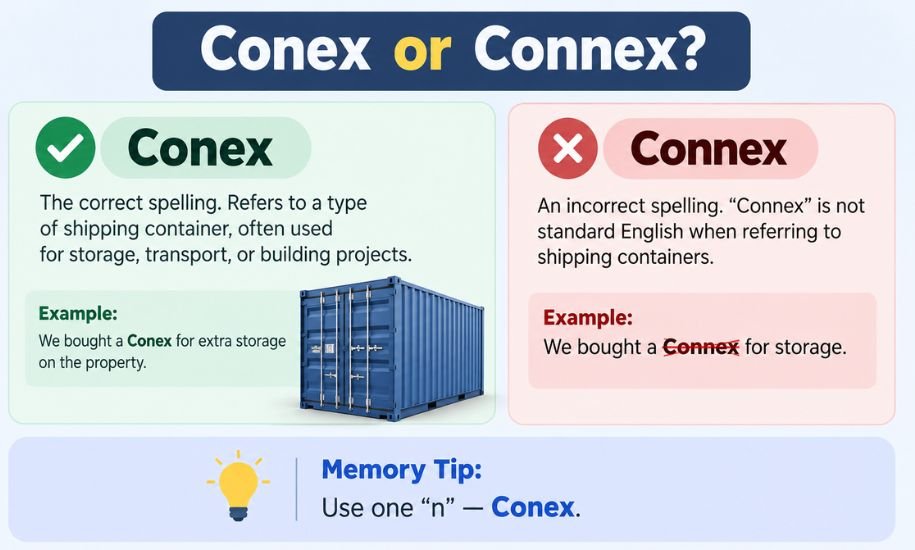
Conex or Connex: Meaning, Differences and Usage
When writing about shipping containers, storage units, or military cargo equipment, you may come across both Conex and Connex. The two spellings look almost identical and are often used to describe the same type of metal container. However, they have slightly different historical and linguistic backgrounds. Understanding their meanings can help you choose the appropriate spelling for your writing. The distinction is particularly useful when discussing military logistics, construction, shipping, or storage, where the term has a specific history.
Quick Answer
Both Conex and Connex are used to refer to shipping or storage containers, so neither is universally incorrect in this context. However, Conex is the historically established spelling derived from “Container Express,” a term associated with military cargo transportation. Connex is a recognized variant and may also appear in specialized usage or proper names.
Conex or Connex: What Is the Difference?
The main difference between Conex and Connex is their historical background and usage rather than their pronunciation or the type of container they describe.
Conex comes from “Container Express” and is associated with the military’s use of standardized cargo containers. Over time, the term became widely used for metal shipping and storage containers, particularly in the United States.
Connex is an alternative spelling that is also used for containers in some contexts. It may appear in informal writing, industry terminology, and company or product names. It can also have other specialized meanings unrelated to shipping.
| Feature | Conex | Connex |
|---|---|---|
| Correct spelling | Yes | Yes, in recognized contexts |
| Historical background | Derived from Container Express | Variant spelling and other specialized uses |
| Meaning | Military-style cargo or storage container | May refer to a cargo or storage container |
| Pronunciation | KON-eks | KON-eks |
| Common usage | Shipping, military, construction, storage | Container terminology, proper names and specialized usage |
| Plural | Conexes | Connexes |
| Formal writing | Established for the historical container term | Depends on the intended meaning |
If you are referring specifically to the historical military container, Conex is the appropriate spelling. For general writing about modern cargo equipment, shipping container or storage container may be clearer.
What Does Conex Mean?
Conex is a noun that refers to a metal cargo or storage container, particularly one associated with the military’s Container Express system. These containers were developed to make transporting, handling, and storing military supplies more efficient.
The term is derived from Container Express, commonly abbreviated as CONEX. Military forces used these containers to move equipment, ammunition, food, clothing, and other supplies while protecting them during transportation.
Today, the word is also used more broadly for sturdy steel containers used in commercial and residential settings.
Examples of Conex in sentences:
- The construction company placed a Conex on-site to store tools and building materials.
- The military transported essential supplies in a large Conex.
- We converted an old Conex into a temporary storage room.
- Several Conex boxes were delivered to the warehouse for additional storage.
In everyday American English, Conex box is a familiar expression for a robust metal storage container. The word may be used even when the container is not part of the original military system.
What Does Connex Mean?
Connex is an alternative spelling associated with cargo and storage containers. It is also found in specialized English usage and as a proper name for various businesses, services, and products.
When used to describe a container, it generally refers to the same kind of sturdy metal unit as Conex. The spelling does not automatically indicate a different size, construction material, or transportation purpose.
For example:
- The workers unloaded a connex at the storage facility.
- The company purchased two connex containers for its construction project.
- The military equipment was stored inside a connex box.
Connex can also appear in contexts unrelated to shipping. In some specialized or historical uses, it is connected with the idea of connection or association. Therefore, its meaning should be understood from the sentence in which it appears.
It is important not to assume that every occurrence of Connex refers to a shipping container, particularly when the word is capitalized as part of a brand or organization’s name.
Why Are Conex and Connex Confused?
The two spellings are easy to confuse because they have nearly identical appearances and are pronounced the same way when referring to containers.
There are several reasons for this overlap.
Similar pronunciation: Both words are generally pronounced KON-eks in the container context. When people hear the word spoken, they cannot easily determine which spelling is intended.
An additional letter: The only visible difference between the two forms is the extra n in Connex. This makes it easy to use one spelling in place of the other, particularly when writing from memory.
Overlapping meanings: Both forms are used in connection with cargo and storage containers. As a result, writers may encounter either spelling in product descriptions, industry documents, and informal conversations.
Specialized terminology: Conex has a historical military association, while Connex also occurs as a variant and in proper names. This can make it difficult to identify a single spelling that suits every context.
The best approach is to consider the intended meaning and use the spelling that matches the relevant technical document, organization, or writing convention.
Conex vs. Shipping Container: Are They the Same?
A Conex and a shipping container can refer to the same general kind of metal cargo unit in everyday conversation. However, the terms are not completely interchangeable in historical or technical writing.
A Conex traditionally refers to a military container associated with the Container Express system. A shipping container is a broader term for a container designed to transport goods by road, rail, or sea.
Modern shipping containers are commonly manufactured according to international standards, including specifications for dimensions, strength, and handling. The word Conex, on the other hand, is often used informally for steel containers used in storage, construction, and transportation.
| Conex | Shipping container |
|---|---|
| Historically associated with military logistics | Used in commercial and international freight |
| Often used as an informal storage-container term | A broad transportation term |
| Commonly found on construction sites and storage facilities | Commonly found at ports, warehouses, and freight terminals |
| May refer to military-style containers | May refer to standardized intermodal containers |
For example, a contractor might refer to a storage unit as a Conex, while a freight company may call a similar unit a shipping container. When technical precision matters, use the container’s actual type or specification.
What Is the Plural of Conex?
The plural of Conex is Conexes. You can also use Conex boxes when referring to multiple containers.
Both forms are grammatically acceptable, although Conex boxes can be more immediately understandable to readers unfamiliar with the term.
| Singular | Plural |
|---|---|
| Conex | Conexes |
| Conex box | Conex boxes |
| Connex | Connexes |
| Connex box | Connex boxes |
Examples:
- The company ordered four Conexes for its new warehouse.
- Several Conex boxes were placed near the construction site.
- The military stored equipment in multiple Conex containers.
- The supplier delivered three connexes to the industrial facility.
The regular plural ending -es is used because the word ends in x, following the same pattern as boxes, foxes, and taxes.
How Is Conex Used in Everyday Situations?
The term Conex has expanded beyond its original military association and is now used in several practical settings.
Construction and building
Conex containers are often used to store tools, machinery, building materials, and protective equipment on construction sites. They can also be modified into temporary offices or workspaces.
Military logistics
The term has historical military roots. Containerized systems help military organizations transport, store, and organize supplies and equipment.
Commercial storage
Businesses use metal containers to store inventory, tools, seasonal materials, and equipment. This is one reason the term is often used in commercial storage listings.
Container buildings
Some containers are converted into offices, workshops, temporary accommodation, and other modular structures. These projects may be described as Conex buildings or container buildings.
In these contexts, the word generally describes the container rather than a specific construction method or guaranteed technical specification.
Conex or Connex in Example Sentences
Seeing both spellings in context makes their usage easier to understand.
Using Conex:
- The supplier delivered a new Conex to the farm for equipment storage.
- A military Conex was used to transport supplies to the base.
- We need two Conex boxes to keep our construction materials secure.
- The warehouse has several Conexes available for temporary storage.
Using Connex:
- The contractor ordered a connex for the remote worksite.
- The equipment was kept inside a connex box during the project.
- Several connexes were arranged beside the industrial building.
Using a more general term:
- The shipping container was loaded onto the freight vessel.
- The company purchased a steel storage container for its machinery.
- The cargo container was inspected before transportation.
These examples show that either spelling may be encountered in container-related writing, while more general terms can avoid ambiguity.
Common Mistakes to Avoid
A few simple mistakes can make writing about these terms less precise.
- Assuming Connex is always incorrect: Connex is used as a variant in container-related contexts and can also be a proper name.
- Confusing a Conex with every type of shipping container: The historical military meaning is more specific than the broader modern term.
- Using the wrong plural: Use Conexes or Conex boxes, rather than Conexs.
- Treating capitalization as a spelling difference: CONEX is often capitalized when emphasizing the abbreviation, while Conex is common in ordinary prose.
- Ignoring technical context: In formal shipping or engineering documents, a precise container designation may be more useful than either informal term.
Frequently Asked Questions
1. Is Conex or Connex the correct spelling?
Both spellings are used in container-related contexts. Conex is the historically established spelling derived from Container Express, while Connex is a recognized variant. For historical military references, Conex is the appropriate choice.
2. What does Conex stand for?
Conex stands for Container Express. The name is associated with a military cargo-container system developed to simplify the transportation and storage of supplies. The term later became widely used for metal storage and shipping containers.
3. Is Connex a misspelling of Conex?
Not necessarily. Although Conex is the established historical spelling, Connex is also used as a variant for cargo or storage containers. It can also appear in company names and specialized terminology, so it should not automatically be treated as a spelling error.
4. What is the plural of Conex?
The plural of Conex is Conexes. You can also say Conex boxes when referring to multiple storage or cargo containers. Both constructions are understandable, but the latter may be clearer for general readers.
5. Is a Conex box the same as a shipping container?
In everyday usage, the terms can describe similar steel containers. Historically, however, Conex refers to a military container system, whereas shipping container is a broad term for containers used to transport cargo across different modes of transportation.
6. Can I use Connex in formal writing?
You can use Connex when it is the correct spelling for a particular name, source, or accepted terminology. In historical writing about the Container Express system, Conex is preferable. For general professional communication, shipping container is often the clearest choice.
Final Verdict: Conex or Connex?
Both Conex and Connex are used in connection with cargo and storage containers, but they have different historical backgrounds. Conex is the established spelling associated with Container Express and military logistics, while Connex is a recognized variant used in some contexts and proper names.
If you are unsure which term to use, choose Conex for the historical military container and shipping container for general cargo transportation. Understanding these distinctions is part of using the right words, which is exactly what Grammarifyr aims to help readers achieve.
You may also Read : Shinning or Shining: Correct Usage Explained