Connotation vs Denotation: Differences and Examples
Words can have more than one layer of meaning. Some communicate a straightforward definition, while others also create feelings, impressions, or associations. This is where connotation and denotation come in. Although both terms describe aspects of a word’s meaning, they serve different purposes. Understanding the distinction can help you choose more appropriate words, interpret literature, and communicate clearly. For example, home and residence can refer to the same place, but they may create different impressions. Learning how these meanings work makes reading and writing more precise.
Connotation vs Denotation: Key Differences
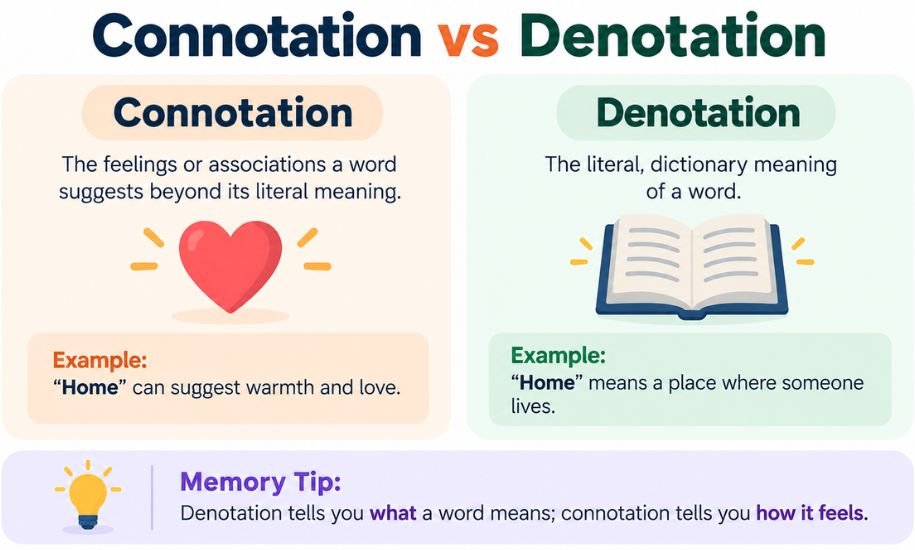
The main difference is that denotation explains what a word directly means, whereas connotation explains what it suggests beyond that definition. Both can influence how a sentence is understood.
| Feature | Denotation | Connotation |
|---|---|---|
| Meaning | Literal or dictionary meaning | Associated or implied meaning |
| Nature | Generally objective | Often subjective |
| Focus | What a word refers to | What a word suggests |
| Influence | Dictionary definition and context | Culture, emotions, and experience |
| Consistency | Usually relatively stable | Can vary between people |
| Types | Literal meanings | Positive, negative, or neutral |
| Example | Home: a place to live | Home: comfort and belonging |
| Common use | Definitions and factual writing | Literature and expressive writing |
For instance, snake denotes a legless reptile. However, when someone calls another person a snake, the word may carry a negative connotation of dishonesty or betrayal.
What Is Denotation?
Denotation is the direct, literal meaning of a word. It is the meaning you would typically find in a dictionary, without adding personal feelings or emotional associations.
For example, the denotation of rose is a flowering plant belonging to the genus Rosa. Its literal definition does not automatically include feelings of love or romance.
Denotation is particularly useful when clarity and accuracy are important. It helps readers understand exactly what a writer is referring to.
Examples of denotation:
- Book: A set of written or printed pages bound together.
- Ocean: A large body of salt water.
- Child: A young human being.
- Residence: A place where someone lives.
- Brave: Showing courage when facing danger or difficulty.
Denotation in sentences:
- The child was reading a book in the library.
- The boat travelled across the ocean.
- Their residence is located near the school.
In each sentence, the words communicate their direct meanings without requiring the reader to interpret an additional emotional message.
What Is Connotation?
Connotation is the emotional, cultural, or social meaning associated with a word beyond its literal definition. It can influence how readers feel about a person, place, object, or situation.
For example, childlike and childish both relate to the qualities of a child. However, childlike often suggests innocence, curiosity, and wonder, while childish commonly suggests immaturity or irresponsible behaviour.
Connotations can be influenced by personal experiences, cultural background, context, and the way a word is used.
Examples of connotation:
- Home: Comfort, family, safety, and belonging.
- Snake: Betrayal, dishonesty, or danger when used figuratively.
- Rose: Love, romance, and beauty.
- Youthful: Energy, freshness, and vitality.
- Stubborn: Inflexibility or, in some contexts, determination.
Connotation in sentences:
- After a difficult journey, she was happy to return home.
- Everyone was surprised by his childish reaction.
- The garden was filled with beautiful roses that reminded her of romance.
The additional associations help create a particular impression rather than simply identifying something.
Positive, Negative, and Neutral Connotations
Connotations are often grouped into three categories according to the feelings or impressions a word may create.
1. Positive Connotation
A positive connotation creates favourable or pleasant associations. These words may communicate admiration, affection, encouragement, or approval.
Examples include:
- Confident: Suggests self-assurance and belief in one’s abilities.
- Frugal: Suggests sensible spending and financial responsibility.
- Courageous: Suggests bravery and strength.
- Youthful: Often suggests energy and freshness.
Example: She is a frugal shopper who carefully manages her money.
Here, frugal presents careful spending as a positive quality.
2. Negative Connotation
A negative connotation creates unfavourable associations. Such words may express criticism, disapproval, or unpleasant impressions.
Examples include:
- Stingy: Suggests unwillingness to spend or share.
- Childish: Suggests immaturity.
- Scrawny: May suggest excessive thinness or weakness.
- Arrogant: Suggests an exaggerated sense of importance.
Example: His arrogant behaviour made it difficult for his colleagues to work with him.
The word arrogant communicates a negative attitude towards the person’s behaviour.
3. Neutral Connotation
A neutral connotation is relatively free from strong positive or negative associations in a particular context. Neutral words are often useful for objective explanations.
Examples include:
- Residence: A place where someone lives.
- Child: A young person.
- Thin: Having relatively little thickness or body fat, depending on context.
- Economical: Using resources efficiently.
Example: The family moved to a new residence last month.
The word residence provides a straightforward description without necessarily suggesting warmth or criticism.
It is worth remembering that these categories are not always fixed. A word’s connotation may change according to the sentence, audience, and situation.
Connotation vs Denotation Examples
The following examples show how a word’s literal meaning can differ from the impression it creates.
| Word | Denotation | Possible connotation |
|---|---|---|
| Home | A place where someone lives | Comfort and belonging |
| Snake | A legless reptile | Betrayal or danger |
| Rose | A flowering plant | Romance and beauty |
| Cheap | Low in price | Poor quality or stinginess |
| Frugal | Economical with money | Sensible and responsible |
| Childish | Characteristic of a child | Immaturity |
| Childlike | Having qualities of a child | Innocence and curiosity |
| Slender | Gracefully or attractively thin | Elegance |
| Scrawny | Very thin | Weakness |
| Stubborn | Unwilling to change an opinion | Inflexibility or determination |
Five Examples in Sentences
1. Cheap vs Frugal
Both words can relate to spending less money, but they can create different impressions.
- Cheap: The company purchased cheap materials that broke easily.
- Frugal: She is frugal and always compares prices before buying anything.
Cheap can imply low quality, while frugal often suggests careful financial management.
2. Home vs Residence
Both words can refer to a place where a person lives.
- Home: The children were excited to return home after their holiday.
- Residence: The official’s residence is situated outside the city.
Home can evoke emotional connections, while residence is generally more formal and descriptive.
3. Slim vs Skinny
Both words can describe a thin body shape.
- Slim: He looked slim and elegant in his new suit.
- Skinny: The abandoned kitten was skinny and needed proper care.
Slim often has a favourable association, whereas skinny can suggest unhealthy thinness in certain contexts.
4. Childlike vs Childish
Both words describe qualities associated with children.
- Childlike: Her childlike curiosity encouraged her to explore new ideas.
- Childish: His childish argument made the disagreement worse.
Childlike often suggests positive qualities, while childish is frequently used critically.
5. Confident vs Arrogant
Both words relate to how someone views their abilities.
- Confident: She was confident about delivering her presentation.
- Arrogant: His arrogant attitude upset the other team members.
Confident usually expresses healthy self-belief, while arrogant suggests an inflated sense of superiority.
Why Are Connotation and Denotation Important?
Understanding both concepts helps readers recognise not only what a sentence says but also what it implies.
In everyday communication: Choosing between inexpensive and cheap can influence how a product is perceived, even when both describe a low price.
In academic writing: Denotation helps writers explain ideas accurately. Clear, literal language is particularly useful in definitions, research, and technical explanations.
In literature: Authors use connotations to create atmosphere, communicate emotions, develop characters, and add depth to descriptions.
In advertising: Words with favourable associations can shape how consumers perceive a product or brand.
In reading comprehension: Recognising connotation helps readers understand a writer’s tone, attitude, and intended message.
These concepts are also useful when reviewing your own writing. A sentence may be grammatically correct but still communicate an unintended impression because of its word choice.
How to Identify Connotation and Denotation
You can distinguish the two by asking yourself a few simple questions.
- What does the word literally mean? Check its direct definition. This is its denotation.
- What does the word suggest? Consider the emotions, attitudes, or associations it creates. This is its connotation.
- How is the word used in the sentence? Look at the surrounding words and the situation.
- Could another word create a different impression? Compare similar words to understand the effect of word choice.
For example, consider the sentence: The old house stood alone on the hill.
The denotation of old refers to something that has existed for a long time. Depending on the context, old may connote history, nostalgia, neglect, or decay. The surrounding description helps readers decide which impression the writer intends.
Common Mistakes to Avoid
- Treating connotation as the dictionary definition: Connotation refers to associations, not the direct meaning of a word.
- Assuming every word has a fixed emotional meaning: Associations can differ between individuals and cultures.
- Confusing connotation with figurative language: Connotation is an associated meaning, while figurative language uses expressions beyond their literal meanings.
- Assuming neutral words have no associations: Even relatively neutral words can create impressions in specific contexts.
- Ignoring context: A word’s intended meaning and emotional effect often become clearer when you consider the full sentence.
Connotation vs Annotation: What Is the Difference?
Connotation and annotation look similar, but they have entirely different meanings.
Connotation refers to the ideas, feelings, or associations connected to a word beyond its literal meaning.
Annotation is a note, comment, or explanation added to a text, document, or image to provide additional information.
For example, rose may connote love and romance. An annotation in a poem may explain why the poet uses a rose as a symbol of love in a particular passage.
Frequently Asked Questions
1. What is the main difference between connotation and denotation?
Denotation is the literal or dictionary meaning of a word, while connotation is the additional feeling, idea, or association connected to it. For example, snake denotes a reptile but can connote betrayal when used to describe a dishonest person.
2. Can a word have both connotation and denotation?
Yes. Most words have a denotation, and many also carry connotations. For example, rose denotes a flowering plant and may connote love, romance, or beauty. The literal and associated meanings work together to shape how readers understand the word.
3. What are five examples of connotation and denotation?
Home denotes a place to live and may connote comfort. Snake denotes a reptile and may connote betrayal. Rose denotes a flowering plant and may connote romance. Frugal denotes economical spending and may connote responsibility. Childish denotes childlike behaviour and often connotes immaturity.
4. What are the three types of connotation?
The three commonly taught types are positive, negative, and neutral. Positive connotations suggest favourable feelings, negative connotations suggest unfavourable feelings, and neutral connotations carry relatively little emotional judgement in a given context.
5. Why are connotation and denotation important in writing?
They help writers communicate precise meanings while controlling tone and emotional impact. Denotation supports clarity, while connotation helps create atmosphere, express attitudes, and influence how readers interpret a message.
6. Is connotation the same as figurative meaning?
No. Connotation refers to the associations or impressions connected to a word. Figurative meaning involves language used beyond its literal sense, such as metaphors and idioms. They can overlap, but they are not the same concept.
The Bottom Line
Denotation tells you what a word literally means, while connotation helps you understand what it suggests or makes you feel. Both are essential for interpreting language accurately, selecting appropriate vocabulary, and understanding the intended tone of a message. With clear examples and practical explanations, Grammarifyr helps readers understand these differences and choose the right words with confidence.
You may also Read : Simile vs Metaphor: Meaning, Uses, and Examples