Simile vs Metaphor: Meaning, Uses, and Examples
Similes and metaphors are two common figures of speech that make writing more expressive, descriptive, and interesting. Although both compare two different things to highlight a shared quality, they do so in different ways. A simile uses words such as like or as to make a comparison, while a metaphor directly describes one thing as another. Understanding the difference between these literary devices can help you interpret poetry, improve your writing, and communicate ideas more clearly. With simple explanations, practical examples, and a few easy tricks, distinguishing between them becomes much easier.
Quick Answer
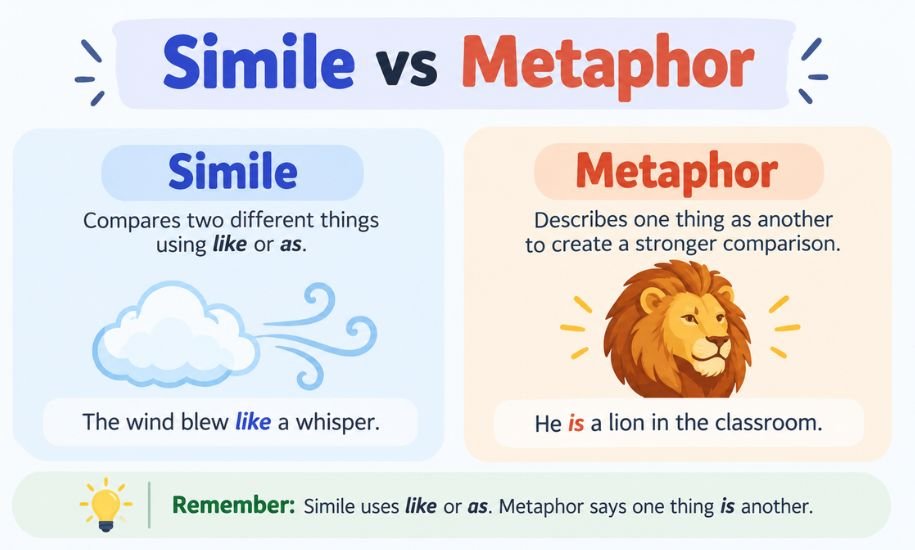
A simile compares two different things using like or as, such as “Her smile is like sunshine.” A metaphor makes a direct comparison without using these words, such as “Her smile is sunshine.” Both are figures of speech used to create vivid images and express ideas in a creative way.
What Is the Difference Between a Simile and a Metaphor?
The main difference is how the comparison is expressed. A simile clearly signals that two things are similar, whereas a metaphor presents one thing as another to suggest a connection between them.
For example:
- Simile: The classroom was as busy as a beehive.
- Metaphor: The classroom was a beehive.
Both sentences describe a noisy, active classroom. The simile uses as to make the comparison explicit, while the metaphor directly identifies the classroom with a beehive in a figurative sense.
Quick comparison
| Feature | Simile | Metaphor |
|---|---|---|
| Meaning | Compares two different things | Directly compares two different things |
| Common words | Like, as | Often is, are, was, were |
| Style | Explicit comparison | Direct or implied comparison |
| Purpose | Highlights a similarity | Creates a vivid or symbolic connection |
| Example | He is as brave as a lion. | He is a lion. |
Both devices belong to figurative language because their meanings are not usually intended to be taken literally. They help readers imagine qualities, emotions, situations, and experiences in a more memorable way.
What Is a Simile?
A simile is a figure of speech that compares two unlike things using like or as. It draws attention to a particular similarity, such as appearance, behaviour, speed, strength, or emotion.
Similes are especially useful when a writer wants readers to picture something unfamiliar by connecting it to something they already understand.
Examples of similes:
- Her eyes sparkled like diamonds.
- The baby slept as peacefully as a kitten.
- He was as stubborn as a mule.
- The wind blew like a roaring train.
- The water was as clear as glass.
In the sentence “Her eyes sparkled like diamonds,” the writer does not mean that her eyes are actual diamonds. The comparison highlights their brightness and sparkle.
Similes are frequently used in everyday conversations, stories, poetry, and descriptive writing. They can make an ordinary sentence more colourful without changing its basic meaning.
What Is a Metaphor?
A metaphor is a figure of speech that describes one thing as another to suggest a shared characteristic, quality, or relationship. Unlike a simile, it does not explicitly use like or as to establish the comparison.
Metaphors can make writing more imaginative by allowing readers to interpret the meaning behind a direct comparison.
Examples of metaphors:
- Time is a thief.
- Her voice is music to my ears.
- The classroom was a zoo.
- My father is my rock.
- His words were daggers.
In “Time is a thief,” time is not literally stealing anything. The metaphor suggests that time takes away opportunities and moments that cannot be recovered.
Metaphors are common in literature, speeches, conversations, and creative writing. They can communicate complex emotions or abstract ideas in a concise and powerful way.
Simile vs Metaphor Examples in Sentences
One of the easiest ways to understand these literary devices is to compare them side by side. The following examples show how a similar idea can be expressed using either a simile or a metaphor.
| Simile | Metaphor |
|---|---|
| Her smile was like sunshine. | Her smile was sunshine. |
| He fought like a lion. | He was a lion in battle. |
| The snow was as white as cotton. | The snow was a white blanket. |
| My brother eats like a horse. | My brother is a hungry machine. |
| The news spread like wildfire. | The news was wildfire. |
| Her hair flowed like a golden river. | Her hair was a golden river. |
| His words cut like a knife. | His words were knives. |
| The night was as dark as coal. | The night was a blanket of darkness. |
In each pair, the comparison creates a similar image, but the structure changes. Similes make the resemblance explicit, while metaphors invite readers to understand the connection more imaginatively.
Not every metaphor has to be a simple replacement of like or as with is. Some metaphors are implied or use other grammatical structures, such as “She carried a mountain of worries.”
Simile vs Metaphor vs Analogy
A simile and a metaphor both make comparisons, but an analogy takes the comparison a step further by explaining how two things are alike. It is often used to make a complicated idea easier to understand.
| Literary device | Example | Purpose |
|---|---|---|
| Simile | Learning is like climbing a mountain. | Makes a direct comparison |
| Metaphor | Learning is a journey. | Creates a figurative connection |
| Analogy | Learning is like climbing a mountain because both require effort, patience, and steady progress. | Explains a similarity in greater detail |
An analogy may use a simile or a metaphor as part of its explanation. However, its main purpose is to clarify an idea or relationship rather than simply create imagery.
Simile vs Metaphor vs Personification
Personification is another literary device that is sometimes confused with similes and metaphors. It gives human qualities, emotions, or actions to animals, objects, or abstract ideas.
| Device | Example | Explanation |
|---|---|---|
| Simile | The wind howled like a wolf. | Compares the wind to a wolf using like. |
| Metaphor | The wind was a wild wolf. | Directly compares the wind to a wolf. |
| Personification | The wind whispered through the trees. | Gives the wind the human action of whispering. |
Personification can also appear alongside a simile or metaphor in the same sentence. For example, “The angry wind roared like a lion” uses personification to describe the wind as angry and a simile to compare its sound to a lion’s roar.
Simile vs Metaphor vs Alliteration
Alliteration differs from these two comparison techniques because it focuses on sound rather than meaning. It involves repeating the same or similar initial consonant sounds in nearby words.
- Simile: The stars glittered like diamonds.
- Metaphor: The stars were diamonds in the sky.
- Alliteration: Silver stars softly shimmered.
Writers use alliteration to create rhythm, emphasize words, and make phrases more memorable. Similes and metaphors, on the other hand, help readers visualize ideas through comparisons.
Funny Simile vs Metaphor Examples
Funny comparisons can make writing more entertaining and help readers remember how these figures of speech work. They are particularly useful in creative writing, storytelling, and informal conversations.
Funny similes
- He was as confused as a penguin in a desert.
- My phone battery disappeared like magic.
- She ran like a chicken escaping a thunderstorm.
- My brother eats like a vacuum cleaner.
- He was as stubborn as a mule arguing with a wall.
Funny metaphors
- My bedroom is a disaster zone.
- My little brother is a walking alarm clock.
- This homework is a mountain.
- My stomach is a bottomless pit.
- That exam was a monster.
The humour comes from making unexpected comparisons. A simile uses an explicit connection, while a metaphor turns the comparison into a direct figurative statement.
How to Identify a Simile or Metaphor
Identifying these devices becomes easier when you focus on how a sentence communicates its comparison.
- Look for comparison words: Check whether the sentence uses like or as to compare two different things. If it does, it may be a simile.
- Check for a direct comparison: If one thing is described as another in a nonliteral sense, it is likely a metaphor.
- Consider the intended meaning: Ask whether the sentence is meant literally or whether it suggests a shared quality.
- Look at the context: Words such as like and as do not automatically indicate a simile. For example, “She likes music” is a literal statement, not a comparison.
A simple way to remember
- Simile: Something is like something else.
- Metaphor: Something is something else in a figurative sense.
For example, “His mind is like a computer” is a simile, while “His mind is a computer” is a metaphor.
Common Mistakes to Avoid
Understanding the difference also means recognizing a few common errors.
- Treating every sentence with like as a simile: “I like reading” does not compare two things.
- Assuming every use of is creates a metaphor: “The garden is beautiful” is a literal description.
- Confusing personification with metaphor: Personification specifically gives human traits or actions to nonhuman things.
- Taking figurative language literally: “She has a heart of stone” describes someone as emotionally unkind or unfeeling, not as having a literal stone heart.
- Thinking similes are always more descriptive: Both devices can create detailed imagery. Their effect depends on the context and the writer’s intention.
Recognizing the intended meaning is just as important as identifying the grammatical structure.
Frequently Asked Questions
1. What are similes and metaphors called?
Similes and metaphors are called figures of speech and are forms of figurative language. They help writers express ideas beyond their literal meanings by making comparisons that communicate emotions, qualities, and experiences.
2. Is “Her eyes are like stars” a simile or a metaphor?
“Her eyes are like stars” is a simile because it uses like to compare her eyes with stars. The comparison suggests that her eyes are bright, sparkling, or beautiful.
3. Is “Time is money” a simile or a metaphor?
“Time is money” is a metaphor. It directly compares time with money to suggest that time is valuable and should be used carefully. It does not mean that time and money are literally the same thing.
4. Can a sentence have both a simile and a metaphor?
Yes. A sentence or passage can contain multiple figures of speech. For example, “Her voice was music, flowing like a gentle river” uses a metaphor to describe her voice and a simile to compare the way it sounds or flows.
5. Which is easier to understand, a simile or a metaphor?
It depends on the comparison. Similes often make the connection more explicit by using like or as, which can help readers recognize the comparison. Metaphors can be just as clear, although some require more interpretation.
6. How can students practise identifying these figures of speech?
Students can practise by reading sentences and deciding whether each one makes a literal statement, an explicit comparison, or a direct figurative comparison. Worksheets, creative writing exercises, and examples from poems or stories can help reinforce the difference.
The Bottom Line
The difference comes down to how a comparison is made. A simile uses like or as to show that two things share a quality, while a metaphor describes one thing as another to create a figurative connection. Both can make writing more engaging, expressive, and memorable. Learning to recognize and use them correctly can strengthen your communication skills, and Grammarifyr makes understanding these language differences easier through clear explanations and practical examples.
You may also Read : Beginning or Begining: Meaning, Rules and Examples