Journies or Journeys: Correct Spelling Explained
If you are unsure whether the plural of journey is journies or journeys, the answer is straightforward: journeys is the correct spelling. The form journies is a common spelling mistake, usually caused by applying the plural rule for words such as city or story to journey. Once you know what comes before the final y, the correct form becomes much easier to remember.
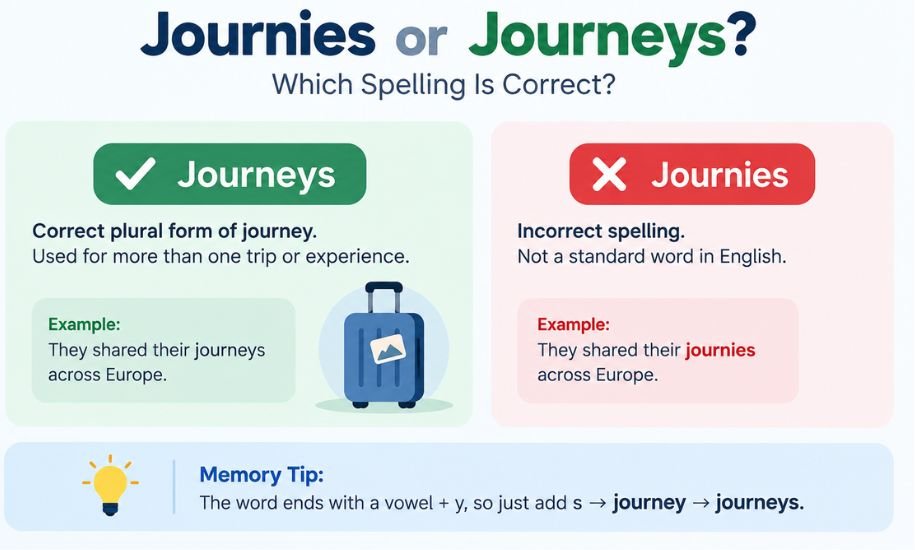
Journeys is the correct plural spelling of journey. Journies is a misspelling and should not be used in standard English. Because the final y in journey follows a vowel, you simply add -s: journey → journeys.
Journeys or Journies: Which Is Correct?
The correct form is journeys.
| Form | Correct? | Use |
|---|---|---|
| journey | ✅ Yes | Singular noun or base verb |
| journeys | ✅ Yes | Plural noun or third-person singular verb |
| journies | ❌ No | Misspelling |
So, if you are writing about more than one trip, experience, or progression, use journeys.
Example:
Their journeys took them across several countries.
Not:
Their journies took them across several countries. ❌
The same spelling applies whether journeys refers to physical travel or a figurative process, such as a career or personal journey.
What Does “Journey” Mean?
A journey is generally a trip or period of travel from one place to another. It can also describe a longer process of development, change, or experience.
For example:
- The journey from Madrid to Lisbon took several hours.
- We had a difficult journey through the mountains.
- Starting a new career can be an exciting journey.
- Her journey toward becoming a writer took many years.
The word is a noun in these examples.
The verb journey is also possible. It means to travel or move from one place to another.
For example:
She journeys through remote villages as part of her work.
In this verb form, journeys is also correct because it is the third-person singular present form: she journeys, he journeys, or it journeys.
Why Is “Journies” Incorrect?
The confusion comes from a real English spelling rule involving words ending in y.
When a noun ends in a consonant + y, the plural commonly changes y to i and adds -es:
- city → cities
- story → stories
- country → countries
- party → parties
That may make journey → journies look logical.
However, journey does not end in a consonant followed by y. The letter immediately before the y is e, which is a vowel:
journe + y
When a word ends in a vowel + y, the usual plural formation is to keep the y and add s:
- boy → boys
- key → keys
- day → days
- toy → toys
- journey → journeys
Therefore:
journey + s = journeys
Not:
journey → journies
Journey or Journeys: What’s the Difference?
The distinction between journey and journeys is simply singular versus plural when the word is used as a noun.
Use journey when referring to one journey:
The journey was longer than expected.
Use journeys when referring to two or more:
Their journeys were longer than expected.
This is the same basic distinction found in many regular nouns:
- journey → journeys
- book → books
- road → roads
- trip → trips
The plural form does not require changing the final y.
As a verb
Journeys can also be a verb:
He journeys across the country each summer.
Here, journeys is not plural. It is the present-tense form used with a singular third-person subject.
So the meaning of journeys depends on context:
- Noun: Several journeys were planned.
- Verb: She journeys through the region every year.
How to Spell Journeys Correctly
If you are wondering how to spell journeys, remember this simple pattern:
journey + s = journeys
The y stays in place.
A useful comparison is:
- key → keys
- boy → boys
- journey → journeys
All three words have a vowel before the final y, so the plural is formed by adding s.
Compare that with:
- city → cities
- baby → babies
- family → families
In those words, the y follows a consonant, so the spelling changes to -ies.
An easy rule
Consonant + y → usually change y to ies
Vowel + y → usually keep y and add s
Since journey has e + y, the correct plural is journeys.
Examples of Correct Usage
Here are several natural examples showing how the word works:
- The travelers shared stories about their journeys.
- Her journeys across Asia changed the way she viewed the world.
- We planned three separate journeys for the summer.
- Their personal journeys inspired the documentary.
- Learning a new language can be one of the most rewarding journeys in life.
- He journeys through the countryside whenever he has time.
Notice that journeys can describe physical trips as well as figurative experiences.
Correct vs. Incorrect
Correct:
The children wrote about their journeys.
Incorrect:
The children wrote about their journies.
Correct:
She has taken several journeys by train.
Incorrect:
She has taken several journies by train.
Correct:
His career journeys were full of unexpected opportunities.
Incorrect:
His career journies were full of unexpected opportunities.
Is “Journies” a Real Word?
No. Journies is not the standard plural spelling of journey. In ordinary English writing, it should be treated as a misspelling.
It is easy to produce because English has many words where a final y changes to -ies in the plural. But that pattern does not apply to journey because the y is preceded by the vowel e.
If you see journies in an email, essay, article, or other piece of writing, the intended word is almost certainly journeys.
Why Do People Write “Journies”?
The most likely reason is confusion with words such as cities, stories, and families.
A writer may remember a general rule that says:
“Words ending in y change to -ies in the plural.”
But that rule is incomplete. The letter before the final y matters.
Compare:
- city → cities because y follows t, a consonant.
- story → stories because y follows r, a consonant.
- journey → journeys because y follows e, a vowel.
This small distinction explains the spelling without requiring you to memorize journeys as an isolated exception.
Common Mistakes to Avoid
1. Changing every final “y” to “ies”
Not every word ending in y follows the same plural pattern.
Incorrect: journey → journies
Correct: journey → journeys
2. Confusing the plural with a different word
Journeys is simply the plural of journey when used as a noun. There is no separate standard word journies with a different meaning.
3. Using “journeys” when only one journey is meant
Although the spelling is correct, the number still matters.
One journey was exhausting.
Several journeys were exhausting.
4. Forgetting that “journeys” can also be a verb
In a sentence such as:
She journeys across the country each year.
Journeys is a verb, not a plural noun.
A Simple Way to Remember the Spelling
Use the vowel + y rule.
Think:
journey → journeys
The e before the y tells you to leave the y alone and simply add s.
You can remember it alongside:
- day → days
- key → keys
- toy → toys
- journey → journeys
If the letter before y is a consonant, then the plural may use -ies:
- city → cities
- story → stories
- country → countries
This makes journeys much easier to remember.
Frequently Asked Questions
Is it journeys or journies?
Journeys is correct. Journies is a misspelling. The plural is formed by keeping the final y and adding s because the y follows the vowel e.
What is the plural of journey?
The plural of journey is journeys. For example: “They went on several journeys during the year.”
Is “journies” ever correct?
No, not in standard English. Journies is an incorrect spelling of journeys, whether you are using the word in formal or informal writing.
Why is journey pluralized as journeys instead of journies?
Because the final y in journey follows a vowel. Words ending in a vowel + y generally keep the y when forming the plural and add s.
Can “journeys” be a verb?
Yes. Journeys can be the third-person singular present form of the verb journey. For example: “He journeys across the region every spring.”
How can I remember the correct spelling?
Remember journey + s = journeys. The y stays because it follows the vowel e. Comparing it with key → keys can also help.
Final Verdict: Journies or Journeys?
When choosing between journies or journeys, always use journeys. The word journey becomes journeys in the plural because its final y follows a vowel. Journies is simply a misspelling, not an alternative form. For more straightforward explanations of confusing English words and spelling choices, Grammarifyr helps you know the difference and use the right words.
You may also Read : Bougie or Boujee: Meaning and Correct Usage