Sometime vs Some Time: Meaning, Difference and Examples
Have you ever wondered whether to write sometime or some time? Although these expressions look almost identical, the space between them changes their meaning and grammatical function. Both are correct in English, but they are used in different situations. One refers to an unspecified point in time, while the other describes a period or amount of time. Understanding this small difference can help you avoid common grammar mistakes and make your writing clearer. With a few simple rules and examples, choosing the right expression becomes much easier.
Quick Answer
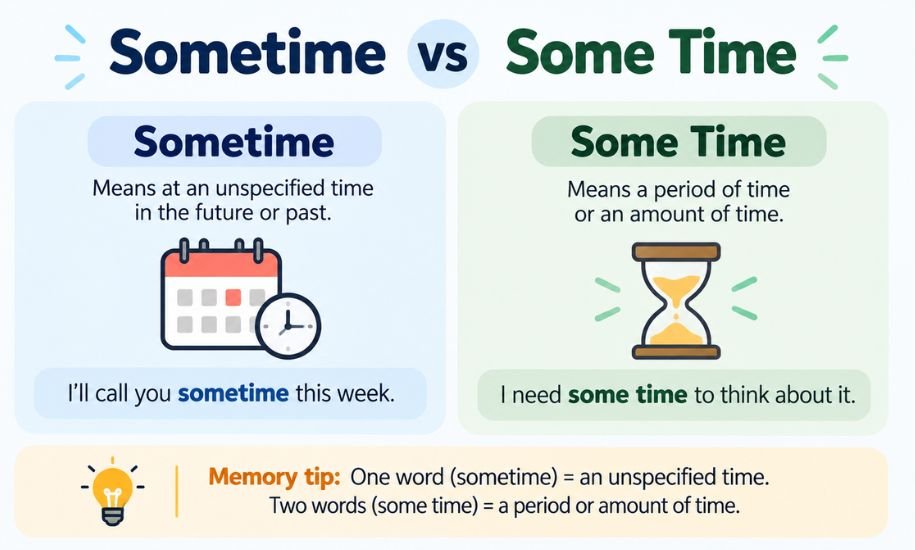
Both sometime and some time are correct, but they have different meanings. Sometime refers to an unspecified moment in the past or future, as in “Let’s meet sometime next week.” Some time refers to a period or amount of time, as in “I need some time to finish my work.”
Sometime vs Some Time: What’s the Difference?
The main difference is that sometime tells you when something happens, whereas some time tells you how long something takes or how much time is needed.
| Feature | Sometime | Some time |
|---|---|---|
| Meaning | An unspecified point in time | An unspecified period of time |
| Part of speech | Usually an adverb | Determiner + noun |
| Main purpose | Indicates when | Indicates duration or amount |
| Typical use | Past or future events | Time needed or spent |
| Synonyms | At some point, someday | A while, a period of time |
| Example | Call me sometime tomorrow. | Give me some time to decide. |
For example, “We should travel sometime this year” means that the trip can happen at an unspecified point during the year. However, “We should spend some time travelling this year” means that a period of the year will be devoted to travelling.
Both expressions are accepted in standard English. The correct choice depends on the meaning you want to communicate.
What Does Sometime Mean?
Sometime is an adverb that refers to an unspecified or unknown point in time. It is commonly used when the exact date, day or moment of an event is not known, has not been decided or is not important.
It can refer to events in the past or future, making it useful in everyday conversations, emails and written communication.
Examples of sometime in sentences:
- We should arrange a meeting sometime next week.
- She moved to London sometime in 2022.
- I will call you sometime this evening.
- They are planning to visit their relatives sometime next summer.
In each sentence, the word identifies an approximate or unspecified point when an event will happen or happened. It does not describe the length of the event.
Sometime as an Adjective
In addition to its use as an adverb, sometime can also be an adjective meaning former or previous. This usage is more formal and less common in everyday English.
Examples:
- The sometime manager returned to the company as a consultant.
- She met her sometime business partner at the conference.
In these sentences, sometime describes a person who previously held a particular role or relationship.
What Does Some Time Mean?
Some time is a two-word phrase made up of the determiner some and the noun time. It refers to an unspecified amount or period of time. It is often used when talking about how long an activity takes, how much time someone needs or how long something has continued.
Unlike sometime, this expression focuses on duration rather than a particular moment.
Examples of some time in sentences:
- I need some time to prepare for the interview.
- It took us some time to understand the new rules.
- She spent some time reading in the garden.
- We have been waiting for some time.
Here, the phrase describes a period of time without specifying its exact length.
In many contexts, some time can be replaced with a while without changing the essential meaning.
For example:
- Original: I need some time to think.
- Alternative: I need a while to think.
This substitution can be a helpful way to determine whether the two-word phrase is appropriate.
Sometime vs Some Time Examples in Everyday English
Seeing the expressions in similar situations makes their difference easier to understand.
SIDE-BY-SIDE EXAMPLES
Sometime
Let’s have dinner sometime this week.
The dinner will happen at an unspecified point during the week.
Some time
Let’s spend some time preparing dinner.
A period of time will be spent preparing the meal.
Sometime
He started working here sometime last year.
The exact date he started is unknown or unimportant.
Some time
He has worked here for some time.
He has been working here for an unspecified period.
Sometime
We will discuss the plan sometime tomorrow.
The discussion will take place at an unspecified moment tomorrow.
Some time
We need some time to discuss the plan.
The discussion requires a period of time.
These examples show that the expressions are not interchangeable, even when they appear in otherwise similar sentences.
Sometime or Some Time This Week?
Both forms can be used with this week, but they communicate different meanings.
Use sometime this week when referring to an unspecified point during the week. It is particularly natural when arranging appointments, making plans or discussing future events.
Examples:
- Can we meet sometime this week?
- I will send you the documents sometime this week.
- She hopes to visit us sometime this week.
Use some time this week when referring to a period of time that someone needs, plans to allocate or intends to spend on an activity.
Examples:
- I need some time this week to complete the assignment.
- We should set aside some time this week for training.
- He plans to spend some time this week reviewing his notes.
The easiest way to decide is to consider whether you are talking about the timing of an event or the duration of an activity.
Sometime Today or Some Time Today?
The same distinction applies when using today.
Sometime today refers to an unspecified moment before the day ends.
Examples:
- I will email you sometime today.
- The delivery should arrive sometime today.
- Let’s speak sometime today if you are available.
Some time today refers to an amount of time that will be needed, allocated or spent during the day.
Examples:
- I need some time today to organize my schedule.
- We should find some time today to discuss the issue.
- She spent some time today preparing for her presentation.
Notice that some time today often appears with verbs such as need, spend, find and allocate, which naturally relate to duration.
Sometime vs Some Time vs Sometimes
Another word worth understanding is sometimes. Although it looks similar to the other two expressions, it has a different meaning.
Sometimes is an adverb of frequency that means occasionally or on certain occasions. It describes how often something happens rather than when it happens or how long it lasts.
| Word | Meaning | Example |
|---|---|---|
| Sometime | At an unspecified point | I will visit sometime next month. |
| Some time | A period of time | I need some time to rest. |
| Sometimes | Occasionally | I sometimes go for a walk after dinner. |
Consider these three sentences:
- Sometime: We will go camping sometime this summer.
- Some time: We spent some time camping near the lake.
- Sometimes: We sometimes go camping during the summer.
The distinction is straightforward: sometime is about an unspecified point, some time is about duration, and sometimes is about frequency.
Common Mistakes and How to Avoid Them
Because these expressions differ by only a space or a few letters, it is easy to mix them up. The following are some common mistakes to watch for.
1. Using sometime to describe a duration
Incorrect: I need sometime to finish this project.
Correct: I need some time to finish this project.
The sentence refers to an amount of time needed to complete the work, so the two-word phrase is appropriate.
2. Using some time when referring to an unspecified moment
Less suitable for the intended meaning: Let’s meet some time next week.
Clearer: Let’s meet sometime next week.
When suggesting an unspecified meeting time, the one-word adverb is the conventional choice.
3. Confusing sometime with sometimes
Incorrect: I sometime watch movies on weekends.
Correct: I sometimes watch movies on weekends.
The sentence describes a recurring habit, so sometimes is the correct form.
4. Using the wrong expression with for
Incorrect: She has lived here for sometime.
Correct: She has lived here for some time.
The phrase for some time refers to an unspecified duration, making the two-word form suitable.
An Easy Way to Remember the Difference
A simple memory trick can help you choose the right expression without having to think about complex grammar rules.
- Sometime = When? Use it when the exact moment of an event is unknown or undecided.
- Some time = How long? Use it when referring to a period or amount of time.
- Sometimes = How often? Use it when describing something that happens occasionally.
For example, “I will visit you sometime” answers when? without giving an exact time. “I will spend some time with you” answers how long? by referring to a period of time.
You can also try replacing some time with a while. If the sentence still makes sense, the two-word expression is likely the right choice.
Frequently Asked Questions
Is sometime one word or two?
Sometime is one word when it means at an unspecified point in time. Some time is two words when referring to a period or amount of time. Both forms are correct, but they serve different grammatical purposes.
Is sometime or some time correct in formal writing?
Both are correct in formal writing when used appropriately. Use sometime for an unspecified moment, such as a future appointment, and some time for a duration, such as the time required to complete a task.
What is a synonym for sometime?
Depending on the sentence, sometime can be replaced with expressions such as at some point, at an unspecified time or someday. These alternatives are not always interchangeable, so choose one that preserves the original meaning.
Can sometime mean a long time?
No, not in its usual adverbial sense. Sometime refers to an unspecified point in time, while some time can refer to a period that may be relatively long. For example, “I met her sometime ago” and “I have known her for some time” express different ideas.
Is sometime the same as sometimes?
No. Sometime refers to an unspecified moment in the past or future, whereas sometimes means occasionally. For example, “I’ll call sometime tomorrow” refers to an unknown moment, while “I sometimes call in the evening” describes a habit.
How do I know whether to use sometime or some time today?
Use sometime today when referring to an unspecified moment, such as “I’ll finish the report sometime today.” Use some time today when referring to a period, such as “I need some time today to finish the report.”
The Bottom Line
The difference between these expressions comes down to timing versus duration. Use sometime when you mean an unspecified point in the past or future, and some time when you mean a period or amount of time. Remember that sometimes has a separate meaning related to frequency. Understanding these distinctions will help you write more clearly and confidently. At Grammarifyr, our goal is simple: Know the Difference. Use the Right Words.
You may also Read : Zyrtec or Benadryl: Key Differences, Uses and Side Effects