Hi vs. High: Meaning, Differences, and Examples
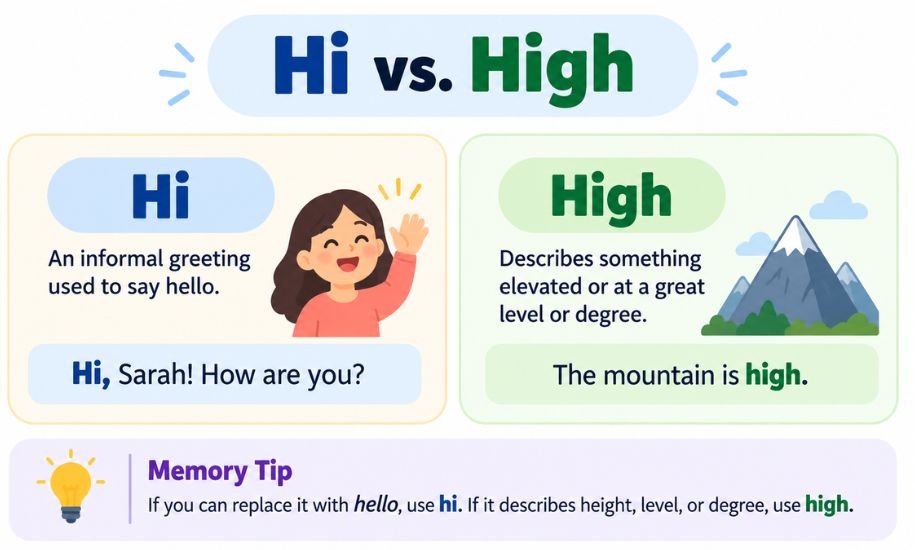
The words hi and high sound exactly the same, but they have completely different meanings and uses. This can make them confusing when writing, especially if you are spelling a sentence based on how it sounds. Hi is an informal greeting used to say hello to someone, while high describes something elevated, a greater level, or a strong degree of something. Although both words are correctly spelled English words, choosing the right one depends on the context of your sentence.
Quick Answer
Both hi and high are correct English words, but they have different meanings. Hi is an informal way to greet someone, while high refers to something elevated, intense, or at a greater level. They are pronounced identically, so the correct spelling depends on what you want to express.
Hi vs. High: What’s the Difference?
The main difference between hi and high is their meaning and grammatical function. Although they share the same pronunciation, they are used in different situations.
- Hi is an interjection used to greet someone, acknowledge their presence, or start a conversation.
- High is commonly an adjective describing something at a considerable height, level, amount, or intensity. It can also function as an adverb or noun.
| Feature | Hi | High |
|---|---|---|
| Meaning | An informal greeting | Elevated or at a great level |
| Part of speech | Interjection | Adjective, adverb, noun |
| Pronunciation | /haɪ/ | /haɪ/ |
| Syllables | One | One |
| Usage | Saying hello | Describing height, degree, or level |
| Example | Hi, how are you? | The wall is high. |
| Common expression | Say hi | High five |
For example:
- Hi: Hi, Emily! It’s nice to see you again.
- High: The airplane is flying high above the clouds.
In the first sentence, hi is used to greet Emily. In the second, high describes the airplane’s position in the sky.
What Does Hi Mean?
Hi is an informal interjection used to greet someone or attract their attention in a friendly way. It is a common alternative to hello and is frequently used in everyday conversations, text messages, and informal emails.
Unlike nouns and verbs, hi does not describe an object or an action. Instead, it expresses a greeting or acknowledgement.
Examples of hi in sentences:
- Hi, James! How was your weekend?
- She smiled and said hi to her neighbour.
- Hi, everyone! Thank you for joining us today.
- I called my friend just to say hi.
- He sent me a message saying, “Hi, are you available?”
The word is suitable for casual conversations with friends, family members, classmates, and colleagues. It can also be used in professional emails when the communication is friendly and informal.
For example, “Hi, Sarah,” is a natural opening for a casual work email. In a more formal letter, “Dear Sarah” may be more appropriate.
What Does High Mean?
High describes something that is physically elevated, greater than a particular level, or considerable in amount or intensity. It is most frequently used as an adjective, although it can also function as an adverb or noun.
The exact meaning depends on the context.
Examples of high in sentences:
- The mountain is so high that its peak is covered in snow.
- The teacher gave him a high score on his examination.
- The temperature is unusually high this afternoon.
- The bird flew high above the trees.
- The company reached a new high in annual sales.
The word also appears in many everyday expressions, including high quality, high priority, high speed, and high expectations.
Different Uses of High
| Meaning | Example |
|---|---|
| Physical height | The building is very high. |
| Amount or level | The cost of living is high. |
| Intensity | The area experienced high winds. |
| Achievement | She reached a new high in her career. |
| Sound pitch | The singer performed a high note. |
| Position or elevation | The village is high in the mountains. |
As an adjective, high also has comparative and superlative forms:
- High: This wall is high.
- Higher: That wall is higher than this one.
- Highest: This is the highest wall in the area.
These forms describe increasing degrees of height or level.
Hi vs. High Pronunciation
Both words are pronounced exactly the same in standard British and American English. Their phonetic transcription is /haɪ/, and each contains one syllable.
The pronunciation begins with the /h/ sound, followed by the /aɪ/ diphthong, as heard in my, sky, and fly.
The spelling difference does not change their pronunciation. In high, the letters “gh” are silent, which is why the word sounds identical to hi.
Because they are homophones, you cannot identify the correct spelling by listening alone. You need to understand the meaning of the sentence.
Examples of Hi and High in Sentences
Looking at both words in similar contexts can make their differences easier to understand.
| Hi | High |
|---|---|
| Hi, Daniel! How are you? | The building is very high. |
| She said hi to her teacher. | The kite flew high in the sky. |
| I stopped by to say hi. | The temperature is high today. |
| Hi, everyone! Welcome to class. | He received a high grade. |
| He waved and shouted hi. | The bird perched on a high branch. |
| I sent her a quick hi. | The company has high standards. |
| Hi, can you hear me? | The plane is flying high. |
Hi vs. High Quotes and Everyday Expressions
These short, original examples show how each word appears in everyday communication.
Examples using hi:
- “A simple hi can start a wonderful conversation.”
- “She greeted everyone with a cheerful hi.”
- “I just wanted to say hi and see how you’re doing.”
Examples using high:
- “Aim high and keep working towards your goals.”
- “The view is beautiful from such a high place.”
- “Great achievements often come with high expectations.”
These examples demonstrate that hi relates to greetings, while high expresses height, level, or degree.
When Should You Use Hi or High?
Choosing the right word becomes easier when you consider what your sentence is trying to communicate.
Use hi when:
- You are greeting someone.
- You want to start a casual conversation.
- You are acknowledging someone’s presence.
- You are sending a friendly, informal message.
For example: “I saw my cousin at the shopping centre and said hi.”
Use high when:
- You are describing the height of an object or place.
- You are talking about a large amount, level, or degree.
- You are describing a high pitch, speed, or intensity.
- You are referring to a peak, achievement, or elevated position.
For example: “The new office building is higher than the one next to it.”
An easy way to remember the difference
Try replacing hi with hello. If the sentence still makes sense, you probably need hi.
– “I said hi to my neighbour.” → “I said hello to my neighbour.”
If the word describes height, level, or intensity, use high.
– “The mountain is high.” → “The mountain is tall.”
Common Expressions with Hi and High
Both words appear in familiar English expressions, but their meanings remain distinct.
| Expression | Meaning | Example |
|---|---|---|
| Say hi | Greet someone | Please say hi to your family. |
| Hi there | Friendly greeting | Hi there! How can I help? |
| Oh, hi | Informal greeting | Oh, hi! I didn’t expect to see you. |
| High five | A celebratory hand gesture | They gave each other a high five. |
| High school | A type of secondary school | My brother attends high school. |
| High quality | A high standard | This product is made from high-quality materials. |
| High priority | Something particularly important | Completing the project is a high priority. |
| High hopes | Strong expectations | She has high hopes for the future. |
One expression that often causes confusion is high five. The correct spelling is high five, not hi five, because high refers to raising the hands.
Common Mistakes to Avoid
Although both spellings are correct, using one in place of the other can change the meaning of a sentence.
1. Using high instead of hi in a greeting
- Incorrect: High, Sarah! How are you?
- Correct: Hi, Sarah! How are you?
Use hi when greeting someone, not high.
2. Using hi instead of high to describe height
- Incorrect: The plane is flying hi above the clouds.
- Correct: The plane is flying high above the clouds.
Use high when referring to elevation or position.
3. Misspelling high five
- Incorrect: They celebrated with a hi five.
- Correct: They celebrated with a high five.
The established expression uses high to describe the raised-hand gesture.
4. Confusing pronunciation with spelling
Since the words sound identical, it is easy to choose the wrong spelling when writing quickly. Always consider whether you are greeting someone or describing a level, height, or degree.
Frequently Asked Questions
1. Is it hi or high?
Both are correct English words, but they have different meanings. Hi is an informal greeting, while high describes something elevated or at a considerable level or degree. The right spelling depends on how the word is used in a sentence.
2. Are hi and high homophones?
Yes, hi and high are homophones because they have the same pronunciation but different spellings and meanings. Both are pronounced /haɪ/ in standard British and American English.
3. Is hi a real English word?
Yes, hi is a standard English word used as an informal greeting. It is widely accepted in everyday speech, text messages, and casual written communication. It is a friendly alternative to the more general greeting hello.
4. What is the meaning of high?
High can mean physically elevated, greater in amount or degree, intense, or at a peak. For example, a tall building can be high, a temperature can be high, and someone can achieve a high score.
5. Is it high five or hi five?
The correct expression is high five. It refers to a celebratory gesture in which two people raise their hands and slap their palms together. Hi five is a common spelling mistake in this expression.
6. Do hi and high sound the same in American and British English?
Yes. Both words are generally pronounced /haɪ/ in standard American and British English. The “gh” in high is silent, so there is no standard pronunciation difference between the two words.
The Bottom Line
The difference between hi and high comes down to meaning, not pronunciation. Use hi to greet someone or start a friendly conversation, and use high to describe elevation, a greater level, or intensity. Remembering this simple distinction will help you avoid spelling mistakes in everyday writing. At Grammarifyr, understanding such differences makes it easier to know the difference and use the right words with confidence.
You may also Read : Connotation vs Denotation: Differences and Examples
One Comment