Benefitting or Benefiting: US and UK Spelling Guide
When writing in English, it is easy to hesitate between benefitting and benefiting. Both spellings appear in published writing, dictionaries and everyday communication, but the difference in their use can be confusing. Should you double the final t when adding -ing to benefit, or is a single t enough? The answer depends partly on accepted spelling conventions and the style you follow. Understanding the rule, along with examples of correct usage, can help you choose the appropriate form for academic, professional and everyday writing.
Quick Answer
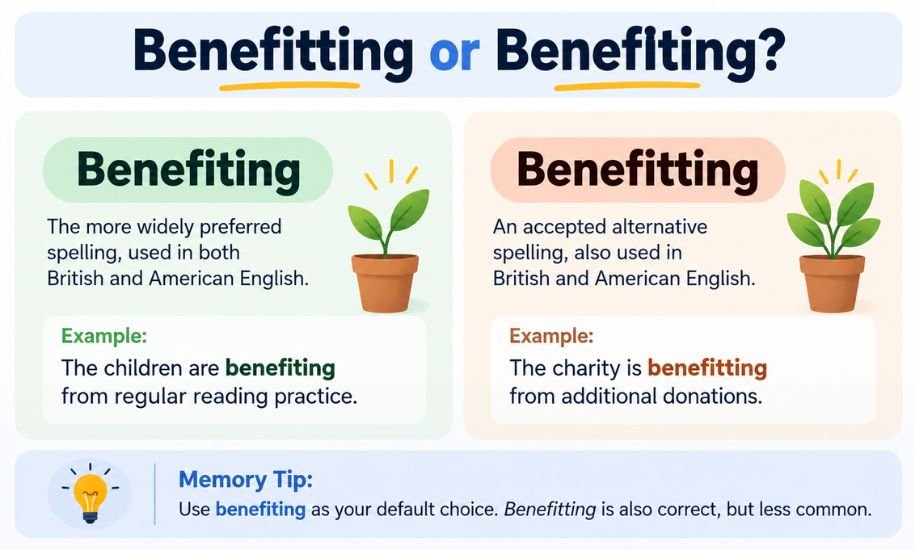
Both benefiting and benefitting are accepted spellings of the present participle of benefit. However, benefiting, with one t, is the more widely preferred spelling in standard English, including American English and many British publications. Use the spelling recommended by your dictionary or style guide, and remain consistent throughout your writing.
Benefitting or Benefiting: What Is the Difference?
The main difference between these two forms is their spelling. Both are present participles of the verb benefit, meaning to receive an advantage, gain something useful or provide help to someone.
Benefiting uses a single t, while benefitting doubles the final t. Neither spelling changes the meaning, pronunciation or grammatical role of the word.
| Feature | Benefiting | Benefitting |
|---|---|---|
| Spelling | One t | Two ts |
| Meaning | Gaining or providing an advantage | Gaining or providing an advantage |
| Part of speech | Present participle | Present participle |
| Grammatical use | Continuous tenses and participial phrases | Continuous tenses and participial phrases |
| Standard usage | Widely preferred | Accepted alternative |
| Formal writing | Suitable | Suitable where accepted by the style guide |
For most general writing, benefiting is a practical choice because it is widely recognized and commonly recommended by editorial style guides.
What Does Benefiting Mean?
Benefiting is the present participle of the verb benefit. It describes the process of receiving an advantage, gaining something valuable or helping someone improve their circumstances.
The word can be used in continuous verb tenses with auxiliary verbs such as is, are, was and were. It can also appear in participial phrases.
Examples:
- Students are benefiting from the school’s improved teaching methods.
- The company is benefiting from its investment in new technology.
- Local residents are benefiting from better healthcare facilities.
- She is benefiting from the experience of her colleagues.
In each example, the word describes someone or something receiving an advantage.
Is Benefitting Also Correct?
Yes, benefitting is an accepted alternative spelling of benefiting. It has the same meaning and grammatical function, so using it does not change the message of a sentence.
Although the single-t spelling is more widely preferred, the double-t form is found in British and other varieties of English. Some dictionaries recognize both forms, while certain publications and institutions specify benefiting as their preferred spelling.
Examples:
- The new community programme is benefitting hundreds of families.
- Small businesses are benefitting from increased customer interest.
- The organisation is benefitting from its partnership with local schools.
These sentences are grammatically correct when the double-t spelling is accepted by the chosen editorial standard.
Why Is the Spelling Confusing?
The confusion arises from a common English spelling rule. When adding -ing to a verb, the final consonant is sometimes doubled. For example:
- Run → Running
- Sit → Sitting
- Stop → Stopping
- Begin → Beginning
However, the consonant is not always doubled. The usual rule for many one-syllable verbs is to double the final consonant when the word ends in a consonant preceded by a single vowel.
For longer verbs, consonant doubling generally depends on the stress pattern of the word. In benefit, the stress falls on the first syllable: BEN-e-fit. The final syllable is unstressed, so the usual spelling rule supports benefiting rather than benefitting.
Despite this, benefitting is an established alternative spelling. This is why both forms can be encountered, even though the single-t form is the more widely recommended choice.
Benefiting or Benefitting in British and American English
Both spellings are used in English-language publications, but regional spelling preferences do not create an absolute distinction between them.
- American English: Benefiting is the conventional and widely preferred spelling in standard American writing.
- British English: Benefiting and benefitting are both encountered. Some British dictionaries recognize both, while individual editorial style guides may prefer the single-t form.
For example, the University of Edinburgh’s editorial style guide recommends benefiting. This illustrates that doubling the t is not a requirement of British English.
If you are writing for a particular audience, follow the relevant publication’s spelling conventions. When no specific style guide applies, benefiting is a suitable choice for both British and American readers.
Benefiting or Benefitting in a Sentence
Seeing both forms in context makes it easier to understand their grammatical use. The following examples demonstrate how the word can be used naturally.
Examples with benefiting:
- The children are benefiting from regular reading practice.
- The business is benefiting from its new marketing strategy.
- Farmers are benefiting from improved irrigation systems.
- The students have been benefiting from online learning.
- The entire community is benefiting from the new public park.
Examples with benefitting:
- The charity is benefitting from additional donations.
- Local companies are benefitting from increased tourism.
- The new policy is benefitting small business owners.
- Many employees are benefitting from flexible working arrangements.
- The project is benefitting from the support of experienced volunteers.
Both sets of sentences express the same meaning. The choice is a matter of spelling preference rather than grammar.
Benefiting and Its Other Verb Forms
The verb benefit has several related forms. Knowing how these forms work can help you avoid spelling mistakes in different tenses.
| Verb form | Spelling | Example |
|---|---|---|
| Base form | Benefit | Exercise can benefit your health. |
| Third-person singular | Benefits | The programme benefits local families. |
| Present participle | Benefiting | She is benefiting from the course. |
| Alternative present participle | Benefitting | She is benefitting from the course. |
| Simple past | Benefited | They benefited from the changes. |
| Alternative simple past | Benefitted | They benefitted from the changes. |
| Past participle | Benefited | The company has benefited from the investment. |
| Alternative past participle | Benefitted | The company has benefitted from the investment. |
The single-t forms benefiting and benefited are widely preferred in standard writing. The double-t forms benefitting and benefitted are also recognized alternatives.
Synonyms for Benefiting
Depending on the context, several words and phrases can replace benefiting. The best choice depends on whether the sentence describes gaining an advantage, making progress or helping someone.
| Synonym | Meaning | Example |
|---|---|---|
| Gaining | Receiving something valuable | Students are gaining useful experience. |
| Profiting | Obtaining a financial or other advantage | The business is profiting from the investment. |
| Improving | Becoming better | Her performance is improving with practice. |
| Advancing | Making progress | The initiative is advancing educational opportunities. |
| Thriving | Growing or succeeding | Local businesses are thriving. |
| Gaining from | Receiving an advantage from something | Families are gaining from the new scheme. |
| Flourishing | Developing successfully | The community is flourishing. |
| Helping | Providing assistance | The programme is helping young learners. |
These synonyms are not interchangeable in every sentence. For instance, profiting may suggest financial gain, while improving focuses on becoming better.
Common Mistakes to Avoid
When using these spellings, keep the following points in mind:
- Treating one form as universally incorrect: Benefitting is an accepted alternative, even though benefiting is more widely preferred.
- Assuming British English always requires two Ts: British publications use both spellings, and some explicitly recommend the single-t form.
- Mixing spellings in the same article: Choose one form and use it consistently unless you are discussing the difference itself.
- Confusing benefiting with beneficial: Benefiting is a verb form, whereas beneficial is an adjective meaning helpful or advantageous.
Paying attention to these distinctions will make your writing clearer and more consistent.
Frequently Asked Questions
Is benefiting or benefitting correct?
Both are correct spellings of the present participle of benefit. However, benefiting is more widely preferred in standard English. Benefitting is an accepted alternative, so the choice can depend on the dictionary or editorial style guide you follow.
Is benefitting British or American English?
Benefitting is used in both British and American English, although it is less commonly preferred in standard American writing. British English also uses benefiting, and there is no strict rule that British writers must double the final t.
Does Oxford Dictionary accept benefitting?
Yes. Oxford dictionary resources recognize benefitting as an alternative form alongside benefiting. The exact presentation may differ between dictionary editions and regional entries.
What is the past tense of benefit?
The past tense of benefit is benefited or benefitted. Both forms are accepted, although benefited is widely preferred in standard American English and is also used in British English.
Is benefiting acceptable in formal writing?
Yes. Benefiting is widely accepted in formal writing, including academic papers, business documents, reports and professional communication. It is a suitable choice when no specific spelling convention has been prescribed.
What is a synonym for benefiting?
Depending on the context, synonyms include gaining, profiting, improving, advancing and thriving. For example, “The students are benefiting from the programme” could be rewritten as “The students are gaining from the programme.”
Final Verdict: Benefitting or Benefiting?
Both benefitting and benefiting are accepted spellings with the same meaning, but benefiting is the more widely preferred form in standard English. It is suitable for both American and British audiences and is a practical choice for most formal and informal writing.
When choosing between the two, consider your audience and any applicable style guide. For more straightforward explanations of confusing spellings and everyday grammar, Grammarifyr helps you know the difference and use the right words.
You may also Read : Thru or Through: Meaning, Difference, and Examples