Thru or Through: Meaning, Difference, and Examples
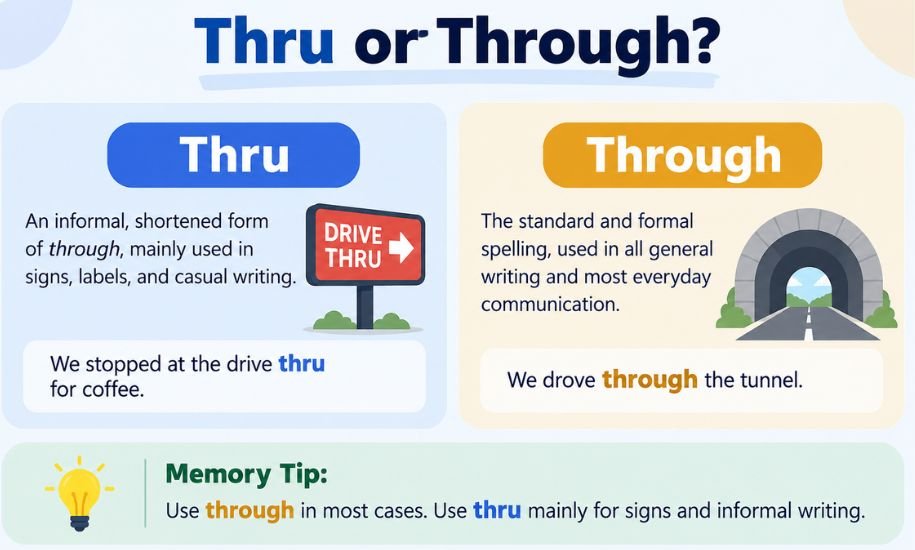
The words thru and through sound exactly the same, and both can refer to moving from one place to another, completing an activity, or continuing over a period of time. However, they are not interchangeable in every situation. Through is the standard spelling used in formal and everyday English, while thru is an informal variant that commonly appears on signs, advertisements, and in casual writing. Understanding when to use each form can help you write more clearly, avoid unnecessary spelling mistakes, and choose the right word for your audience.
Quick Answer
Both thru and through are accepted English spellings, but through is the standard form for formal, academic, professional, and general writing. Thru is an informal variant often used in signs, advertisements, and expressions such as drive-thru. When in doubt, choose through.
Thru or Through: What’s the Difference?
The main difference between these two words is their level of formality, not their meaning or pronunciation. Both are used to describe movement, duration, completion, or a method of doing something. However, through is the conventional spelling in standard English.
| Feature | Through | Thru |
|---|---|---|
| Correct spelling | Yes | Yes, as an informal variant |
| Meaning | From one side to another, by means of, or from beginning to end | Generally the same |
| Pronunciation | /θruː/ | /θruː/ |
| Formal writing | Preferred | Generally avoided |
| Academic writing | Standard | Not recommended |
| Casual messages | Suitable | Acceptable |
| Signs and advertisements | Common | Common |
| Example | We walked through the tunnel. | We used the drive-thru. |
For example, in a formal report, you would write, “The road passes through the village.” On a restaurant sign, however, “Drive-Thru” is a familiar and acceptable spelling.
What Does Through Mean?
Through is a standard English word that functions as a preposition, adverb, and adjective. Its meaning changes slightly depending on the sentence, but it generally relates to movement, continuation, completion, or a method.
Here are its main meanings.
1. Moving from one side to another
When something enters one side of a place or object and exits from another, through describes that movement.
- The children ran through the garden.
- We drove through a long tunnel.
- Sunlight streamed through the window.
2. Continuing during a period
Through can describe something that continues throughout a particular time or period.
- She worked through the night to finish the project.
- The store is open Monday through Friday.
- It rained through most of the afternoon.
3. Completing something
The word can also describe reading, reviewing, or working on something from beginning to end.
- I read through the entire report.
- He went through all the application forms.
- We talked through the problem before making a decision.
4. By means of something
When an action happens using a particular person, system, or method, through can explain how it happened.
- I received the invitation through a colleague.
- She found the information through an online course.
- They applied for the position through the company’s website.
These meanings make through a versatile word in both spoken and written English.
What Does Thru Mean?
Thru is an informal variant of through. It has the same pronunciation and broadly the same meanings, but it is generally associated with shortened, casual, or commercial writing.
It is a recognized English word, so it is not necessarily a spelling mistake. However, its informal status means that it is not usually the preferred choice in formal documents or academic work.
Examples include:
- We ordered lunch at the drive-thru.
- The sign says, “No Thru Traffic.”
- The promotion runs Monday thru Saturday.
- I finally made it thru the busy day.
In these examples, thru communicates the intended meaning, but through would generally be the more appropriate choice in polished prose.
When Should You Use Each Spelling?
Choosing between the two forms depends mainly on the type of writing and the context.
Use Through in Standard Writing
Through is the preferred spelling in:
- Academic essays and research papers
- Business reports and professional emails
- News articles and blog posts
- Formal letters and applications
- Books, manuals, and official documents
For example:
- The research was conducted through several stages.
- Please send the completed documents through email.
- The programme will run from January through March.
Using the standard spelling helps maintain a consistent and professional writing style.
Use Thru in Informal or Established Expressions
Thru is often suitable in short, informal, or commercial expressions, particularly where space is limited or a familiar compound spelling is preferred.
Examples include:
- Drive-thru restaurant
- Drive-thru coffee shop
- No thru traffic
- Thru lane
It can also appear in casual text messages, personal notes, or advertisements. However, even in informal writing, through is perfectly acceptable and is often the more natural choice.
Thru or Through for Dates
When describing a range of dates, days, or periods, through is the standard spelling in American English. Thru sometimes appears in informal notices, advertisements, and abbreviated schedules.
| Context | Example |
|---|---|
| Formal date range | The event runs from June 1 through June 5. |
| Work schedule | The office is open Monday through Friday. |
| Academic schedule | The course runs from September through December. |
| Informal advertisement | The sale runs June 1 thru June 5. |
| Casual notice | Available Monday thru Saturday. |
In British English, to is also widely used for date ranges. For example, “The exhibition runs from June 1 to June 5.”
For professional documents, articles, and formal announcements, choose through in American English or to where that construction is more natural for your variety of English.
Through and Through or Thru and Thru?
The standard expression is through and through, which means completely, entirely, or in every respect. It is used to emphasize that a particular quality or characteristic is present throughout a person, thing, or experience.
Examples:
- She is a teacher through and through.
- He is a musician through and through.
- Their commitment to the project was evident through and through.
Although thru and thru may appear in informal writing, slogans, or stylized names, through and through is the established spelling of the idiom.
Remember that the expression is not simply about physical movement. It often describes someone’s character, identity, or defining qualities.
Drive-Thru or Drive-Through?
Both drive-thru and drive-through are accepted spellings. They refer to a service that allows customers to receive food, drinks, or other products without leaving their vehicles.

Drive-thru
This shortened spelling is particularly common in restaurant names, signs, menus, and advertising.
Example: We stopped at the drive-thru to get breakfast.

Drive-through
This full spelling is also standard and is suitable for general and formal writing.
Example: The pharmacy offers a drive-through service.
The shortened spelling is well established in this compound, so using drive-thru is not considered an error simply because thru is informal in other contexts.
Thru or Through in a Sentence
Seeing both words in context makes their usage easier to understand. The following examples demonstrate how they work in everyday English.
Examples with through:
- We walked through the forest to reach the lake.
- The train travelled through the mountain tunnel.
- She looked through the documents before signing them.
- He stayed awake through the entire night.
- The river flows through several small villages.
- I learned the skill through regular practice.
- They managed to get through a difficult situation.
- The teacher talked us through the assignment.
- The offer is valid from Monday through Friday.
- The light shone through the curtains.
Examples with thru:
- We ordered burgers at the drive-thru.
- The road sign indicates no thru traffic.
- The store is advertising a Monday thru Friday discount.
- I went thru my notes before the examination.
- The restaurant has a separate drive-thru lane.
The examples with thru are understandable, but several would generally be written with through in formal or carefully edited text.
Common Mistakes to Avoid
Although the two spellings have the same basic meaning, writers sometimes use the informal form in contexts where the standard spelling is expected.
| Informal or less suitable in formal writing | Preferred standard form |
|---|---|
| I walked thru the park. | I walked through the park. |
| Please read thru the report. | Please read through the report. |
| We drove thru the tunnel. | We drove through the tunnel. |
| The office is open Monday thru Friday. | The office is open Monday through Friday. |
| She got thru a difficult time. | She got through a difficult time. |
Another mistake is assuming that thru is always incorrect. It is a recognized informal variant and is appropriate in established expressions such as drive-thru.
The important point is to consider the context rather than treating one form as universally wrong.
Synonyms for Through
The synonyms for through depend on the meaning you want to express. Not every alternative works in every sentence, so choose one that preserves the original meaning.
| Meaning | Synonyms | Example |
|---|---|---|
| From one side to another | Across, from end to end | We walked across the field. |
| During a period | Throughout, during | It rained throughout the night. |
| By means of | Via, by, using | She contacted me via email. |
| Completing something | Finish, complete | He completed the assignment. |
| Experiencing something | Undergo, endure | They endured a difficult year. |
| From beginning to end | Throughout, all the way | We travelled all the way across the country. |
For example, “She learned through experience” can be rewritten as “She learned from experience.” However, “We walked through the doorway” cannot always be replaced naturally with “We walked across the doorway.”
How to Remember the Difference
A simple way to remember the distinction is to associate through with standard writing and thru with shortened, informal expressions.
- Through: Use it in formal writing, articles, reports, essays, and most everyday sentences.
- Thru: Reserve it for informal contexts, signs, advertising, and established compounds such as drive-thru.
If you are unsure which spelling to choose, write through. It is suitable for nearly every context in which the word is used, making it the more reliable option.
Frequently Asked Questions
Is thru a real English word?
Yes. Thru is a recognized informal variant of through. It has the same pronunciation and broadly the same meanings, but it is generally used in casual writing, signs, advertisements, and certain established expressions.
Is through more correct than thru?
Through is the standard spelling in English, while thru is an informal alternative. Both are recognized, but through is the expected form in formal, academic, and professional writing.
Is thru American or British English?
Thru is particularly associated with informal American English, especially in commercial expressions such as drive-thru. It is not exclusively American, however, and its use does not make it the standard spelling in British English.
Should I use thru or through in a formal letter?
Use through in a formal letter. It is the standard spelling and is appropriate for professional correspondence, applications, official notices, and business communication.
Is it through and through or thru and thru?
Through and through is the standard idiom. It means completely or in every respect. The shortened version may be used stylistically, but it is not the conventional spelling in formal writing.
Is drive-thru grammatically correct?
Yes. Drive-thru is an established spelling of the compound noun used for services that customers access from their vehicles. Drive-through is also correct, and both forms are widely understood.
The Bottom Line
Thru and through share the same pronunciation and basic meanings, but they differ in formality. Through is the standard spelling for general, academic, and professional writing, while thru is an informal variant commonly used in signs, advertisements, and expressions such as drive-thru. Choosing the appropriate form helps make your writing clear and consistent. At Grammarifyr, the goal is to help you understand these small but meaningful distinctions so you can know the difference and use the right words.
You may also Read : Recurring or Reoccurring: Meaning and Examples
One Comment