Presume vs Assume: Meaning, Differences and Examples
Have you ever wondered whether to use presume or assume in a sentence? Both words describe believing something to be true without having complete proof, so they are often used interchangeably. However, they have slightly different meanings. Assume generally refers to accepting something as true without checking the facts, while presume often suggests that a belief is based on reasonable evidence, probability, or previous experience. Understanding this distinction can help you choose the right word in everyday conversations, professional writing, and formal situations.
Quick Answer
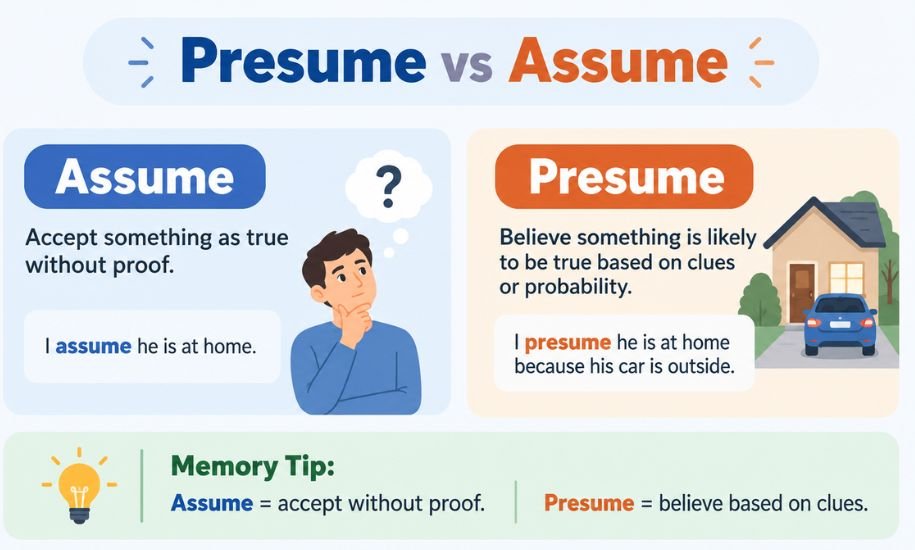
Both presume and assume are correct English words. Assume means to accept something as true without confirmation, while presume usually means to believe something is likely to be true based on clues, probability, or reasonable grounds. For example, you might assume someone is at home without knowing, but presume they are home because their car is parked outside.
What Is the Difference Between Presume and Assume?
The main difference is the reasoning behind a belief. Assume often involves accepting an idea without verifying it, whereas presume tends to imply that there is some reason to believe it is true.
| Feature | Assume | Presume |
|---|---|---|
| Meaning | Accept something as true without proof | Believe something is likely to be true |
| Evidence | May involve little or no evidence | Often involves clues or reasonable grounds |
| Certainty | Depends on the context | Often suggests a reasonable expectation |
| Tone | Common and conversational | Often more formal |
| Typical use | Guesses, beliefs, and starting points | Expectations, probability, and formal situations |
| Noun | Assumption | Presumption |
| Example | I assume he is busy. | I presume he is busy because he has a deadline. |
The distinction is not absolute. Both words can describe beliefs based on incomplete information, and their meanings sometimes overlap. The context of a sentence determines which word sounds more natural.
What Does Assume Mean?
Assume is a verb that means to accept something as true without having confirmation or sufficient proof. It is commonly used when someone makes a guess, forms an expectation, or treats an idea as a starting point without checking whether it is correct.
For example, if your friend does not answer your phone call, you might assume they are busy. However, they could be sleeping, driving, or away from their phone.
Examples of assume in sentences:
- I assumed you had already completed your homework.
- She assumed that the meeting would start at nine.
- Don’t assume everyone understands the instructions.
- We assumed the restaurant was open because it was a weekend.
- He assumed responsibility for managing the new project.
The word also has other meanings. It can refer to taking on a responsibility, adopting a particular role, or beginning to display a certain appearance or quality.
For instance, assume responsibility means to take responsibility for something, while assume a role means to take on a particular position or function.
What Does Presume Mean?
Presume is a verb that means to believe something is likely to be true based on probability, available information, previous experience, or reasonable grounds. It does not mean that something has been proven beyond doubt.
For example, if you know that your colleague normally arrives at the office by eight and you see their car outside, you might presume they are already at work.
Examples of presume in sentences:
- I presume you have received the invitation.
- She presumed that he was the team leader because he was conducting the meeting.
- We presume the flight is delayed because of the weather.
- I presume you are familiar with the new company policy.
- The law presumes a person innocent until proven guilty.
Presume can also mean to act as if you have the right or authority to do something when you may not. For example, I would not presume to tell you how to manage your business suggests that the speaker does not consider it appropriate to give unsolicited instructions.
This meaning makes presume particularly useful in formal, polite, and legal contexts.
Presume vs Assume Examples in Sentences
Looking at both words in similar situations makes their difference easier to understand. The following examples show how the choice of word can change the implication of a sentence.
| Assume | Presume |
|---|---|
| I assumed you were at home. | I presumed you were at home because your car was outside. |
| She assumed he was upset. | She presumed he was upset because he left the meeting early. |
| We assumed the event was canceled. | We presumed the event was canceled after seeing the announcement. |
| He assumed she knew the answer. | He presumed she knew the answer based on her experience. |
| They assumed the road was safe. | They presumed the road was safe after checking the conditions. |
More examples in everyday situations:
- Assume: I assumed the store was closed because nobody answered the phone.
- Presume: I presume the store is closed because its posted opening hours have ended.
- Assume: He assumed that his friend would join him for dinner.
- Presume: He presumed that his friend would join him because they had already agreed on a time.
These examples illustrate a general tendency, not a strict grammar rule. You can use assume for a belief supported by evidence, and presume for an expectation that has not been fully confirmed.
When Should You Use Assume or Presume?
Choosing between these words depends on what you want to communicate and how you formed your belief.
Use assume when:
- You accept something as true without checking.
- You are making a guess based on limited information.
- You are treating an idea as a starting point for discussion or reasoning.
- You are referring to taking on a duty, position, or responsibility.
Example: I assumed the train would arrive on time because it usually does.
Use presume when:
- You believe something is likely based on clues or probability.
- You have a reasonable expectation, although you lack confirmation.
- You are writing in a formal, legal, or professional context.
- You want to describe acting as if you have the right to do something.
Example: I presume the train is delayed because the railway company has announced disruptions.
In everyday English, the two words are sometimes interchangeable. However, when you want to emphasize an expectation based on reasonable grounds, presume may be the better choice.
Presume vs Assume vs Suppose
Suppose is another word related to presume and assume. All three can express uncertainty, but they are not always used in the same way.
| Word | Meaning | Example |
|---|---|---|
| Assume | Accept something as true without confirmation | I assume she is at work. |
| Presume | Believe something is likely based on probability or clues | I presume she is at work because her office lights are on. |
| Suppose | Think something may be true or consider a possibility | I suppose she might be at work. |
Suppose often sounds more tentative and is also used to introduce hypothetical situations.
For example:
- Assume: I assume the shop is open.
- Presume: I presume the shop is open because its sign says so.
- Suppose: Suppose the shop is closed. What will we do instead?
The best word depends on whether you are accepting a belief, expressing a reasonable expectation, or considering a possibility.
Presume vs Assume vs Infer
Infer is related to both words, but it focuses on drawing a conclusion from evidence or reasoning rather than simply accepting something as true.
- Assume: I assumed Mark was tired.
- Presume: I presumed Mark was tired because he had worked all night.
- Infer: I inferred that Mark was tired from his yawning and slow responses.
The important distinction is that infer describes reaching a conclusion from available information. Assume and presume describe accepting or believing that something is true, even if it has not been confirmed.
Assumption vs Presumption
Assumption is the noun form of assume, while presumption is the noun form of presume. Both refer to beliefs or ideas that have not necessarily been proven.
| Assumption | Presumption |
|---|---|
| A belief accepted as true without confirmation | A belief that something is likely based on reasonable grounds |
| Often used for guesses or starting points | Often used for expectations or formal reasoning |
| Can be unsupported | Often suggests some supporting basis |
| Example: Your assumption was incorrect. | Example: The presumption was based on previous results. |
Examples:
- Her assumption that the meeting was canceled turned out to be wrong.
- His presumption that everyone would agree with him caused confusion.
- We should avoid making assumptions without checking the facts.
- The presumption of innocence is an important legal principle.
Presumption can also refer to behaviour that is considered overconfident, presumptuous, or inappropriate, as in It was a presumption to speak on behalf of the entire team without permission.
Common Mistakes to Avoid
Although the words have similar meanings, some usage mistakes can make a sentence unclear or unnatural.
- Treating them as completely identical: They overlap, but presume often implies a reasonable basis for belief.
- Thinking presume means certainty: A presumption may still be incorrect and should not be treated as established fact.
- Using presume for every responsibility-related expression: The natural phrase is assume responsibility, not usually presume responsibility.
- Confusing presume with infer: Infer emphasizes drawing a conclusion from evidence, while presume emphasizes believing something is likely.
- Assuming that assume always means an unreasonable guess: An assumption can also be a practical starting point based on reasonable information.
Understanding these distinctions helps you express your intended meaning more accurately in both spoken and written English.
Easy Way to Remember the Difference
A simple way to remember the distinction is to associate assume with accepting and presume with probability.
- Assume: Accept something as true, even when you have not checked it.
- Presume: Believe something is likely to be true because you have a reason to think so.
For example, if you think your neighbour is home without knowing anything about their whereabouts, you assume they are home. If you see their car parked in the driveway and the lights on, you might presume they are home.
This memory aid is useful for everyday writing, although it is important to remember that actual usage is flexible.
Frequently Asked Questions
1. Are presume and assume interchangeable?
Yes, presume and assume can be interchangeable in some contexts because both describe believing something without complete proof. However, presume often suggests a reasonable expectation or supporting evidence, while assume is more general.
2. Is presume more formal than assume?
Generally, presume can sound more formal, particularly in legal, professional, and academic contexts. Assume is common in everyday conversations as well as formal writing. Neither word is restricted to a particular level of formality.
3. What is an example of presume in a sentence?
“I presume you have already read the report because you attended yesterday’s meeting.” This sentence suggests that the speaker has a reason to believe the report has been read, although it has not been confirmed.
4. What is the difference between an assumption and a presumption?
An assumption is an idea accepted as true without confirmation, whereas a presumption often suggests that something is likely based on reasonable grounds or probability. Both can be incorrect, depending on the available information.
5. Is presume the same as infer?
No. Presume means to believe something is likely to be true, while infer means to reach a conclusion from evidence or reasoning. For example, you might infer that someone is tired from their behaviour and presume they need rest.
6. Which word should I use in formal writing?
Both words are suitable for formal writing. Use assume when referring to an accepted idea, condition, or responsibility, and presume when expressing a reasonable expectation, a legal presumption, or a belief based on probability.
Final Verdict: Presume or Assume?
Both presume and assume are correct, but they carry slightly different implications. Assume generally means accepting something as true without verifying it, while presume often suggests a belief supported by probability, clues, or reasonable grounds. Since their meanings overlap, context is the best guide to choosing the appropriate word. Understanding this distinction will help you communicate more clearly, and Grammarifyr makes learning such differences easier with practical explanations and examples.
You may also Read : BC vs BCE: Meaning, Timeline, and Examples
One Comment