Spicey or Spicy: Meaning, Usage and Examples
It is easy to hesitate between spicey and spicy because the word comes from the noun spice, and keeping the final e can seem logical. However, standard modern English uses a different spelling. The preferred form is spicy, whether you are describing food, a strong flavor, or something figuratively exciting or provocative. While spicey does appear in some dictionaries as an uncommon variant, it is not the normal choice for everyday or formal writing.
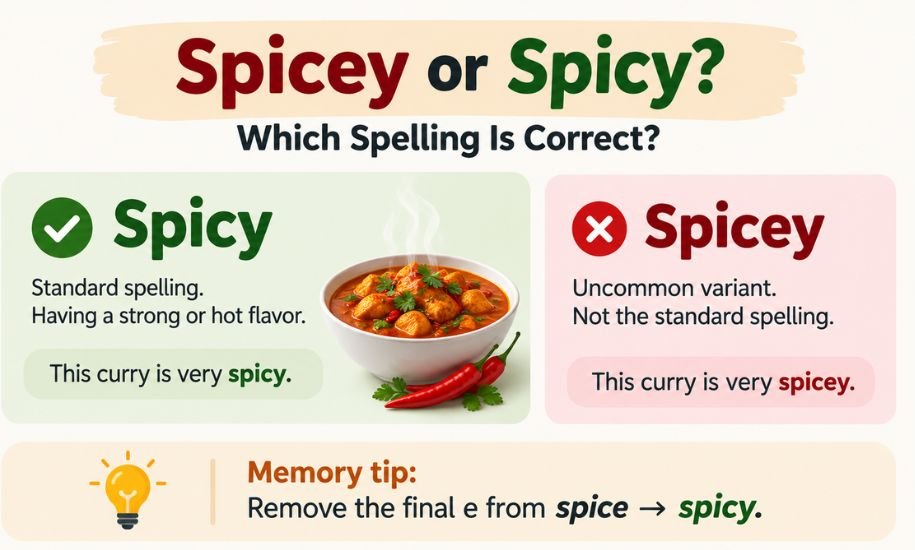
Spicy is the standard spelling in modern English. Spicey is an uncommon variant recorded by some dictionaries, but it is not the form normally recommended in everyday, academic, or professional writing. Use spicy when describing food, flavors, or something informally exciting or provocative.
Spicy or Spicey: Which Is Correct?
If you are writing a sentence today, choose spicy.
For example:
- This curry is very spicy.
- I enjoy spicy food.
- The restaurant serves spicy chicken.
- She added a spicy sauce to the noodles.
The spelling spicey may be encountered in informal writing or as a variant spelling, but it is much less common and is not the standard form most readers expect.
| Feature | Spicy | Spicey |
|---|---|---|
| Standard modern spelling | Yes | No |
| Dictionary-recorded form | Yes | Yes, as an uncommon variant |
| Common in everyday writing | Yes | No |
| Meaning | Having a strong or hot flavor; also figuratively exciting or provocative | Generally the same meaning as spicy |
| Best choice for formal writing | Yes | No |
The simplest rule is: write spicy, not spicey, in standard English.
What Does “Spicy” Mean?
Spicy is an adjective. Its most familiar meaning is describing food or drink with a strong flavor produced by spices, peppers, or other ingredients.
For example:
- The soup is too spicy for me.
- We ordered a spicy curry for dinner.
- These noodles have a surprisingly spicy sauce.
- He prefers mild food rather than spicy dishes.
The word can describe more than just heat from chilli peppers. Something can be described as spicy because it has a strong, pungent, or distinctive seasoning.
Spicy in informal language
The word has also developed several figurative uses.
Someone might describe an opinion, conversation, story, or situation as spicy when it is provocative, controversial, exciting, or likely to cause a strong reaction.
For example:
That interview became pretty spicy when the host asked about the disagreement.
Similarly:
She posted a spicy opinion about the new policy.
In these informal contexts, the word does not literally mean that something contains chilli or spices.
Is “Spicey” a Real Word?
This question requires a little more explanation than simply saying “no.”
Spicey is recorded as an uncommon variant spelling of spicy by some dictionary sources. Collins, for example, includes spicey as a variant and directs readers toward spicy. Other lexical sources also record it as an alternative or historical spelling.
That means calling it an entirely invented word would be misleading.
However, dictionary recognition does not mean that it is the preferred spelling for modern English. If you are writing an email, article, school assignment, recipe, report, or website content, spicy is the appropriate choice.
So the practical distinction is:
- spicy = standard and preferred
- spicey = uncommon variant spelling
If you encounter spicey somewhere, the writer may simply have retained the e from spice or may be using the less common variant.
Why Do People Write “Spicey”?
The spelling is understandable because of the way the adjective is formed.
The noun is:
spice
A reader might naturally assume that adding -y produces:
spice + y = spicey
But the established spelling is:
spicy
English has many adjective formations that remove a final e before adding -y:
- ice → icy
- juice → juicy
- noise → noisy
- grease → greasy
- spice → spicy
The pattern is not completely universal, which is one reason spelling mistakes can happen. Words such as pricey and dicey retain the e, so someone familiar with those forms may reasonably expect spicey to work in the same way.
Nevertheless, the conventional modern spelling is spicy.
Spicy Food: How Should You Use the Word?
When talking about food, spicy is the standard adjective.
Consider these examples:
Correct:
The restaurant makes very spicy tacos.
Incorrect in standard usage:
The restaurant makes very spicey tacos.
Correct:
I cannot eat extremely spicy food.
Incorrect in standard usage:
I cannot eat extremely spicey food.
Correct:
This sauce is much spicier than the original.
Notice that the comparative form is spicier, not spiceyer.
The superlative is spiciest:
That was the spiciest curry I have ever tasted.
Spicy, Spicier, and Spiciest
The adjective has regular comparative and superlative forms:
| Degree | Form | Example |
|---|---|---|
| Positive | spicy | This salsa is spicy. |
| Comparative | spicier | This salsa is spicier than that one. |
| Superlative | spiciest | This is the spiciest salsa here. |
Because spicy ends in -y, the y changes to i before -er and -est.
So:
- spicy → spicier
- spicy → spiciest
Avoid forms such as spicyer, spicyest, spiceyer, or spiceyest in standard English.
What Are Some Synonyms for “Spicy”?
The best synonym depends on the exact meaning you want.
When describing food, possible alternatives include:
- hot
- fiery
- peppery
- pungent
- piquant
- zesty
- sharp
These words are not always interchangeable.
For example, hot can specifically emphasize chilli heat:
The curry is extremely hot.
Peppery suggests a flavor resembling pepper:
The dressing has a pleasantly peppery taste.
Fiery can suggest intense heat:
He ordered a fiery chilli sauce.
Piquant can describe a pleasantly sharp or spicy flavor and can also have a figurative meaning connected with liveliness or interest.
Therefore, if someone asks for a spicey or spicy synonym, the safest answer is to consider the context rather than replacing the word automatically.
Is There a UK Spelling Difference?
No. Spicy is the standard spelling in both British and American English.
There is no standard British spelling spicey that contrasts with an American spicy.
For example, British English:
This curry is too spicy.
American English:
This curry is too spicy.
The spelling remains the same.
This makes the issue different from pairs such as colour/color, centre/center, and theatre/theater, where regional spelling conventions genuinely differ.
Spicy vs. Spiced
Another useful distinction is between spicy and spiced.
Spicy describes a flavor that is strong, hot, or characteristic of spices.
The curry is spicy.
Spiced means that something has been prepared or flavored with spices.
The rice was spiced with cumin and cardamom.
These descriptions can overlap, but they are not identical.
A dish can be heavily spiced without necessarily being very hot. For example, a dessert might be spiced with cinnamon, nutmeg, or cardamom without having the chilli-like heat that many people associate with the word spicy.
How Is “Spicy” Pronounced?
The standard pronunciation of spicy is approximately represented by /ˈspaɪ.si/.
The stress falls on the first syllable.
The spelling spicey does not represent a different standard pronunciation. If you encounter the variant in writing, it generally refers to the same adjective rather than a separate word with a different meaning.
Common Mistakes to Avoid
1. Keeping the final “e”
The most common mistake is writing:
❌ This curry is spicey.
Use:
✅ This curry is spicy.
2. Using “spicey” because it looks logical
The spelling may seem natural because the noun is spice, but standard English uses spicy.
3. Writing “spicyer”
The comparative is:
✅ spicier
Not:
❌ spicyer
4. Writing “spicyest”
The superlative is:
✅ spiciest
Not:
❌ spicyest
5. Assuming “spicey” is the British form
It is not. British and American English both use spicy as the standard spelling.
An Easy Way to Remember the Correct Spelling
A useful memory trick is to connect spicy with other adjectives that lose the final e from their base words:
spice → spicy
ice → icy
juice → juicy
noise → noisy
When you need the adjective, think of spicy as the established form rather than simply attaching y to the complete spelling of spice.
Is “Spicey” Acceptable in Formal Writing?
Generally, no. Even though the variant spelling is recorded in some dictionaries, spicy is the clear choice for formal and standard contemporary writing.
Use spicy in:
- academic assignments
- professional documents
- articles
- recipes
- menus
- business communication
- educational material
- website content
The uncommon spelling may occasionally appear in names, informal posts, creative writing, or other contexts where the writer intentionally uses a particular spelling. But if your goal is standard English, choose spicy.
Is “Spicy” a Scrabble Word?
Yes. Spicy is an accepted Scrabble word. It is a five-letter adjective describing something containing or having the flavor of spices.
If you are playing a word game, however, dictionary acceptance can depend on the specific word list or edition being used. For ordinary English writing, the more important point is that spicy is unquestionably the standard spelling.
Frequently Asked Questions
Is spicy or spicey correct?
Spicy is the standard and preferred spelling in modern English. Spicey is an uncommon variant recorded by some dictionaries, but it is not normally recommended for standard writing.
Is spicey a word?
Spicey is recorded as an uncommon variant spelling of spicy in some dictionary sources. It should not be treated as the normal modern spelling. In most situations, write spicy.
Is “spicy” the same in British and American English?
Yes. Spicy is the standard spelling in both British and American English. There is no normal UK/US spelling distinction between spicey and spicy.
What does spicy mean in slang?
Informally, spicy can describe something provocative, controversial, exciting, or likely to cause a strong reaction. Depending on context, it can also refer to material that is suggestive or sexually provocative.
What is the comparative form of spicy?
The comparative is spicier, while the superlative is spiciest. For example: “This sauce is spicier than the other one” and “That was the spiciest dish on the menu.”
What are synonyms for spicy?
Depending on context, synonyms can include hot, fiery, peppery, pungent, piquant, and sharp. The exact choice depends on whether you mean heat, flavor, or a figurative sense of the word.
Final Verdict: Spicey or Spicy?
For standard modern English, choose spicy. It is the established spelling for describing food with a strong or hot flavor and is also used informally for something provocative or exciting. Spicey does appear as an uncommon variant, so it is not quite accurate to call it an invented word, but it is not the spelling you should normally use.
When you are unsure, remember the simple form: spice → spicy. For more clear explanations of confusing spellings and word choices, Grammarifyr follows the same principle: Know the Difference. Use the Right Words.
You may also Read : What Does LMS Mean in Text? Meaning and Examples