Dessert or Desert: Pronunciation and Meaning Explained
Have you ever wondered whether the sweet treat served after dinner is called dessert or desert? These two words look almost identical, but they have different meanings and are usually pronounced differently. One refers to cakes, ice cream, and other sweet foods, while the other describes a dry region with little rainfall. The good news is that remembering the difference is simple once you understand their spelling, pronunciation, and usage. Learning when to use each word will help you avoid embarrassing spelling mistakes and communicate more clearly in everyday writing.
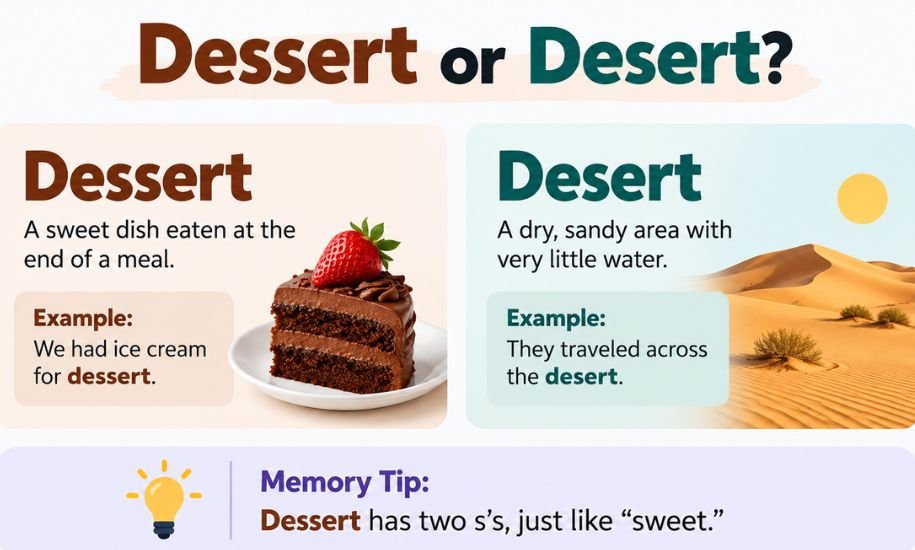
Both dessert and desert are correct English words, but they have different meanings. Dessert means sweet food eaten after a meal, such as cake or ice cream. Desert usually means a dry region with little rainfall. Remember: dessert has two S’s because you might want a second serving of something sweet.
Dessert vs. Desert: What’s the Difference?
The main difference is meaning and spelling. Although both words contain nearly the same letters, using the wrong one can change the meaning of a sentence completely.
| Feature | Dessert | Desert |
|---|---|---|
| Meaning | Sweet food served after a meal | A dry region with little rainfall |
| Part of speech | Noun | Noun or verb |
| Spelling | Two S’s | One S |
| Pronunciation | dih-ZURT | DEZ-ert as a noun |
| Example | We ordered cake for dessert. | The explorers crossed the desert. |
For example, if you write, “We ate ice cream in the desert,” the sentence means that you ate ice cream in a dry region. If you intended to say that ice cream was served after dinner, you should write, “We ate ice cream for dessert.”
Both spellings are legitimate. The important thing is to choose the word that matches your intended meaning.
What Does Dessert Mean?
Dessert is a noun that refers to sweet food typically eaten at the end of a meal. It can include cakes, cookies, puddings, pastries, fruit, ice cream, and other sweet dishes.
Dessert is often served after lunch or dinner, although people may enjoy sweet treats at other times of the day.
Examples of dessert in sentences:
- We had chocolate cake for dessert after dinner.
- My sister prepared a delicious strawberry pudding.
- Would you like some ice cream for dessert?
- The restaurant offers several homemade desserts.
In the last example, desserts is the plural form of dessert. It refers to multiple sweet dishes or varieties of sweet food.
When discussing food, menus, recipes, or meals, use dessert with two S’s.
Correct: The children chose their favourite dessert from the menu.
Incorrect: The children chose their favourite desert from the menu.
The second sentence uses the word for a dry region rather than a sweet dish.
What Does Desert Mean?
Desert has two main uses in English. As a noun, it refers to a geographical region that receives very little precipitation. Such areas often have limited vegetation, and they may be hot or cold.
The Sahara Desert in Africa is a well-known example. However, not every desert consists entirely of sand. Some have rocky terrain, gravel, or other landscapes.
Examples of desert as a noun:
- The Sahara is one of the world’s best-known deserts.
- Many desert plants have adaptations that help them conserve water.
- The travellers carried enough water to cross the desert.
- Some deserts experience extremely cold temperatures in winter.
The word can also function as a verb meaning to abandon someone or leave a place or responsibility.
Examples of desert as a verb:
- The soldiers refused to desert their fellow troops.
- He did not want to desert his family during a difficult period.
- The village appeared deserted after its residents moved away.
Notice that deserted can also work as an adjective, meaning empty or abandoned, as in “a deserted street.”
The meaning of the word depends on how it is used in the sentence. A geographical desert has one S, while the verb meaning to abandon also has one S but is pronounced differently.
Dessert or Desert Pronunciation
Pronunciation is another important difference between the two words.
In standard English pronunciation, the noun desert, meaning a dry region, is usually pronounced DEZ-ert, with the stress on the first syllable.
Dessert is pronounced dih-ZURT, with the stress on the second syllable.
The verb desert, meaning to abandon, is also pronounced dih-ZURT. This makes it sound like dessert, even though the spelling and meanings differ.
Here is a simple comparison:
- Dessert: dih-ZURT — sweet food.
- Desert (noun): DEZ-ert — dry land.
- Desert (verb): dih-ZURT — to abandon.
Pronunciation can vary slightly between speakers and accents, but the difference in stress between the noun and the other two forms is a useful guide.
For example:
“I would love dessert after dinner.”
“The desert can be difficult to cross.”
“He decided to desert his post.”
Listening to the words in context can help you identify which meaning is intended.
Are Dessert and Desert Homophones?
Homophones are words that sound the same but have different meanings and spellings. Examples include flower and flour, which are pronounced alike but refer to different things.
The relationship between dessert and desert depends on which meaning of desert you are using.
The noun desert, meaning a dry region, is normally pronounced differently from dessert. Therefore, these two forms are not usually homophones.
However, the verb desert, meaning to abandon, is pronounced the same way as dessert. In this case, the words are homophones because they sound alike but have different meanings and spellings.
For example:
- “We ordered dessert.” — We ordered a sweet dish.
- “They would never desert their friends.” — They would never abandon their friends.
The context makes the intended meaning clear. Understanding this distinction is particularly useful when writing sentences that could otherwise be misunderstood.
How to Remember the Correct Spelling
The easiest way to remember the difference is to associate the extra S in dessert with something sweet.
Dessert has two S’s because you may want a second serving.
Imagine finishing a meal and asking for another slice of cake. You might want a second helping, so remember the word with two S’s.
By contrast, desert has one S. You can associate it with sand, sunshine, and dry landscapes.
Another simple approach is to remember these two phrases:
- Sweet dessert: two S’s.
- Sandy desert: one S.
You can also use the meaning of the sentence to decide which spelling belongs there. If the sentence discusses a meal, cake, ice cream, or pudding, choose dessert. If it describes a dry geographical region, choose desert.
For example:
“We enjoyed a delicious dessert before visiting the desert the following day.”
The first word refers to food, while the second refers to a landscape.
Common Mistakes to Avoid
Although the distinction is straightforward, several mistakes can occur when using these words.
1. Writing desert when referring to food
Incorrect: I ordered chocolate desert after dinner.
Correct: I ordered chocolate dessert after dinner.
The extra S is necessary when referring to a sweet dish.
2. Writing dessert when referring to a landscape
Incorrect: The travellers crossed the dessert.
Correct: The travellers crossed the desert.
A geographical region with little rainfall is a desert, not a dessert.
3. Confusing the noun and verb pronunciations
The noun desert is stressed on the first syllable, while the verb is stressed on the second. Remembering this difference can help you understand spoken English more accurately.
4. Forgetting the expression “just deserts”
The expression just deserts means the reward or punishment someone deserves. It is spelled deserts, with one S after the initial D, even though it sounds like desserts.
For example: “After ignoring the rules, he got his just deserts.”
This is a special expression and does not refer to food or a dry landscape.
Is There a Difference in British and American English?
No major spelling difference exists between British and American English for these two words. Both varieties use dessert for sweet food and desert for a dry region or the verb meaning to abandon.
Pronunciation may vary somewhat by accent, but the standard spelling remains the same.
Examples:
- British English: We had apple pie for dessert.
- American English: We had apple pie for dessert.
- British English: The expedition crossed the desert.
- American English: The expedition crossed the desert.
If you are writing for a British, American, or international audience, you should use the same spelling distinction. Neither word is an American or British alternative to the other.
Funny Examples to Make the Difference Memorable
A little humour can make the spelling rule easier to remember. Consider these sentences:
- I wanted dessert, but my friend sent me into the desert.
- If you take two S’s out of dessert, you might lose your appetite.
- The desert was so dry that even my ice cream wanted to escape.
- I asked for a sweet dessert, not a sandy desert.
These examples play on the similar spelling and different meanings of the words. They are useful for remembering the distinction, but the central rule remains simple: food takes two S’s, while the geographical noun takes one.
Frequently Asked Questions
1. Is dessert or desert correct for cake?
Dessert is the correct spelling when referring to cake, ice cream, pudding, or another sweet dish served after a meal. The word desert refers to a dry geographical region or, as a verb, to abandon someone or something.
2. Why does dessert have two S’s?
A helpful memory trick is that dessert has two S’s because you might want a second serving. This is a mnemonic rather than a strict spelling rule, but it makes the difference easier to remember.
3. Are dessert and desert pronounced the same?
Not always. The noun desert, meaning dry land, is usually pronounced DEZ-ert. Dessert and the verb desert, meaning to abandon, are pronounced dih-ZURT.
4. Is desert a verb?
Yes. Desert can mean to abandon someone, leave a place, or give up a responsibility. For example, “He would never desert his friends.” As a noun, it refers to a dry region.
5. What does “just deserts” mean?
“Just deserts” refers to the reward or punishment someone deserves because of their actions. For example, “The dishonest employee eventually got his just deserts.” Despite its pronunciation, the expression is spelled deserts, not desserts.
6. Is dessert spelled differently in British English?
No. Dessert is the standard spelling in both British and American English when referring to sweet food. The spelling desert is used for a dry region and for the verb meaning to abandon.
Final Verdict: Dessert or Desert?
Both words are correct, but they serve different purposes. Use dessert with two S’s when talking about sweet food, and use desert with one S when describing a dry region. The verb desert means to abandon and is pronounced like dessert. Remembering the extra S for a second helping is a simple way to avoid confusion. At Grammarifyr, our goal is to help you understand these distinctions clearly, so you can know the difference and use the right words.
You may also Read : Humour or Humor: Meaning, Differences and Examples