Ser or Estar: Rules, Examples, and Conjugations
If you are learning Spanish, one of the first grammar challenges you will encounter is deciding between ser and estar. Both verbs can translate as “to be” in English, but they are not interchangeable. The choice depends on what you want to describe: identity, characteristics, origin, location, feelings, conditions, or an action in progress. The familiar shortcut “ser is permanent and estar is temporary” can help at first, but it does not cover every situation. Understanding the actual patterns makes the choice much easier.
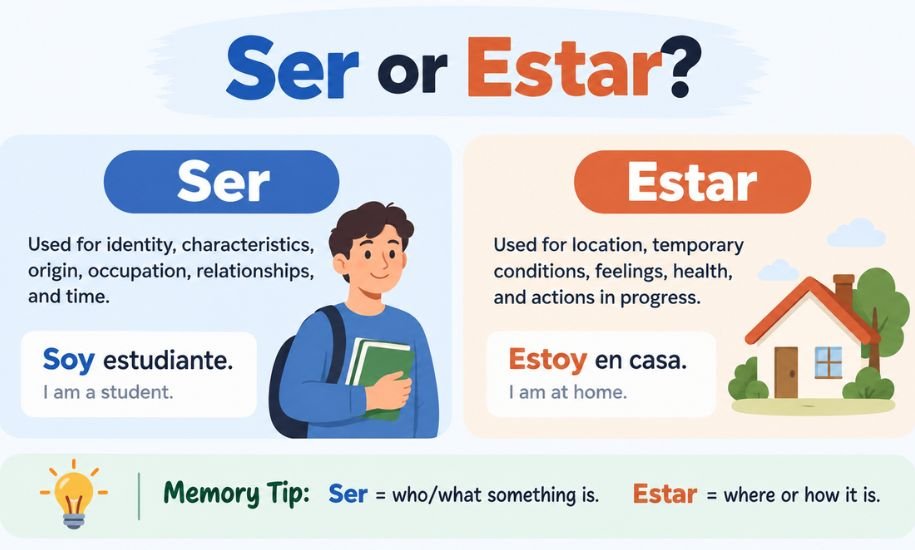
Ser and estar are both Spanish verbs meaning “to be,” but they are used differently. Use ser mainly for identity, origin, characteristics, occupations, relationships, time, and events. Use estar mainly for location, temporary conditions, feelings, health, and actions in progress.
Ser or Estar: What’s the Difference?
The easiest way to begin is to think about the kind of information you are giving.
Ser generally identifies or defines a person, object, or situation. It answers questions such as “What is it?”, “Who is it?”, “Where is it from?” or “What is it like?”
Estar generally describes a state, condition, location, or situation. It often answers questions such as “Where is it?”, “How is it?” or “What is happening right now?”
| Use | Ser | Estar |
|---|---|---|
| Identity | ✓ | |
| Occupation | ✓ | |
| Origin | ✓ | |
| Nationality | ✓ | |
| Characteristics | ✓ | |
| Relationships | ✓ | |
| Time and dates | ✓ | |
| Location | ✓ | |
| Feelings | ✓ | |
| Health/condition | ✓ | |
| Ongoing actions | ✓ | |
| Location of an event | ✓ | |
| Resulting state | ✓ |
The distinction is more useful than simply memorizing “permanent” versus “temporary.”
What Does “Ser” Mean?
Ser is one of the two main Spanish verbs for “to be.” It is used when describing identity, defining characteristics, origin, occupation, relationships, possession, time, and other information that identifies or defines something.
For example:
- Soy Ana. — I am Ana.
- Él es profesor. — He is a teacher.
- Somos de México. — We are from Mexico.
- Mi hermana es inteligente. — My sister is intelligent.
- Hoy es lunes. — Today is Monday.
Identity
Use ser to identify people and things.
- Ella es María. — She is María.
- Este es mi hermano. — This is my brother.
- ¿Qué es eso? — What is that?
Occupation
Professions and occupations normally use ser.
- Soy estudiante. — I am a student.
- Mi padre es médico. — My father is a doctor.
- Ellos son ingenieros. — They are engineers.
Origin and Nationality
Use ser when stating where someone or something comes from.
- Soy de España. — I am from Spain.
- Ella es argentina. — She is Argentine.
- El café es de Colombia. — The coffee is from Colombia.
Characteristics
Use ser for characteristics that describe what someone or something is like.
- Mi hermano es alto. — My brother is tall.
- La casa es grande. — The house is big.
- Ana es muy amable. — Ana is very kind.
Relationships
Family and other relationships generally use ser.
- Ella es mi hermana. — She is my sister.
- Carlos es mi amigo. — Carlos is my friend.
- Ellos son mis padres. — They are my parents.
Time and Dates
One important rule is that Spanish uses ser to express the time and date.
- Es la una. — It is one o’clock.
- Son las tres. — It is three o’clock.
- Hoy es martes. — Today is Tuesday.
- Es el diez de octubre. — It is October 10.
So if you are wondering is time ser or estar, the answer is ser.
What Does “Estar” Mean?
Estar is the other Spanish verb meaning “to be.” It is generally used for location, feelings, physical conditions, temporary states, and actions that are currently happening.
Examples include:
- Estoy en casa. — I am at home.
- Ella está cansada. — She is tired.
- Estamos felices. — We are happy.
- Están estudiando. — They are studying.
Location
Use estar for the location of people, objects, and places.
- Estoy en Madrid. — I am in Madrid.
- El libro está en la mesa. — The book is on the table.
- La escuela está cerca. — The school is nearby.
This is one of the most important differences to remember.
However, there is an important exception: events use ser for their location.
Compare:
- El libro está en la biblioteca. — The book is in the library.
- La conferencia es en la biblioteca. — The conference is at the library.
The book has a physical location, so estar is used. The conference is an event, so ser is used.
Feelings and Emotions
Use estar to describe emotional states.
- Estoy feliz. — I am happy.
- Ella está triste. — She is sad.
- Estamos preocupados. — We are worried.
- ¿Estás enojado? — Are you angry?
Health and Physical Conditions
Estar is commonly used for temporary health and physical conditions.
- Estoy enfermo. — I am sick.
- Ella está cansada. — She is tired.
- El niño está mejor. — The child is better.
- Estamos bien. — We are well.
Actions in Progress
Use estar + gerund to form the Spanish progressive construction.
- Estoy estudiando. — I am studying.
- Está trabajando. — He/She is working.
- Estamos comiendo. — We are eating.
- Están hablando. — They are talking.
This is another clear reason why learning the difference is important: English often uses “am/is/are + -ing,” while Spanish uses a form of estar followed by a gerund.
Ser and Estar Conjugations
Both verbs are irregular in the present tense, so their forms need to be learned individually.
| Subject | Ser | Estar |
|---|---|---|
| Yo | soy | estoy |
| Tú | eres | estás |
| Él/Ella/Usted | es | está |
| Nosotros/as | somos | estamos |
| Vosotros/as | sois | estáis |
| Ellos/Ellas/Ustedes | son | están |
Examples:
- Yo soy estudiante. — I am a student.
- Yo estoy cansado. — I am tired.
- Tú eres amable. — You are kind.
- Tú estás ocupado. — You are busy.
- Ella es española. — She is Spanish.
- Ella está en España. — She is in Spain.
Past and Future Forms
The verbs also have different forms in other tenses.
| Subject | Ser: Preterite | Estar: Preterite |
|---|---|---|
| Yo | fui | estuve |
| Tú | fuiste | estuviste |
| Él/Ella | fue | estuvo |
| Nosotros/as | fuimos | estuvimos |
| Vosotros/as | fuisteis | estuvisteis |
| Ellos/Ellas | fueron | estuvieron |
For the future:
- seré — I will be
- serás — you will be
- será — he/she will be
- seremos — we will be
- seréis — you will be
- serán — they will be
For estar:
- estaré
- estarás
- estará
- estaremos
- estaréis
- estarán
The preterite forms are particularly important because fui can represent either the preterite of ser or the preterite of ir, depending on context.
Examples That Show the Difference Clearly
Seeing the two verbs side by side can make the distinction much easier.
Identity vs. Location
- Soy de Madrid. — I am from Madrid.
- Estoy en Madrid. — I am in Madrid.
The first sentence identifies origin, so it uses ser. The second gives current location, so it uses estar.
Characteristic vs. Temporary State
- Ella es tranquila. — She is calm/quiet by nature.
- Ella está tranquila. — She is calm right now.
The first can describe a characteristic. The second describes her present state.
Boring vs. Bored
- Él es aburrido. — He is boring.
- Él está aburrido. — He is bored.
Changing the verb changes the meaning.
Smart vs. Ready
- Ella es lista. — She is smart.
- Ella está lista. — She is ready.
These examples show why translating both verbs simply as “to be” is not enough.
Good Person vs. Good Food
- Él es bueno. — He is a good person.
- La comida está buena. — The food is good/tastes good.
Again, the verb helps establish the intended meaning.
Why “Permanent vs. Temporary” Is Not Enough
You may have heard a beginner’s rule saying:
Ser = permanent
Estar = temporary
It is useful as a first memory aid, but it can cause problems if treated as an absolute rule.
For example:
Madrid está en España.
Madrid’s location is not temporary, yet estar is correct because this is a location.
Likewise:
La fiesta es en mi casa.
A party is temporary, but ser is correct because this sentence describes where an event takes place.
A better approach is to learn the function of each verb. Ask yourself what kind of information the sentence is expressing rather than deciding whether something is permanent.
Easy Ways to Remember the Difference
A traditional mnemonic for ser is DOCTOR:
- D — Description
- O — Occupation
- C — Characteristics
- T — Time
- O — Origin
- R — Relationships
For estar, PLACE can be useful:
- P — Position
- L — Location
- A — Action
- C — Condition
- E — Emotion
These memory devices are helpful, but they are not complete rules. The best long-term strategy is to associate each verb with its common grammatical functions.
Common Mistakes to Avoid
1. Using estar for a profession
Incorrect: Estoy profesor.
Correct: Soy profesor.
A profession normally uses ser.
2. Using ser for physical location
Incorrect: El libro es en la mesa.
Correct: El libro está en la mesa.
A person’s or object’s location uses estar.
3. Using estar for the time
Incorrect: Está las tres.
Correct: Son las tres.
Time is expressed with ser.
4. Forgetting the event exception
Incorrect: La fiesta está en mi casa.
Correct: La fiesta es en mi casa.
When you mean where an event takes place, use ser.
5. Assuming every adjective has exactly one verb
Some adjectives change meaning depending on whether they follow ser or estar.
For example:
- Es aburrido. — He is boring.
- Está aburrido. — He is bored.
Learning these combinations in context is more effective than applying a strict permanent/temporary rule.
A Quick Ser or Estar Practice Quiz
Choose ser or estar in each sentence.
- Yo ___ estudiante.
- María ___ cansada.
- Nosotros ___ de Colombia.
- El teléfono ___ en la mesa.
- Hoy ___ viernes.
- La reunión ___ en el hotel.
- Ellos ___ felices.
- Mi hermano ___ médico.
Answers
- soy — occupation/status
- está — temporary condition
- somos — origin
- está — location
- es — day/date
- es — event location
- están — emotion
- es — occupation
Try to explain why each answer is correct rather than simply memorizing the answers. That habit will make the distinction easier to apply to new sentences.
Frequently Asked Questions
Is “ser” or “estar” used for time?
Use ser. For example, Son las cinco means “It is five o’clock,” and Hoy es lunes means “Today is Monday.”
Is “es” ser or estar?
Es is a present-tense form of ser. It can mean “is” when referring to identity, characteristics, origin, occupation, time, and other uses of ser. The corresponding third-person singular form of estar is está.
Which verb is used for location?
Use estar for the location of people, objects, and places: El museo está en el centro. However, use ser when describing where an event takes place: El concierto es en el museo.
Are ser and estar both translated as “to be”?
Yes. Both are commonly translated as “to be” in English, but Spanish uses them in different contexts. English does not make the same grammatical distinction, which is why this can be challenging for learners.
How do I remember which one to use?
Start with the main patterns: ser for identity, characteristics, origin, occupation, relationships, and time; estar for location, conditions, feelings, and ongoing actions. Then learn the important exceptions, especially event locations and adjectives whose meanings change.
Final Verdict: Ser or Estar?
Both ser and estar are correct Spanish verbs, but they are used for different purposes. Think of ser as the verb that often identifies or defines something, while estar commonly describes a location, condition, feeling, or current state. Avoid relying exclusively on “permanent versus temporary”; learning the actual patterns will give you much more reliable results.
For more clear explanations of confusing words, grammar forms, and everyday language choices, Grammarifyr helps you know the difference and use the right words.
You may also Read : Spicey or Spicy: Meaning, Usage and Examples