Vertical or Horizontal: Easy Examples and Rules
When you see something described as vertical or horizontal, the choice usually comes down to direction: does it move from side to side, or from top to bottom? The distinction sounds simple, but it can become confusing when it appears in mathematics, spreadsheets, geography, or business terminology. For example, the x-axis is horizontal, a row is horizontal, and latitude is generally shown horizontally on maps. In business history, however, “horizontal” and “vertical” integration describe relationships between companies and stages of production. Here’s how to tell them apart quickly and use each term correctly.
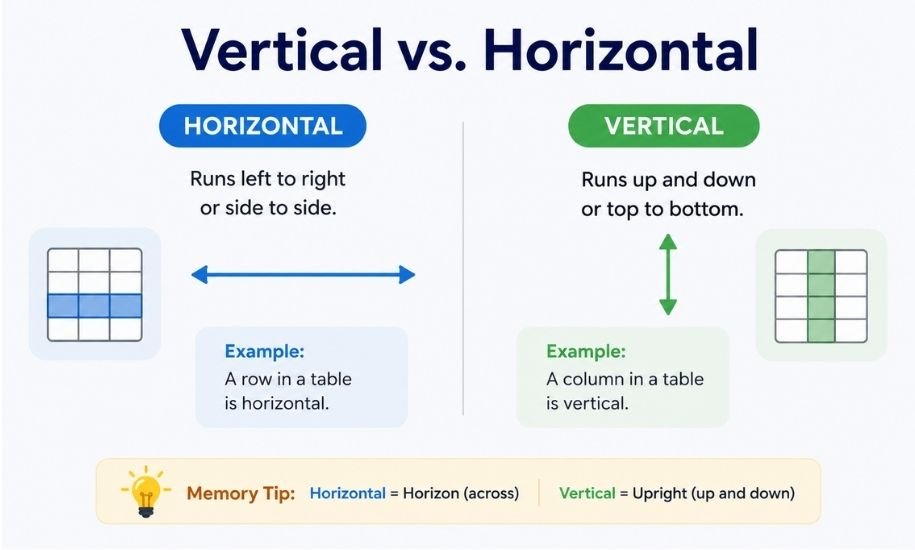
Horizontal means side to side, while vertical means up and down. In a standard coordinate plane, the x-axis is horizontal and the y-axis is vertical. A row is horizontal, while a column is vertical.
Horizontal vs. Vertical at a Glance
| Feature | Horizontal | Vertical |
|---|---|---|
| Direction | Left to right | Up to down |
| Visual | — | | |
| Coordinate axis | X-axis | Y-axis |
| Spreadsheet | Row | Column |
| Line equation | y = constant | x = constant |
| Slope | 0 | Undefined |
The simplest distinction is direction. Something horizontal extends across your field of view; something vertical extends upward or downward.
A useful memory trick is horizontal = horizon. The horizon appears to stretch from left to right. Vertical objects, such as poles and standing people, extend upward and downward.
What Does “Horizontal” Mean?
Horizontal describes something that runs from one side to another, generally parallel to the horizon.
For example:
- The shelf is horizontal.
- Draw a horizontal line across the page.
- The table has several horizontal rows.
- The x-axis runs horizontally across the graph.
In everyday language, horizontal often describes position, direction, arrangement, or movement.
If you move horizontally, you normally move left or right, rather than up or down.
What Does “Vertical” Mean?
Vertical describes something that extends from top to bottom or follows an upright direction.
Examples include:
- The flagpole is vertical.
- Draw a vertical line down the page.
- The building has several vertical columns.
- The y-axis runs vertically through the graph.
If you move vertically, you normally move up or down.
The two directions are perpendicular when they meet at a right angle.
Is a Row Horizontal or Vertical?
A row is horizontal.
Think of a table or spreadsheet. A row runs across the page:
Row 1  →  A   B   C   D
Row 2  →  A   B   C   D
Row 3  →  A   B   C   D
A column, on the other hand, runs from top to bottom:
Column
  ↓
  A
  B
  C
  D
So the easiest rule is:
Rows go across; columns go down.
This applies to spreadsheets, tables, databases, matrices, and many other grid-based layouts.
Is X Horizontal or Vertical?
In the standard two-dimensional Cartesian coordinate system, x is horizontal and y is vertical. The x-axis runs left to right, while the y-axis runs up and down.
This also explains how ordered pairs work.
In (x, y):
- x tells you the horizontal position.
- y tells you the vertical position.
For example, the point (4, 3) means you move 4 units horizontally and 3 units vertically from the origin.
Easy way to remember it
Think:
X = across
Y = up/down
This convention is so common that once you associate x with horizontal and y with vertical, many coordinate problems become easier.
Horizontal or Vertical Line in Mathematics
A horizontal line and a vertical line have distinctive equations.
Horizontal line
A horizontal line has a constant y-value. Its general form is:
y = b
For example:
y = 4
Every point on this line has a y-coordinate of 4, while the x-coordinate can change. OpenStax describes horizontal lines as having a constant output or y-value.
A horizontal line also has a slope of 0.
Vertical line
A vertical line has a constant x-value. Its general form is:
x = a
For example:
x = 4
Every point on this line has an x-coordinate of 4, while the y-coordinate can change.
A vertical line has an undefined slope, because the horizontal change is zero.
Examples
y = 7→ horizontaly = -2→ horizontalx = 5→ verticalx = -8→ vertical
Distance Between Points: Vertical or Horizontal?
When working with points on a coordinate plane, you can determine whether the segment connecting them is horizontal or vertical by comparing their coordinates.
Horizontal distance
Two points form a horizontal segment when they have the same y-coordinate.
For example:
(2, 5) and (8, 5)
The y-coordinate is 5 for both points, so the segment is horizontal.
The distance is:
|8 - 2| = 6 units
Vertical distance
Two points form a vertical segment when they have the same x-coordinate.
For example:
(4, 2) and (4, 9)
The x-coordinate is 4 for both points, so the segment is vertical.
The distance is:
|9 - 2| = 7 units
Khan Academy specifically teaches students to find distances between points sharing the same x- or y-coordinate, and this is also aligned with the relevant sixth-grade coordinate-plane standard.
A useful rule is:
Horizontal → subtract x-values.
Vertical → subtract y-values.
If neither coordinate matches, the segment is neither purely horizontal nor purely vertical, so the general distance formula may be needed.
Is Latitude Horizontal or Vertical?
Latitude is generally represented by horizontal lines on conventional maps.
Latitude measures how far north or south a location is from the Equator. Lines of latitude are called parallels because they run parallel to one another.
A simple way to remember the usual map representation is:
- Latitude → horizontal
- Longitude → vertical
However, “horizontal” here describes the conventional way geographic coordinates are displayed on a map. Earth itself is spherical, so latitude lines are not literally flat lines in three-dimensional space.
Is Rockefeller Associated With Horizontal or Vertical Integration?
If you’re asking whether John D. Rockefeller used horizontal or vertical integration, the most accurate answer is:
Rockefeller used both.
The distinction matters because Standard Oil’s expansion involved different strategies at different stages.
Horizontal integration
Rockefeller initially became especially associated with horizontal integration by consolidating competing oil refineries.
Horizontal integration occurs when a company acquires or combines with businesses operating at essentially the same stage of an industry.
For Standard Oil, that meant gaining control over competing refineries. OpenStax identifies Standard Oil’s mergers and acquisitions of similar oil businesses as horizontal integration.
Vertical integration
Standard Oil also pursued vertical integration, gaining control over different stages involved in getting petroleum products from production to customers.
Historical accounts describe Standard Oil’s expansion into areas such as oil fields, pipelines, transportation, and marketing. The Gilder Lehrman material notes that by the early 1890s, Standard Oil had achieved both substantial horizontal and vertical integration.
So if a history question asks “Was Rockefeller’s strategy horizontal or vertical integration?”, the safest answer depends on what it is emphasizing:
- Buying competing refineries → horizontal integration
- Controlling multiple stages of the oil supply chain → vertical integration
- Standard Oil overall → both
This is why simply labeling Rockefeller’s entire business strategy as only horizontal or only vertical can be misleading.
Horizontal vs. Vertical Integration
The business meanings are different from the ordinary directional meanings.
Horizontal integration means expanding across the same level of an industry.
Example:
Oil refinery A acquires oil refinery B.
Both businesses perform a similar function.
Vertical integration means expanding through different stages of a supply chain.
Example:
Oil production → transportation → refining → distribution
A company that controls several of those stages is vertically integrated.
A useful conceptual distinction is:
Horizontal = more of the same stage.
Vertical = more stages of the process.
Standard Oil is a particularly useful historical example because it employed both approaches.
Common Mistakes With Horizontal and Vertical
1. Calling a row vertical
A row runs across, so it is horizontal. A column runs up and down, so it is vertical.
2. Mixing up x and y
In the standard Cartesian plane:
- x = horizontal
- y = vertical
Remember “x is across.”
3. Assuming every distance uses the same coordinate
For a horizontal segment, compare the x-values. For a vertical segment, compare the y-values.
4. Saying Rockefeller used only one type of integration
Rockefeller’s Standard Oil is associated with horizontal integration as well as vertical integration. The refinery consolidation is the classic horizontal example, while control of multiple stages of the petroleum business illustrates vertical integration.
5. Treating “horizontal” and “vertical” as mathematical terms only
The words also describe layouts, geography, organizational structures, business strategies, and physical orientation. The meaning depends on context.
A Simple Way to Remember the Difference
Use these four associations:
Horizontal → horizon → across
Vertical → standing upright → up/down
Then apply the rule to common examples:
- Row → horizontal
- Column → vertical
- X-axis → horizontal
- Y-axis → vertical
- Horizontal line →
y = constant - Vertical line →
x = constant - Latitude → generally horizontal on maps
- Rockefeller → both horizontal and vertical integration
Once the basic directional distinction is clear, most of these related questions become much easier.
Frequently Asked Questions
Is horizontal left to right?
Yes. Horizontal generally describes a direction running from left to right or right to left, parallel to the horizon.
Is vertical up and down?
Yes. Vertical describes an upright direction, extending from top to bottom or bottom to top.
Is the x-axis horizontal or vertical?
The x-axis is horizontal in the standard two-dimensional Cartesian coordinate system. The y-axis is vertical.
Is a row horizontal or vertical?
A row is horizontal because it extends across a table or grid. A column is vertical.
Is latitude horizontal or vertical?
Latitude is conventionally shown as horizontal lines on standard maps. Longitude is generally represented by lines running north to south.
Did Rockefeller use horizontal or vertical integration?
Both. Rockefeller’s Standard Oil first became strongly associated with horizontal integration through the consolidation of competing refineries, and it also developed extensive vertical integration across different parts of the petroleum supply chain.
The Bottom Line
Horizontal means side to side, while vertical means up and down. That basic distinction explains why rows are horizontal, columns are vertical, x is horizontal, and y is vertical. In mathematics, it also tells you which coordinate to compare when finding horizontal or vertical distance. In business history, the terms take on a related but specialized meaning: Rockefeller’s Standard Oil used both horizontal and vertical integration. For more clear explanations of easily confused terms and forms, Grammarify helps you know the difference and use the right words.
You may also Read : Bachelors or Bachelor’s: The Simple Grammar Guide