Bachelors or Bachelor’s: The Simple Grammar Guide
If you are writing about university qualifications, it is easy to hesitate over bachelors or bachelor’s. The apostrophe changes the grammatical form and, in some contexts, the meaning. The good news is that the rule is straightforward: bachelor’s is the standard form when referring to a bachelor’s degree, while bachelors is simply the plural of bachelor. Understanding when the apostrophe belongs will help you avoid forms such as “bachelors degree” and “bachelor degree” in formal writing.
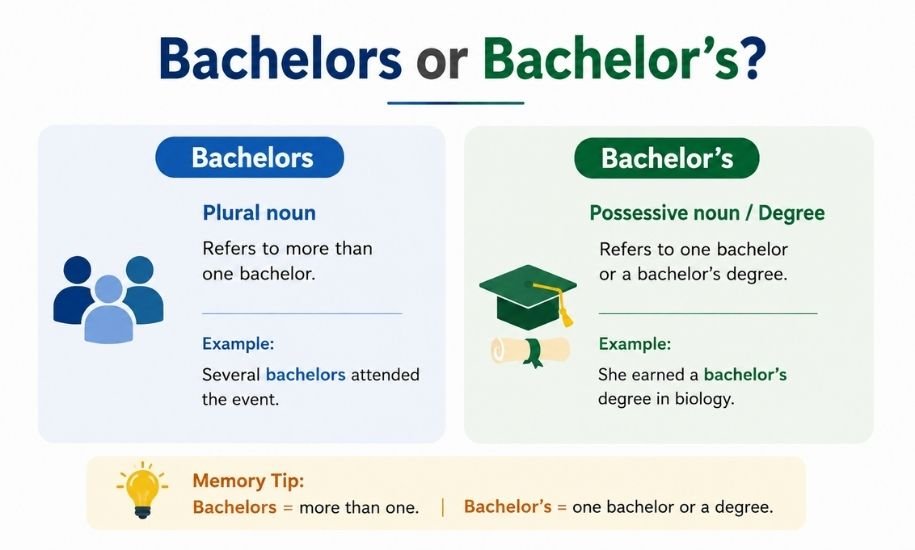
Bachelor’s is correct when referring to a bachelor’s degree, as in “She earned a bachelor’s degree.” Bachelors is the plural of “bachelor,” meaning more than one bachelor. For formal degree titles, use forms such as “Bachelor of Arts” or “Bachelor of Science,” without an apostrophe.
Bachelors vs. Bachelor’s: The Key Difference
Both bachelors and bachelor’s can be grammatically correct, but they serve different purposes.
| Form | Function | Example |
|---|---|---|
| bachelors | Plural noun | Several bachelors attended the event. |
| bachelor’s | Possessive noun or shortened degree reference | He completed his bachelor’s. |
| bachelor’s degree | Academic qualification | She has a bachelor’s degree in biology. |
| Bachelor of Arts | Formal degree title | He earned a Bachelor of Arts. |
The important point is that bachelors does not mean a bachelor’s degree. If you are talking about the academic qualification, bachelor’s degree is the standard expression.
What Does “Bachelors” Mean?
Bachelors is the plural form of bachelor. It refers to more than one bachelor.
For example:
- The three bachelors shared an apartment.
- Several bachelors attended the dinner.
- The novel follows two young bachelors living in London.
In these sentences, the word has no apostrophe because it is simply a plural noun.
The singular is bachelor, and the plural is bachelors:
one bachelor → two bachelors
The apostrophe is unnecessary because there is no possession involved.
What Does “Bachelor’s” Mean?
Bachelor’s is the singular possessive form of bachelor. It can indicate that something belongs to or is associated with one bachelor.
For example:
- The bachelor’s apartment was surprisingly spacious.
- I borrowed the bachelor’s car.
- The bachelor’s decision surprised everyone.
The apostrophe before the s shows the possessive relationship.
However, bachelor’s has another very common use. It can be a shortened reference to a bachelor’s degree:
She completed her bachelor’s last year.
He is working toward his bachelor’s.
When the context clearly concerns education, readers understand bachelor’s as shorthand for bachelor’s degree.
Bachelor Degree or Bachelor’s Degree?
When you mean an undergraduate academic qualification, bachelor’s degree is the standard form.
Correct
She earned a bachelor’s degree in history.
He is pursuing a bachelor’s degree in engineering.
I already have a bachelor’s degree in English.
Usually avoid
She earned a bachelor degree in history.
He is pursuing a bachelor degree in engineering.
The apostrophe is part of the conventional expression bachelor’s degree.
The same pattern applies to master’s degree:
She has a master’s degree in education.
This distinction explains why phrases such as “bachelor degree or bachelor’s degree” can cause confusion. For the general name of the qualification, bachelor’s degree is the appropriate choice.
Why Is There an Apostrophe in “Bachelor’s Degree”?
The apostrophe marks the possessive form bachelor’s. In the established expression bachelor’s degree, the degree is associated with a bachelor.
English commonly retains this possessive construction even though modern speakers do not usually think about literal ownership when saying “bachelor’s degree.”
That is why the standard forms are:
- bachelor’s degree
- master’s degree
- bachelor’s degrees
- master’s degrees
The apostrophe does not disappear simply because degrees is plural.
For example:
The university offers several bachelor’s degrees.
Here, degrees is plural, while bachelor’s remains possessive.
Bachelor’s Degree or Bachelor of Arts?
One of the most important distinctions is between a general description of a degree and its formal title.
Use bachelor’s degree when speaking generally:
She earned a bachelor’s degree in chemistry.
Use the formal title Bachelor of Arts or Bachelor of Science when naming the specific degree:
She earned a Bachelor of Arts in English.
He received a Bachelor of Science in physics.
Notice that Bachelor of Arts does not contain an apostrophe. It is a formal degree name, not the possessive construction bachelor’s degree.
Other formal titles follow the same pattern:
- Bachelor of Fine Arts
- Bachelor of Engineering
- Bachelor of Business Administration
- Bachelor of Music
The exact capitalization can depend on the institution’s style, but formal degree names are generally capitalized.
When Should You Use “Bachelor’s” by Itself?
You can use bachelor’s alone when it clearly means bachelor’s degree.
For example:
After finishing his bachelor’s, he applied to graduate school.
She completed her bachelor’s in psychology.
This is particularly natural when the educational context has already been established.
For maximum clarity, especially in formal writing, you can use the complete phrase:
She completed her bachelor’s degree in psychology.
The shortened form is not the same as bachelors. The apostrophe remains because the shortened word represents bachelor’s degree.
Examples in Sentences
Here are some examples showing how the forms work in different contexts.
Plural: “bachelors”
Several bachelors rented rooms in the same building.
The story centers on two wealthy bachelors.
Possessive: “bachelor’s”
The bachelor’s house was near the university.
We were invited to the bachelor’s apartment.
Academic qualification: “bachelor’s degree”
Maya earned a bachelor’s degree in journalism.
A bachelor’s degree is required for the position.
Shortened academic reference: “bachelor’s”
He completed his bachelor’s before moving abroad.
Formal degree title
She received a Bachelor of Science in computer science.
Common Mistakes to Avoid
1. Writing “bachelors degree”
Incorrect:
He has a bachelors degree in economics.
Correct:
He has a bachelor’s degree in economics.
2. Dropping the apostrophe in “bachelor degree”
If you mean the general academic qualification, use bachelor’s degree, not “bachelor degree.”
3. Writing “Bachelor’s of Science”
Incorrect:
She earned a Bachelor’s of Science.
Correct:
She earned a Bachelor of Science.
The formal title uses Bachelor of Science, not “Bachelor’s of Science.”
4. Using “bachelors” for a degree
Incorrect:
I finished my bachelors last year.
Correct:
I finished my bachelor’s last year.
If you mean the degree, the apostrophe is required.
5. Confusing “bachelor’s degrees” with “bachelors”
Correct:
The university offers several bachelor’s degrees.
Here, degrees is the plural noun. Bachelor’s remains possessive.
An Easy Way to Remember the Difference
Use this simple rule:
Bachelors = more than one bachelor.
one bachelor → several bachelors
Bachelor’s = belonging to one bachelor or referring to a bachelor’s degree.
a bachelor’s apartment
a bachelor’s degree
And remember a third pattern:
Bachelor of Arts / Bachelor of Science = formal degree title.
So if you are talking about university education, the safest quick check is:
bachelor’s degree ✅
not:
bachelors degree ❌
Frequently Asked Questions
Is it bachelor or bachelor’s?
It depends on the context. Bachelor is the singular noun, while bachelor’s is the possessive form and is also used in bachelor’s degree. For an academic qualification, write bachelor’s degree.
Is it bachelors or bachelor’s degree?
If you mean an academic qualification, use bachelor’s degree. Bachelors is simply the plural of bachelor and does not normally refer to an academic degree.
Is “bachelor degree” grammatically correct?
For standard English, bachelor’s degree is the preferred expression when referring generally to the academic qualification. However, Bachelor without an apostrophe is correct in formal titles such as Bachelor of Arts and Bachelor of Science.
Is it bachelor’s degrees or bachelors degrees?
The correct plural is bachelor’s degrees. The word degrees carries the plural, so the possessive bachelor’s keeps its apostrophe.
Can “bachelor’s” stand alone?
Yes. When the educational context is clear, bachelor’s can be used as a shortened reference to bachelor’s degree, as in “She completed her bachelor’s.”
Should “bachelor’s degree” be capitalized?
Usually not when it is a general reference: bachelor’s degree. Capitalize formal degree names such as Bachelor of Arts or Bachelor of Science, following the applicable style guide.
The Bottom Line
Use bachelors when you mean more than one bachelor. Use bachelor’s when showing possession or when referring to a bachelor’s degree, including the shortened form “my bachelor’s.” For a formal degree title, use Bachelor of Arts, Bachelor of Science, and similar constructions without an apostrophe. For clear, accurate word-choice guidance, Grammarify helps you know the difference and use the right words.
You may also Read : Family’s or Families: What’s the Difference?
One Comment