Humour or Humor: Meaning, Differences and Examples
Have you ever wondered whether to write humour or humor? Both spellings are correct, but the right choice depends on the variety of English you are using. British English prefers humour, while American English uses humor. The two words have the same meaning and can be used as both nouns and verbs. The difference is simply a regional spelling preference, not a difference in definition. Understanding this distinction will help you write consistently, choose the right form for your audience, and avoid confusion in everyday writing.
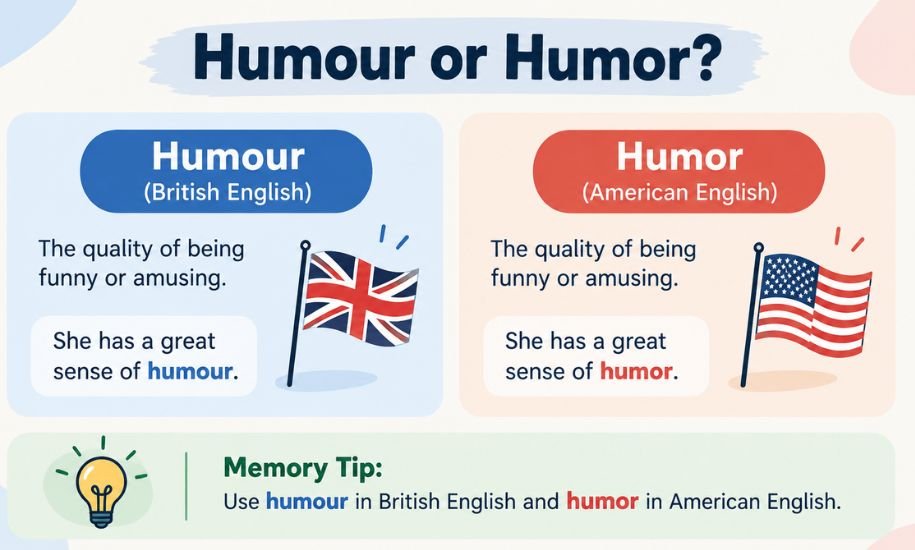
Both humour and humor are correct spellings. Use humour in British English and humor in American English. Both refer to the quality of being funny, the ability to appreciate something amusing, or the act of accommodating someone’s wishes.
Humour vs. Humor: What’s the Difference?
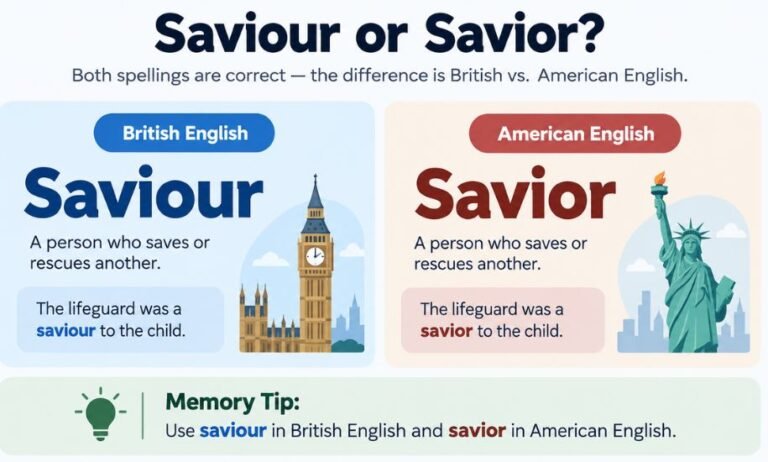
The main difference is regional spelling. British English generally retains the letter u in words such as humour, colour, and favour. American English typically omits it, producing humor, color, and favor.
| Feature | Humour | Humor |
|---|---|---|
| Correct spelling | Yes | Yes |
| English variety | British English | American English |
| Meaning | Funniness, amusement, or mood | Funniness, amusement, or mood |
| Part of speech | Noun and verb | Noun and verb |
| Example | She has a great sense of humour. | She has a great sense of humor. |
| Related verb form | Humoured | Humored |
Neither spelling is universally better or more correct. Your choice should depend on your intended audience and the spelling convention you follow throughout your writing.
What Does Humour Mean?
Humour is the standard British English spelling of the word. As a noun, it describes the quality of being amusing, the ability to recognize funny situations, or a person’s general mood. As a verb, it means to accommodate someone or go along with their wishes, sometimes to keep them happy or avoid an argument.
Here are some examples:
- Amusement: The comedian’s humour made the entire audience laugh.
- Personal quality: My grandmother has a wonderful sense of humour.
- Style of comedy: His dry humour makes even ordinary stories entertaining.
- Verb: She decided to humour her younger brother by listening to his unusual idea.
The meaning depends on how the word is used in a sentence. In most everyday contexts, it relates to comedy, amusement, or a person’s ability to appreciate something funny.
What Does Humor Mean?
Humor is the standard American English spelling of the same word. It has the same meanings as its British counterpart and can also function as a noun or a verb.
Consider these examples:
- Amusement: The movie uses humor to make a serious subject easier to understand.
- Personal quality: He has an excellent sense of humor.
- Style of comedy: Her sarcastic humor is not appreciated by everyone.
- Verb: The teacher decided to humor the curious student and answer another question.
The spelling changes, but the definition does not. An American writer would normally use humor and humored, while a British writer would generally choose humour and humoured.
When Should You Use Each Spelling?
The easiest way to choose is to consider who will read your writing.
Use “humour” in British English
Choose humour when writing for readers who expect British spelling conventions. This includes most UK-focused publications and many other contexts that follow British English.
Examples:
- The author uses humour to explore serious social issues.
- Her sense of humour helped everyone relax.
- He humoured his friend by pretending to believe the story.
Use “humor” in American English
Choose humor when writing for a US audience or following an American English style guide.
Examples:
- The author uses humor to discuss serious social issues.
- Her sense of humor helped everyone relax.
- He humored his friend by pretending to believe the story.
Other varieties of English may follow British-style spelling or their own established conventions. When in doubt, follow the dictionary or style guide used by your publication.
The most important rule is consistency. Avoid switching between humour and humor within the same article unless you are quoting a source or discussing the spelling difference itself.
“I Like Your Humor” or “I Like Your Humour”?
Both expressions are correct. The choice depends on whether you are using American or British English.
- “I like your humour.” This is the usual form in British English.
- “I like your humor.” This is the usual form in American English.
Both sentences express appreciation for someone’s ability to make people laugh or see the amusing side of a situation.
For example, if a British friend tells a funny story, you might say, “I love your sense of humour.” In an American conversation, you would normally say, “I love your sense of humor.”
Neither sentence is grammatically superior. The spelling simply reflects the variety of English being used.
Examples of Humour and Humor in Sentences
The following examples show how the two spellings work in different contexts.
| Context | British English | American English |
|---|---|---|
| Personal quality | She has a great sense of humour. | She has a great sense of humor. |
| Comedy | His humour is subtle and clever. | His humor is subtle and clever. |
| Entertainment | The play combines humour with drama. | The play combines humor with drama. |
| Everyday conversation | I appreciate your humour. | I appreciate your humor. |
| Past-tense verb | They humoured the guest. | They humored the guest. |
| Mood | He was in a good humour. | He was in a good humor. |
These examples demonstrate that the words retain their meanings across both varieties. Only the spelling conventions and certain associated forms change.
What Are Some Synonyms for Humour or Humor?
Several words are related to humour, but the best synonym depends on the context.
- Wit: The ability to express clever or amusing ideas.
- Comedy: Entertainment designed to amuse an audience.
- Amusement: The feeling of finding something entertaining or funny.
- Mirth: Happiness or laughter caused by something amusing.
- Satire: Humour used to criticize people, institutions, or social problems.
- Playfulness: A light-hearted attitude or manner.
- Fun: Enjoyment or an entertaining experience.
For instance, wit may describe someone’s clever remarks, while comedy often refers to a performance or genre. Satire is more specific because it uses humour to make a point or expose a problem.
These words are related in meaning, but they are not interchangeable in every sentence.
Is “Humourous” or “Humorous” Correct?
The standard spelling is humorous, in both British and American English.
Although the noun is spelled humour in British English, its related adjective is generally spelled humorous, without the additional u. American English also uses humorous.
Examples:
- Correct: The speaker gave a humorous presentation.
- Incorrect in standard modern usage: The speaker gave a humourous presentation.
This is a useful distinction because British English does not preserve the extra u in every word related to humour. Learning the adjective separately can help prevent spelling mistakes.
Frequently Asked Questions
1. Is humour or humor correct in the UK?
Humour is the standard spelling in the United Kingdom. It follows the British convention of retaining the letter u in words such as colour and favour. Although readers will understand humor, British publications generally prefer the spelling with u.
2. Do humour and humor have different meanings?
No. They have the same meanings and grammatical functions. Both can refer to something funny, a person’s ability to appreciate comedy, a mood, or the act of accommodating someone’s wishes. The distinction is regional spelling rather than meaning.
3. How do you pronounce humour and humor?
The two spellings have essentially the same pronunciation within their respective English varieties. The word begins with a sound similar to the beginning of human, and the stress falls on the first syllable. The final vowel may sound slightly different between British and American accents.
4. Is “sense of humour” or “sense of humor” correct?
Both expressions are correct. Sense of humour is standard in British English, while sense of humor is standard in American English. Both describe someone’s ability to recognize, appreciate, or create something funny.
5. What is the correct adjective: humorous or humourous?
Humorous is the standard spelling in both British and American English. The noun follows the regional pattern—humour or humor—but the adjective does not normally take an additional u. For example, write “a humorous story” regardless of which variety of English you use.
Final Verdict: Humour or Humor?
Both spellings are correct, and the difference comes down to regional English conventions. Choose humour for British English and humor for American English. Keep your spelling consistent, and remember that the related adjective is humorous in both varieties. For more straightforward explanations of confusing words and spelling differences, Grammarifyr helps you know the difference and use the right words.
You may also Read : Repast or Repass: Meaning, Difference and Usage