Neice or Niece: Meaning, Spelling and Examples
Have you ever paused while writing the word for your brother’s or sister’s daughter and wondered whether it should be neice or niece? The two spellings look almost identical, making it easy to mix up the letters. However, only one is correct in standard English. Understanding the proper spelling, meaning, and pronunciation will help you avoid this common mistake in emails, messages, schoolwork, and other writing. The good news is that there is a simple way to remember the correct form.
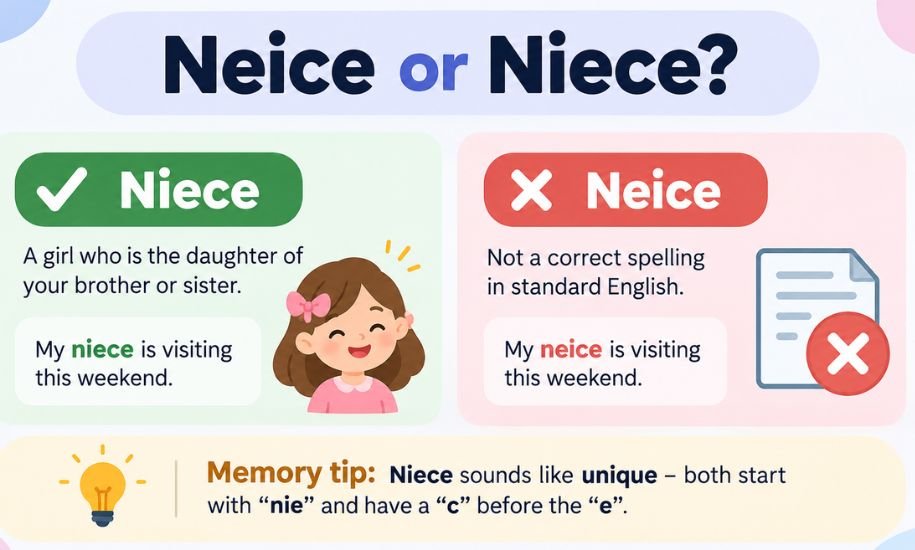
**Niece** is the correct spelling. **Neice** is a misspelling and is not the standard form in English. A niece is the daughter of your brother or sister, or of your spouse’s brother or sister. The spelling is the same in British and American English.
Neice or Niece: What Is the Difference?
The difference comes down to the order of two letters. In standard English, the correct spelling is niece, with the letter i before e after the initial n. The spelling neice reverses these vowels and is incorrect when referring to a female family member.
| Feature | Niece | Neice |
|---|---|---|
| Correct spelling | Yes | No |
| Meaning | A female family relative | No standard meaning for this intended use |
| Part of speech | Noun | Misspelling of the noun |
| British English | Correct | Incorrect |
| American English | Correct | Incorrect |
| Example | My niece loves reading. | My neice loves reading. (Incorrect) |
For example:
- Correct: My niece is coming to visit us on Sunday.
- Incorrect: My neice is coming to visit us on Sunday.
The first sentence uses the accepted spelling. The second contains a spelling error, even though the intended meaning is understandable.
What Does “Niece” Mean?
A niece is a female relative who is the daughter of your brother or sister. The word also applies to the daughter of your husband’s or wife’s brother or sister.
For example, if your sister has a daughter named Emily, Emily is your niece. Likewise, if your brother has a daughter, she is also your niece.
The word is a noun and can appear as the subject or object of a sentence.
Here are some examples:
- My niece starts school next month.
- I bought a birthday present for my niece.
- Her niece enjoys drawing and painting.
- We invited our nieces and nephews to the family celebration.
In each sentence, the word identifies a female family member.
Niece vs. Nephew
Niece and nephew describe related family relationships, but they refer to different genders in traditional English usage.
- Niece: The daughter of your sibling.
- Nephew: The son of your sibling.
For example, your brother’s daughter is your niece, while his son is your nephew. The same distinction applies to the children of your sister.
The plural forms are nieces and nephews. If you are referring to both groups together, you can write “my nieces and nephews.”
Is “Neice” a Real Word?
In standard English, neice is considered a misspelling of niece. It is not an accepted alternative spelling for the family relationship.
You might encounter the incorrect form in an informal message, a social media post, or a piece of writing that has not been proofread. Its appearance does not make it a standard spelling.
For example:
- Correct: My niece sent me a lovely card.
- Incorrect: My neice sent me a lovely card.
The incorrect version may still be understood because the context makes the intended meaning clear. Nevertheless, you should use niece in formal writing, professional correspondence, educational assignments, and everyday communication.
If you see neice in a document, correct it to niece unless it is deliberately being reproduced as a spelling error or appears as part of a proper name.
Why Do People Confuse the Two Spellings?
The confusion usually occurs because the words contain the same letters in a slightly different order. English spelling does not always follow one simple pattern, and the familiar phrase “i before e” can sometimes lead writers to second-guess themselves.
There are three practical reasons the mistake happens:
1. Reversing the vowels
The most direct cause is placing e before i instead of using the correct sequence. Because the word is short, writers may make the mistake without noticing it.
2. Relying on how a word sounds
The pronunciation does not clearly indicate the order of the written vowels. Someone who knows the word orally but has rarely written it may have difficulty remembering its spelling.
3. Typing quickly
When writing a text message, email, or social media post, people sometimes type the wrong letter sequence. A quick review can catch the error before the message is sent.
The solution is to learn the spelling as a complete word rather than trying to work it out from pronunciation alone.
How to Spell “Niece” Correctly
The word contains five letters:
N – I – E – C – E
Remember the sequence niece, not neice. Breaking it into its individual letters can help if you frequently reverse the vowels.
A useful memory trick is to connect niece with piece. Both words contain the letter sequence iece.
For example:
- niece
- piece
Think of the phrase “a niece is a special piece of the family.” You do not need to use this phrase when writing; it is simply a reminder of the correct letter order.
Another practical method is to write the word correctly several times in a sentence:
“My niece is visiting.”
“My niece enjoys music.”
“I bought a gift for my niece.”
Using the word in natural sentences helps reinforce the spelling and its meaning at the same time.
Is the Spelling Different in British and American English?
No. Niece is the standard spelling in both British and American English.
Some English words have different spellings depending on the region. For example, British English commonly uses colour, while American English uses color. The same type of regional variation does not apply to niece.
Here are examples that are correct in both varieties:
- My niece lives in London.
- My niece lives in New York.
- Her niece is learning to play the piano.
- Their nieces are visiting during the holidays.
If you are writing for a British audience, use niece. If you are writing for an American audience, use niece as well. There is no need to change the spelling to suit either variety.
How to Pronounce “Niece”
The word niece is pronounced /niːs/. It sounds like “neess,” rhyming with words such as piece and peace.
The pronunciation is essentially the same in standard British and American English, although individual accents may produce small differences.
A useful way to remember the spelling is to connect it with piece, which has the same final four letters and a similar vowel sound.
Keep in mind that pronunciation alone cannot reliably tell you whether the word should be written as niece or neice. Learning the correct spelling is the safest approach.
What Is the Plural of “Niece”?
The plural of niece is nieces. You form it by adding s to the singular noun.
| Form | Example |
|---|---|
| Singular: niece | My niece is seven years old. |
| Plural: nieces | My nieces are seven and ten years old. |
Use niece when referring to one person and nieces when referring to two or more.
For example:
- My niece is interested in science.
- My three nieces enjoy playing together.
Do not confuse the plural form with the spelling error neice. The correct singular spelling remains niece, and the correct plural is nieces.
Frequently Asked Questions
1. Is it neice or niece?
Niece is correct. The spelling neice is a common error caused by reversing the letters i and e. Use niece whenever you mean the daughter of your brother or sister, or of your spouse’s sibling.
2. Is “neice” correct in British English?
No. British English uses niece, just like American English. The incorrect spelling is not a regional variation, so you should not use it in standard British writing.
3. How do you spell niece and nephew?
Niece refers to the daughter of your sibling, while nephew refers to the son of your sibling. Their plurals are nieces and nephews. Both words describe family relationships.
4. What is the plural of niece?
The plural is nieces. Simply add the letter s to the end of the singular form. For example, “My niece is visiting” becomes “My nieces are visiting” when you are talking about more than one person.
5. How can I remember the correct spelling?
Connect niece with piece. Both contain the sequence iece, which makes the correct vowel order easier to recall. You can also practise writing the word in short sentences until the spelling becomes familiar.
6. Is “niece” a noun?
Yes. Niece is a countable noun that identifies a female family member. You can use it as a subject, as in “My niece is here,” or as an object, as in “I called my niece.”
Final Verdict: Neice or Niece?
The correct spelling is niece, not neice. The word refers to the daughter of your brother or sister, and its spelling remains the same in British and American English. Remember the connection between niece and piece to keep the letters in the right order. For more practical explanations of confusing words and spelling mistakes, Grammarifyr helps you know the difference and use the right words.
You may also Read : Bellow or Below: Correct Usage Explained