Requester or Requestor: Meaning and Usage
If you are unsure whether the person making a request should be called a requester or a requestor, you are not alone. The two forms look almost identical, sound the same, and have essentially the same meaning. The good news is that neither spelling is simply an error: both are recognized English nouns. However, requester is the better default for most general writing, while requestor is a legitimate alternative that appears in some specialized and technical contexts.
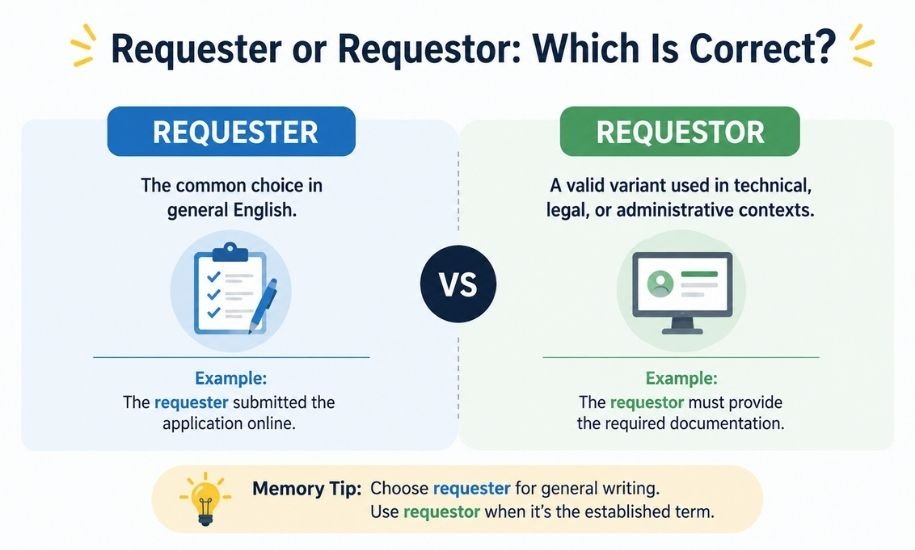
Requester and requestor are both correct words for someone who makes a request. Requester is the better general-purpose choice, while requestor is a valid variant often encountered in specialized, administrative, legal, or technical language. If you are choosing a spelling for ordinary writing, use requester.
Requester or Requestor: What’s the Difference?
The simplest answer is that there is very little difference in meaning.
A requester is a person or organization that asks for something. Cambridge Dictionary lists requestor as an alternative form of requester, and Merriam-Webster likewise gives “requester” as a noun “or requestor.”
| Feature | Requester | Requestor |
|---|---|---|
| Correct word? | Yes | Yes |
| Meaning | Someone who makes a request | Someone who makes a request |
| Part of speech | Noun | Noun |
| General writing | Preferred | Less common |
| Specialized contexts | Common | Can be established terminology |
| Plural | Requesters | Requestors |
So, if someone asks for a document, service, answer, payment, or other item, that person can technically be described as either a requester or a requestor.
The important point is that requestor is not simply a misspelling of requester.
What Does “Requester” Mean?
Requester is a noun formed from the verb request. It refers to someone or something that makes a request.
For example:
- The requester provided the required identification.
- Please contact the requester for more information.
- The system sends an email to the requester after the application is approved.
- The requester asked for a copy of the report.
The word can refer to an individual, an organization, or, particularly in technical contexts, a system or component that makes a request.
For ordinary English, requester is the clearest choice.
What Does “Requestor” Mean?
Requestor is also a noun meaning someone or something that makes a request. It is an accepted variant of requester, not a word with a fundamentally different definition. Cambridge explicitly gives “also requestor,” while Merriam-Webster lists “requester noun or requestor.”
Examples include:
- The requestor must provide proof of identity.
- The software records the identity of the requestor.
- The agency notified the requestor that the application was incomplete.
The spelling with -or may feel more formal or technical, but that does not mean it has a separate grammatical function.
Why Are These Two Spellings Confused?
The confusion comes from the two possible noun endings: -er and -or.
English uses both endings to create nouns describing someone or something that performs an action. For example:
- teach → teacher
- drive → driver
- inspect → inspector
- create → creator
- operate → operator
Because requestor looks similar to established words such as operator and administrator, it can seem like the more formal or technically correct form.
But English noun formation does not always follow one simple rule. Both requester and requestor have developed as nouns from request, and dictionaries recognize both forms.
That is why it is better not to claim that the -or ending is automatically wrong.
Which Should You Use in General Writing?
If you are deciding which spelling to put in an email, article, report, essay, or other general-purpose text, requester is the safest choice.
For example:
The requester should submit the completed form by Friday.
This sounds natural and straightforward.
You could also write:
The requestor should submit the completed form by Friday.
The second sentence is not grammatically incorrect. However, unless requestor is part of an established terminology system, requester is generally the more natural choice for broad audiences.
A useful rule is:
When you have no special reason to choose the -or spelling, choose requester.
When Might “Requestor” Be Appropriate?
There are situations where requestor may be the preferred form because an organization, legal document, software application, database, or technical system has adopted it as its terminology.
For example:
The requestor must enter a valid account number.
If requestor is the official label used throughout a particular system, changing it to requester could actually create inconsistency.
The same principle applies to established terminology in contracts, government forms, technical documentation, or internal procedures. Consistency with the terminology of the relevant system matters more than trying to replace every instance of requestor with requester.
In other words, do not assume that requestor must be “corrected” simply because requester is more familiar.
Requester or Requestor in American English
Both forms can be found in American English. There is no general rule saying that requestor is the British spelling and requester is the American spelling, or vice versa.
The distinction is better understood as one of usage and convention rather than a straightforward US-versus-UK spelling difference.
For general American English, requester is a reliable choice:
The requester submitted the application online.
But requestor can also be correct:
The requestor is responsible for supplying the necessary documentation.
If you are writing for an American audience and are free to choose, requester is usually the uncomplicated option.
Requesters or Requestors: Which Plural Is Correct?
Both plural forms are grammatically possible:
- requester → requesters
- requestor → requestors
The plural is formed simply by adding -s.
Examples:
Several requesters asked for access to the records.
The system keeps a log of all requestors.
If you use requester, use requesters. If an established document or system uses requestor, use requestors.
Do not switch between the two forms without a reason.
Requester vs. Requestee
One related word can cause another kind of confusion: requestee.
A requester is the person or entity making the request. A requestee is the person to whom the request is made.
For example:
Maria asked Daniel for the report.
Here:
- Maria is the requester.
- Daniel is the requestee.
This distinction is useful when describing formal workflows or interactions involving multiple parties.
Requester or Requestor: Examples in Sentences
Here are some natural examples showing how the words work.
With “requester”
The requester asked for a copy of the contract.
The requester must verify their identity before accessing the records.
We contacted the requester to clarify the application.
Each requester receives a confirmation email.
With “requestor”
The requestor must provide the required documentation.
The database stores the requestor’s account information.
The requestor will receive a notification when the request is processed.
The agency informed the requestor of its decision.
In these examples, changing requester to requestor generally does not change the basic meaning.
Common Mistakes to Avoid
1. Calling “requestor” a misspelling
This is the biggest mistake. Requestor is a recognized English word. Major dictionaries list it as an alternative to requester.
2. Assuming the two words have different meanings
In ordinary usage, they refer to the same basic role: the person or entity making a request.
3. Treating the choice as strictly American vs. British
The distinction is not that simple. Both forms can occur in American English, and the choice is more about convention and context.
4. Changing established terminology unnecessarily
If a form, application, contract, or technical system officially uses requestor, retaining that terminology can be preferable for consistency.
5. Using the wrong plural
The plural of requester is requesters. The plural of requestor is requestors.
An Easy Way to Remember Which One to Use
When you are writing ordinary English, remember:
request + er = requester
Think of familiar words such as worker, writer, speaker, and runner. The -er ending is a natural way to describe someone performing an action.
That does not make requestor wrong. It simply gives you a practical default: if you are choosing freely, use requester.
Frequently Asked Questions
Is it requester or requestor?
Both are correct. Requester is the more straightforward choice for general English, while requestor is a recognized alternative that may be preferred in particular technical, administrative, legal, or organizational contexts.
Is “requestor” a real word?
Yes. Requestor is a real English noun. Cambridge lists it as an alternative to requester, and Merriam-Webster also recognizes both forms. It should not automatically be treated as a spelling mistake.
Is requester more correct than requestor?
Not in the sense that requestor is grammatically wrong. However, requester is generally the better default when you are writing for a broad audience and have no established terminology to follow.
Is it requesters or requestors?
Both are correct plural forms. Requesters is the plural of requester, while requestors is the plural of requestor. Choose the plural that matches the singular form you are using.
Can “requestor” be used in formal writing?
Yes. Formal writing does not prohibit requestor. If it is established terminology in a legal, administrative, technical, or organizational context, it may be entirely appropriate. Otherwise, requester is usually the simpler choice.
What is the difference between a requester and a requestee?
A requester or requestor makes the request. A requestee is the person or entity receiving the request. For example, if one employee asks another employee for a document, the first employee is the requester and the second is the requestee.
Final Verdict: Requester or Requestor?
Requester and requestor are both legitimate words with essentially the same meaning. The best general-purpose choice is requester, especially when you are writing for a broad audience and are free to choose the terminology yourself.
Use requestor when it is the established form in a particular organization, document, legal context, or technical system. The key lesson from Grammarifyr is simple: know the difference, use the right words—and recognize that sometimes two spellings can both be correct.
You may also Read : Vertical or Horizontal: Easy Examples and Rules