Moulding or Molding: British and American English
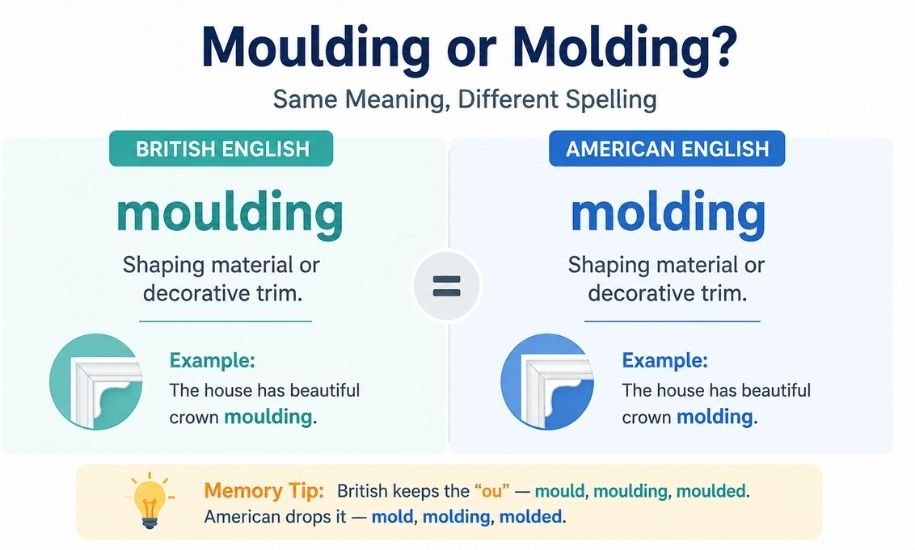
If you have seen both moulding and molding, you may wonder whether one is a spelling mistake. The good news is that neither form is inherently wrong. The difference comes mainly from British and American English spelling conventions. British English generally uses moulding, while American English uses molding. The same pattern appears with mould/mold and moulded/molded. Although the spelling changes, the basic meaning remains the same.
Moulding and molding are both correct. Moulding is the usual British English spelling, while molding is standard in American English. Both can refer to the process of shaping material or to a decorative architectural feature.
Moulding vs. Molding: A Quick Comparison
| Feature | Moulding | Molding |
|---|---|---|
| Standard usage | British English | American English |
| Correct spelling? | Yes | Yes |
| Main meaning | Shaping material; decorative trim | Shaping material; decorative trim |
| Related noun | Mould | Mold |
| Past form | Moulded | Molded |
| Example | Crown moulding | Crown molding |
The important point is that moulding and molding are regional spelling variants, not different words with different meanings.
What Does “Moulding” Mean?
Moulding is the British English form. As a noun, it can describe a shaped strip or feature used for decoration, especially around walls, ceilings, doors, windows, or furniture.
It can also refer to the process of forming or shaping a material.
Examples:
- The old house has ornate moulding around the ceiling.
- The carpenter repaired the wooden moulding around the door.
- The artist is moulding the clay into a small bowl.
- The factory uses injection moulding to produce plastic components.
So, the word is not limited to interior decoration. Its meaning depends on context.
What Does “Molding” Mean?
Molding is the standard American English spelling of the same word.
It can describe a decorative architectural feature:
The new apartment has decorative molding around the windows.
It can also describe the act of shaping something:
The technician is molding the plastic into the required form.
In manufacturing, terms such as injection molding and compression molding are standard American forms.
Therefore, if your writing follows American English conventions, molding is normally the spelling to choose.
Why Are Moulding and Molding Spelled Differently?
The difference is part of a broader pattern between British and American English spelling.
British English often retains the ou in words such as:
- mould
- moulding
- moulded
American English generally uses:
- mold
- molding
- molded
The distinction is similar to familiar pairs such as colour/color and favour/favor. It does not mean that one variety is more correct than the other.
The most important rule is consistency. If you are writing in American English, use mold, molding, and molded. If you are following British English, use mould, moulding, and moulded.
Crown Moulding or Crown Molding?
Both crown moulding and crown molding are correct.
Crown moulding follows British spelling, while crown molding is the American form. The term refers to decorative trim installed where a wall meets a ceiling.
For example:
British English:
The period property features elegant crown moulding.
American English:
The historic home features elegant crown molding.
The spelling changes, but the architectural feature does not.
If you are writing product descriptions, renovation guides, or other home-improvement content, match the spelling to the English variety used by your intended audience.
Mold or Mould: Which One Should You Use?
The same regional distinction applies to mold and mould.
In American English, mold is standard:
There is mold growing on the bathroom wall.
In British English, mould is standard:
There is mould growing on the bathroom wall.
Both forms can also refer to a container or shape used to form another material:
- Pour the mixture into the cake mold. — American English
- Pour the mixture into the cake mould. — British English
They can also function as verbs:
- The machine molds the plastic into shape. — American English
- The machine moulds the plastic into shape. — British English
Is it mold or mould?
If you are using American English, choose mold. If you are using British English, choose mould. Neither spelling should automatically be treated as a misspelling.
Molding or Moulding in Different Contexts
The choice remains the same even when the subject changes.
Architecture and interior design
- British: The ceiling moulding adds character to the room.
- American: The ceiling molding adds character to the room.
Manufacturing
- British: The company specializes in injection moulding.
- American: The company specializes in injection molding.
Art and crafts
- British: She is moulding the clay by hand.
- American: She is molding the clay by hand.
Figurative use
The verb can also describe influencing or shaping something in a less literal sense.
- British: Early experiences can help mould a person’s character.
- American: Early experiences can help mold a person’s character.
This demonstrates that the spelling difference applies consistently across the word’s different uses.
Molded or Moulded?
The past tense and past participle follow the same pattern.
Molded is the American English form.
The plastic was molded into a precise shape.
Moulded is the British English form.
The plastic was moulded into a precise shape.
The forms can be summarized as:
| British English | American English |
|---|---|
| mould | mold |
| moulds | molds |
| moulding | molding |
| moulded | molded |
This makes the pattern relatively easy to remember: British English keeps “ou,” while American English generally drops the “u.”
Common Mistakes to Avoid
1. Calling “molding” a misspelling
Molding is not a mistake simply because you normally use British English. It is the standard American spelling.
2. Calling “moulding” incorrect
Likewise, moulding is not wrong in British English. It is the established British form.
3. Mixing regional spellings
Using moulding in one paragraph and molding in another can make your writing look inconsistent when you are following one English variety.
Choose the appropriate style and stick with it.
4. Assuming the meaning changes
The extra u does not create a different meaning. Moulding and molding generally refer to the same concepts.
5. Forgetting related forms
Once you choose one spelling system, remember that the same distinction appears in related words:
- mould/mold
- moulding/molding
- moulded/molded
How to Choose the Right Spelling
The easiest approach is to consider your audience and your chosen style of English.
Use molding when writing in American English:
We replaced the damaged crown molding.
Use moulding when writing in British English:
We replaced the damaged crown moulding.
If your publication has a style guide, follow it. For international writing, consistency matters more than trying to make one spelling universally applicable.
Easy way to remember
Think of the word pair as a family:
British: mould → moulding → moulded
American: mold → molding → molded
If your other spelling choices use British forms such as colour and centre, moulding will normally fit that style. If you use American forms such as color and center, molding is the natural choice.
Frequently Asked Questions
Is it molding or moulding?
Both are correct. Molding is the standard American English spelling, while moulding is the standard British English spelling. They have the same basic meanings, including shaping a material and referring to decorative architectural trim.
Is it mold or mould?
Both are accepted regional spellings. Mold is standard in American English, while mould is standard in British English. The words can refer to fungal growth, a shaping container, or the act of shaping something, depending on context.
Is crown moulding or crown molding correct?
Both are correct. Crown moulding follows British spelling, whereas crown molding follows American spelling. Both refer to decorative trim installed around the junction between a wall and ceiling.
Is molded or moulded correct?
Both forms are correct in their respective varieties of English. Molded is the American spelling, and moulded is the British spelling. They are the past tense and past participle forms of mold/mould.
Is “moulding” only used for decorative trim?
No. It can refer to decorative architectural material, but it can also describe the process of shaping materials such as clay, plastic, or metal. The context determines the exact meaning.
Should I use moulding or molding in formal writing?
Use the form that matches your chosen variety of English. Neither is inherently more formal or more correct. The key is to maintain consistent spelling throughout the document.
The Bottom Line
Moulding and molding are both correct spellings. Choose moulding for British English and molding for American English. The same distinction applies to mould/mold and moulded/molded, so once you identify your preferred English variety, the choice becomes straightforward. For more clear, practical explanations of confusing English forms, Grammarify helps you know the difference and use the right words.
You may also Read : Requester or Requestor: Meaning and Usage