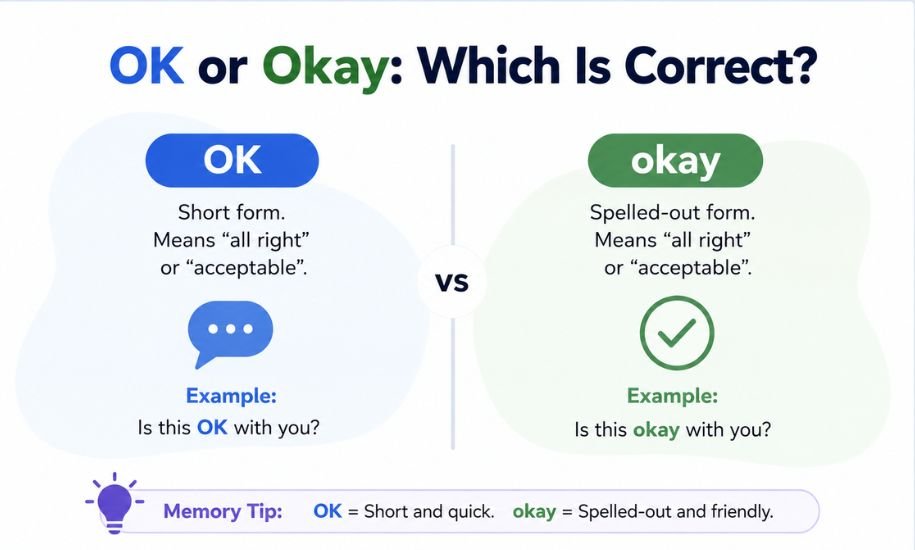
OK or Okay: Which Is Correct? Meaning & Usage
It is easy to wonder whether OK or okay is the proper spelling. You may see both forms in everyday conversation, emails, books, websites, and text messages, which can make the choice seem confusing. The good news is that you do not have to choose between a “correct” word and an incorrect one: both OK and okay are standard English forms. The real difference is mainly one of style, context, and consistency. Understanding when each form works best can help you write more naturally and confidently.
OK and okay are both correct spellings. They have essentially the same meaning and can usually be used interchangeably. In polished writing, choose the form that fits your style guide and keep your choice consistent; okay can feel more conversational, while OK is concise and widely used.
OK or Okay: Which Is Correct?
If you are asking “ok or okay which is correct?”, the answer is simple: both are correct.
Neither spelling is a misspelling of the other. OK is the shorter form, while okay is the fully spelled-out form. Both can express agreement, acceptance, permission, or a satisfactory condition.
Compare:
- OK, I’ll call you later.
- Okay, I’ll call you later.
Both sentences are correct.
Likewise:
- Is it OK if I sit here?
- Is it okay if I sit here?
Again, both are acceptable.
The choice becomes more about tone and editorial preference than grammar.
A Quick Comparison
| Feature | OK | Okay |
|---|---|---|
| Correct spelling? | Yes | Yes |
| Basic meaning | All right; acceptable | All right; acceptable |
| Common role | Adjective, adverb, interjection, noun, verb | Adjective, adverb, interjection, noun, verb |
| Style | Short and direct | More fully spelled out |
| Informal writing | Very common | Very common |
| Formal writing | Depends on style guide | Depends on style guide |
| Example | Is this OK? | Is this okay? |
There is no universal grammar rule requiring writers to use one instead of the other.
What Does “OK” Mean?
OK can mean “all right,” “acceptable,” “fine,” “approved,” or “satisfactory.” It can also be used to show agreement or acknowledgment.
For example:
- Are you OK after the trip?
- The quality of the report is OK.
- OK, let’s start the meeting.
- My supervisor gave the OK.
- The manager OK’d the request.
The word can therefore perform several grammatical functions depending on the sentence.
As an adjective, it can describe something as satisfactory:
The results are OK.
As an interjection, it can indicate agreement:
OK, I’ll do it.
As a noun, it can refer to approval:
We need your OK before proceeding.
What Does “Okay” Mean?
Okay carries essentially the same meanings as OK. It can indicate that something is acceptable, satisfactory, or permitted, or that someone agrees with something.
Examples include:
- Is everything okay?
- The food was okay, but not excellent.
- Okay, I understand.
- She gave me the okay to continue.
- He okayed the proposal.
In many sentences, replacing okay with OK does not change the meaning:
Everything is okay.
Everything is OK.
Both communicate the same basic idea.
Is It OK or Okay in Writing?
If you are wondering about ok or okay in writing, the best choice depends on the type of writing and the style you are following.
In ordinary writing, both forms are acceptable:
It is OK to change the schedule.
It is okay to change the schedule.
For a blog, article, email, or other general-purpose writing, you can normally choose whichever form fits your preferred style.
The most important principle is consistency. If you choose OK in one part of an article, there is usually little reason to switch randomly to okay elsewhere.
For highly formal writing, you may sometimes want a more precise alternative:
- OK → acceptable
- OK → approved
- okay → satisfactory
- okay → permitted
For example:
Informal: Is it okay to submit the form tomorrow?
More formal: Is it acceptable to submit the form tomorrow?
This does not mean that OK or okay is grammatically wrong in formal writing. It simply means that a more specific word can sometimes create a more professional tone.
When to Use OK or Okay
There is no single rule that says you must always use one spelling. Instead, consider the context.
Use “OK” when you want a concise style
OK is especially convenient in short statements, instructions, labels, or situations where space matters.
Examples:
- Click OK to continue.
- Is this OK with you?
- OK, let’s move on.
- The document is OK.
Use “okay” when a fully spelled-out form feels more natural
Okay can work particularly well in ordinary prose and dialogue.
Examples:
- It’s okay to make mistakes while learning.
- Okay, I’ll explain it again.
- She said everything was okay.
These are style preferences rather than strict grammar requirements.
Is “OK” Spelled OK or Okay?
Both spellings are established forms.
You may also encounter O.K., especially in older texts or particular editorial styles. However, modern English commonly uses OK without periods.
The lowercase form ok is also widespread, particularly in informal digital communication. For carefully edited prose, however, OK or okay is generally a safer choice.
So, if you are asking “is ok spelled ok or okay?”, the practical answer is:
- OK — standard abbreviated form
- okay — standard spelled-out form
- ok — common informal lowercase form
- O.K. — older or style-specific form
Why Are OK and Okay Both Used?
The two forms developed as alternative written representations of the same expression. OK is the abbreviated spelling, while okay represents the word in a more fully spelled-out form.
That is why the two forms can generally substitute for one another without changing the meaning.
The important point for modern writers is not to treat okay as a correction of OK, or OK as a shortened misspelling of okay. They are both legitimate forms.
Examples: OK vs. Okay
Here are some natural examples showing how either form can work.
Agreement
OK, I’ll meet you at six.
Okay, I’ll meet you at six.
Asking for permission
Is it OK to leave early?
Is it okay to leave early?
Describing a condition
The computer is OK now.
The computer is okay now.
Giving approval
I need your OK before I publish this.
I need your okay before I publish this.
Describing something as satisfactory
The movie was OK, but I expected more.
The movie was okay, but I expected more.
The meaning remains essentially unchanged in each pair.
Is “OK” or “Okay” Better for Formal Writing?
Neither is automatically incorrect in formal writing, but style guides may have different preferences.
For example, Microsoft’s style guidance recommends OK rather than “okay” in its documentation style. Other editorial environments may prefer okay, while some may encourage writers to use a more precise expression altogether.
Therefore, if you are writing for a company, publication, school, or organization, check its style guide first.
If no specific style guide exists, choose one form and use it consistently.
For especially formal documents, consider whether a more precise word communicates your meaning better:
- The proposal was approved.
- The request was acceptable.
- Permission was granted.
- The results were satisfactory.
These alternatives can be more informative than simply saying something was “OK.”
Common Mistakes to Avoid
1. Assuming “okay” is the only correct form
This is incorrect. OK is also a standard English form.
2. Assuming “OK” is only slang
Although it is informal in some contexts, OK is not simply slang. It is an established English word with several grammatical uses.
3. Switching forms without a reason
Using OK in one paragraph and okay in the next is not necessarily a grammar error, but unnecessary variation can make edited writing feel inconsistent.
4. Treating “ok” as the best choice everywhere
Lowercase ok is common in texting and casual online communication. In polished writing, OK or okay is usually preferable.
5. Believing formal writing always requires a different spelling
The issue is more about tone and precision than a universal spelling rule. In some formal contexts, OK may be perfectly acceptable according to the applicable style guide.
An Easy Way to Remember
Think of OK and okay as two versions of the same word:
OK = shorter form
okay = spelled-out form
Neither one needs to be memorized as “right” versus “wrong.”
Instead, remember this practical rule:
Choose the form your style requires, then use it consistently.
If you are writing a casual sentence, either form will normally work.
Frequently Asked Questions
Is OK or okay correct?
Both OK and okay are correct. They have essentially the same meaning and can generally be substituted for one another. The preferred form may vary according to context, publication style, or an organization’s style guide.
Is “ok” grammatically correct?
Lowercase ok is widely used in informal communication, particularly texting and casual digital writing. For polished or edited prose, OK or okay is generally a better choice.
Can I use OK and okay interchangeably?
Yes, in most ordinary sentences. For example, “Are you OK?” and “Are you okay?” mean the same thing. The main consideration is consistency and the preferred style of the writing context.
Which is better in formal writing, OK or okay?
There is no universal rule. Some style guides prefer OK, while others may favor okay. In particularly formal documents, a more precise word such as acceptable, approved, or satisfactory may be preferable.
Is “O.K.” still correct?
O.K. is an established older form, but modern writing commonly uses OK without periods. Unless a particular style guide requires O.K., OK or okay will usually be the more natural modern choices.
Does OK mean the same thing as okay?
Yes. In normal usage, OK and okay have the same basic meaning: all right, acceptable, satisfactory, or agreed. Differences between them are primarily related to style, presentation, and context.
The Bottom Line
If you have been wondering “OK or okay?”, you can confidently use either spelling. OK is the concise form, while okay is the fully spelled-out form, and both are correct in standard English. For professional or published work, follow the relevant style guide and avoid switching between forms without a reason. For more practical explanations of confusing English choices, Grammarify helps you Know the Difference. Use the Right Words.
One Comment