Truely or Truly: Meaning, Spelling and Examples
It is easy to hesitate over truely or truly, especially because the adjective true keeps its final e. That makes truely look like a logical spelling when you add -ly. However, standard modern English uses a different form. The correct spelling is truly, and the extra e is not used. Understanding this small spelling change can help you avoid an error in emails, essays, professional writing, and everyday messages.
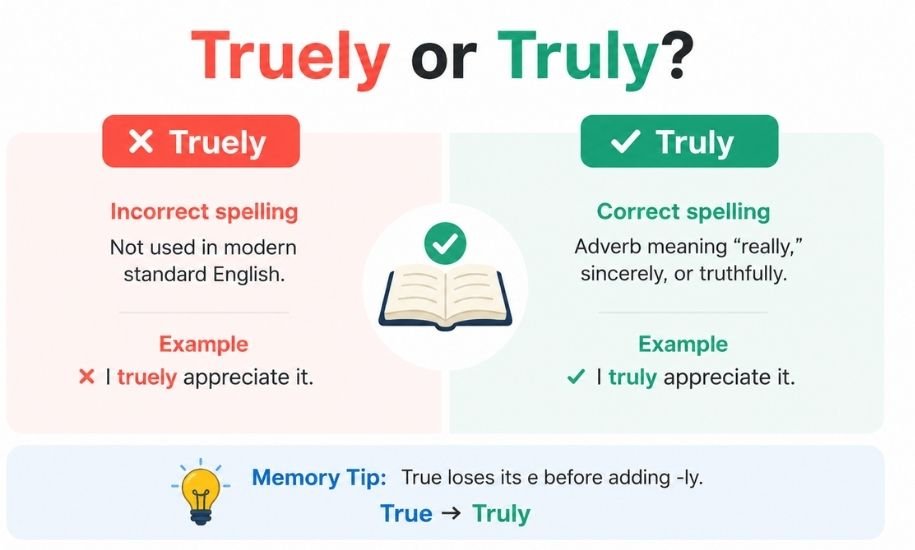
Truly is the correct spelling in modern standard English. Truely is generally considered a misspelling, although it can be found as an archaic historical spelling. When you mean “really,” “sincerely,” or “in a truthful way,” write truly.
Truly or Truely: What’s the Difference?
The difference is spelling, not meaning.
| Feature | Truly | Truely |
|---|---|---|
| Standard modern spelling | ✅ Yes | ❌ No |
| Part of speech | Adverb | — |
| Meaning | Really, sincerely, or truthfully | — |
| Used in modern formal writing | Yes | No |
| Example | I truly appreciate it. | I truely appreciate it. ❌ |
If you are wondering which is correct truly or truely, choose truly.
The confusion comes from the word true. It is natural to think that adding -ly gives truely, but English spelling does not work that way here:
true → truly
The final e is removed.
What Does “Truly” Mean?
Truly is an adverb. It can modify a verb, adjective, or an entire statement and generally expresses truth, sincerity, or emphasis.
Depending on the sentence, it can mean really, genuinely, sincerely, indeed, or in a truthful way.
Examples:
- I truly believe you made the right decision.
- She was truly surprised by the news.
- We truly appreciate your kindness.
- That was truly an impressive performance.
In each case, truly adds the idea that something is genuine, sincere, or real.
Truly as an intensifier
It can also strengthen an adjective:
The view from the mountain was truly spectacular.
Here, truly emphasizes just how spectacular the view was.
Is “Truely” a Real Word?
In modern standard English, no—not as the normal spelling of the adverb.
You may occasionally encounter truely in older texts or historical material. It has existed as an older spelling, but that does not make it the appropriate form for contemporary writing.
So if you are writing an essay, email, article, application, report, or other modern text, use truly.
Correct: I truly understand your concerns.
Incorrect in modern standard English: I truely understand your concerns.
There is no need to invent a separate meaning for truely. In ordinary contemporary English, it is simply the form to avoid.
Why Is “Truly” Spelled Without the E?
The spelling becomes easier to remember once you separate the base word from the finished adverb.
The adjective is:
true
The adverb is:
truly
Not:
true + ly = truely
Instead, the final e is dropped before the suffix is added:
true → truly
This is one of those English spelling patterns that cannot always be predicted simply by looking at the base word. That is why truely feels intuitive even though it is not the standard form.
A useful comparison is due → duly. The final e is also absent in duly.
Correct Usage Examples
If you are unsure how to spell the word, these examples show the standard form in context.
Correct
- I truly enjoyed the concert.
- She truly cares about her friends.
- He was truly grateful for the opportunity.
- This is truly the best solution.
- I truly hope everything works out.
Incorrect
- I truely enjoyed the concert.
- She truely cares about her friends.
- He was truely grateful.
- This is truely the best solution.
The incorrect examples all contain the same problem: the unnecessary e after the u.
How to Spell Truly Correctly
If you need to spell truely or truly, remember this simple pattern:
true loses its e when it becomes truly.
Think of it as:
TRUE → TRULY
The spelling contains trul- followed by -y:
t-r-u-l-y
not:
t-r-u-e-l-y
A quick memory trick is to remember that truly has only one “e”—in the word “true” before the transformation, not in the final spelling. Even simpler: memorize the five-letter ending -uly in truly.
“Truly” vs. “True”
Another source of confusion is that true and truly have different grammatical jobs.
True is normally an adjective:
That statement is true.
Truly is an adverb:
I truly believe that statement.
Compare:
- She is true to her word.
- She truly kept her promise.
The first describes something; the second tells us how genuinely or sincerely something happens.
Common Mistakes to Avoid
1. Adding the original e
The most common mistake is treating the formation as true + ly and writing truely.
Remember:
true → truly
2. Adding extra letters
Other variants such as truley, trully, or truelly are also incorrect spellings of the standard adverb.
The correct form is simply:
truly
3. Assuming the spelling changes by country
There is no standard British-versus-American distinction here. Truly is the normal spelling in both American and British English.
4. Confusing “true” with “truly”
Use true when you need an adjective and truly when you need an adverb.
- The story is true.
- I truly believe the story.
Is “Truly” Used in “Yours Truly”?
Yes. Yours truly is a standard expression.
It is traditionally used as a closing in letters:
Yours truly,
Michael
It can also refer informally to the speaker:
The person responsible was yours truly.
The spelling remains truly, never truely.
Frequently Asked Questions
Which is correct, truly or truely?
Truly is correct in modern standard English. Truely is not the standard spelling and should generally be treated as a misspelling in contemporary writing.
How do you spell truly?
Spell it T-R-U-L-Y: truly. The word comes from true, but the final e is dropped when forming the adverb.
Is “truely” ever acceptable?
You may encounter truely in historical or archaic texts, where spelling conventions differed. However, it is not the standard modern spelling. For contemporary English, use truly.
Is truly a verb or adjective?
Neither. Truly is an adverb. It can modify a verb, adjective, or statement, as in I truly understand, truly remarkable, or She truly believes him.
Is truly the same in British and American English?
Yes. Truly is the standard spelling in both British and American English. There is no regional spelling change comparable to color/colour.
What is an easy way to remember the spelling?
Remember:
TRUE → TRULY
When true becomes the adverb truly, the final e disappears. If you see truely, check whether you can replace it with truly—in standard modern English, you normally can.
The Bottom Line
When deciding between these two forms, choose truly. It is the standard modern adverb meaning “really,” “sincerely,” or “truthfully,” while truely is not appropriate for contemporary standard writing. The easiest rule to remember is true → truly: drop the final e before adding the y. For clear word choices and spelling guidance, that is exactly the kind of distinction Grammarify is designed to make easier.
You may also Read : Verbiage or Verbage: Meaning and Correct Usage