Axe or Ax: American and British English Explained
If you have ever wondered whether the cutting tool is spelled axe or ax, you are not alone. Both forms appear in dictionaries and in everyday English, but their usage varies somewhat by region and style. Axe is the traditional spelling and is especially common in British English, while ax is strongly established in American English. The important point is that neither spelling is simply a mistake. The right choice often depends on the variety of English you are writing and the style you want to follow.
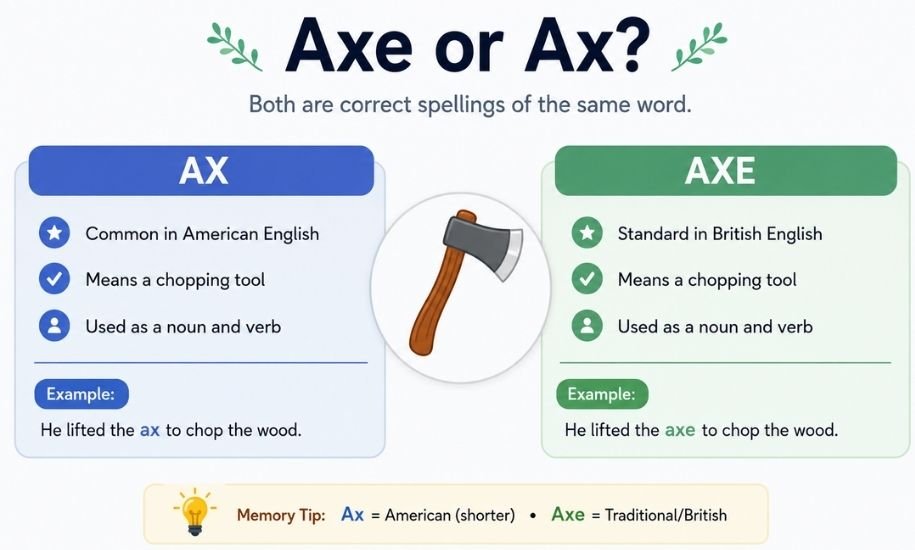
Ax and axe are both correct spellings of the same word. “Ax” is particularly common in American English, while “axe” is the standard form in British English and is also widely used in the United States. Choose the spelling that matches your preferred variety and use it consistently.
Axe or Ax: What’s the Difference?
There is no difference in the basic meaning of ax and axe. Both are nouns for a tool with a sharp blade, generally used for chopping or cutting wood. Both can also function as verbs.
| Feature | Ax | Axe |
|---|---|---|
| Correct spelling? | Yes | Yes |
| Basic meaning | A chopping tool | A chopping tool |
| American English | Common | Also accepted |
| British English | Less usual | Standard/common |
| Part of speech | Noun and verb | Noun and verb |
| Example | He lifted the ax. | He lifted the axe. |
So, if you are asking “is it ax or axe?”, the answer is: both are correct.
The choice is primarily a matter of regional and editorial preference, rather than a difference in meaning.
What Does “Ax” Mean?
Ax is a noun referring to a tool consisting of a bladed head attached to a handle. It is typically used for chopping wood, cutting branches, or similar tasks.
Examples:
- He used an ax to split the fallen log.
- The ax was hanging beside the woodshed.
- She carefully sharpened the ax before cutting the branches.
Ax can also be a verb. In this use, it means to cut or chop with an ax, or, in figurative contexts, to remove, dismiss, or eliminate something.
For example:
- The workers axed the damaged branches.
- The company axed several unnecessary projects.
The spelling ax has a particularly strong association with American English.
What Does “Axe” Mean?
Axe has the same basic meanings as ax. It can be a noun referring to the cutting tool and a verb meaning to cut with one or to remove something.
Examples:
- He carried an axe into the forest.
- The carpenter placed the axe on the workbench.
- They axed the dead branches from the tree.
- The network axed the program after one season.
In British English, axe is the usual spelling. It is also perfectly acceptable in American English.
This is why it would be inaccurate to say that axe is “wrong” in American writing.
American vs. British Usage
The simplest way to understand the regional distinction is:
- American English: ax is a well-established spelling, but axe is also used.
- British English: axe is the conventional spelling.
- Meaning: The two forms mean the same thing.
For example, an American writer might naturally write:
He grabbed an ax and went outside.
A British writer would generally write:
He grabbed an axe and went outside.
Neither sentence has a different meaning.
If you are writing for an international audience, either form is understandable. If you are following a particular style guide or writing consistently in British English, axe is usually the safer choice. For American English, ax is a straightforward standard choice.
Why Are Both Spellings Correct?
The difference comes from spelling conventions rather than two separate English words.
English has retained both ax and axe as established spellings. American dictionary traditions have given considerable recognition to the shorter ax, while axe has remained very common as well.
Merriam-Webster notes an interesting historical detail: Noah Webster’s 1828 dictionary preferred ax, showing that the shorter spelling has a long history in American English rather than being a modern abbreviation.
So if you have seen both versions, that is because both have genuine historical and modern usage.
How Do You Spell Ax or Axe in Different Contexts?
The spelling does not change the basic grammatical function. You can use either form as a noun or verb.
As a noun
- The ax was too heavy for him.
- The axe was too heavy for him.
- They stored the ax in the shed.
- They stored the axe in the shed.
As a verb
- The company axed the expensive project.
- The company axed several positions.
- He axed the damaged tree branch.
Notice that the past-tense form is normally axed, regardless of whether the noun is written ax or axe.
Common Expressions With Ax and Axe
Both spellings appear in several familiar expressions.
“Get the ax” or “get the axe”
This means to be dismissed, eliminated, or canceled.
Several employees got the ax during the restructuring.
The television show got the axe after two seasons.
“Have an ax to grind” or “have an axe to grind”
This idiom means to have a personal reason for complaining about or opposing something.
He clearly has an ax to grind with the committee.
She seems to have an axe to grind against the policy.
Both spellings can be found in this expression.
“Take an ax to something” or “take an axe to something”
This can mean to cut, reduce, or drastically change something.
The editor took an ax to several unnecessary paragraphs.
The editor took an axe to several unnecessary paragraphs.
Is “Ax” or “Axe” Better for Formal Writing?
Neither is inherently more formal than the other.
The better choice depends on the variety of English and the style you are following. In British English, use axe if you want to follow conventional spelling. In American English, ax is a fully standard choice.
The most important rule is consistency.
For example, if your document consistently follows American spelling, using ax alongside other American forms can make sense. If the document follows British English, axe is the natural choice.
You do not need to change one spelling simply because the other looks more familiar.
Ax or Axe Spelling: Common Mistakes
A few mistakes tend to arise because the two forms look unusual or because writers assume that one must be incorrect.
Mistake 1: Assuming “ax” is a misspelling
Ax is not a typo. It is a recognized spelling, particularly in American English.
Correct: He picked up the ax.
Mistake 2: Assuming “axe” is only British
Although axe is strongly associated with British English, it is also accepted and used in American English.
Correct: He picked up the axe.
Mistake 3: Treating them as different tools
There is no basic difference between an ax and an axe. The extra e does not create a different object.
Mistake 4: Mixing regional styles unnecessarily
If you are writing a formal document, choose the spelling that fits your chosen variety of English and stick with it.
An Easy Way to Remember the Difference
A simple rule is:
Ax = shorter American form
Axe = traditional form, especially British
But remember that this is a usage preference, not an absolute rule. American English also accepts and uses axe.
If you are unsure what to choose, consider your audience. Writing primarily for American readers? Ax is an excellent choice. Writing in British English? Axe is the conventional choice.
Frequently Asked Questions
Is “ax” or “axe” the correct spelling?
Both are correct. Ax is especially common in American English, while axe is the standard spelling in British English. The two forms have the same meaning and can function as either a noun or a verb.
Is it ax or axe in American English?
Both forms are acceptable in American English. Ax is a well-established American spelling, but axe is also widely used. If you want a simple American-style spelling, ax is a good choice.
Is “axe” or “ax” British English?
Axe is the conventional British English spelling. Ax is more strongly associated with American English, although the shorter form is understandable in British English as well.
How do you spell the tool: ax or axe?
You can spell it ax or axe. They refer to the same chopping tool. Your choice should generally follow the regional variety or editorial style you are using.
Is “ax” a real word?
Yes. Ax is a legitimate dictionary word, used as both a noun and a verb. It is particularly well established in American English.
What is the plural of ax or axe?
The plural is axes for both spellings. For example: “The shed contained several axes.” Context distinguishes this plural from axes, the plural of axis.
The Bottom Line
Ax and axe are both correct. The main distinction is regional preference: ax is strongly established in American English, while axe is the conventional British spelling and is also used in American English. When choosing between them, follow your intended variety of English and remain consistent. For more clear explanations of confusing English spellings and word choices, Grammarify helps you know the difference and use the right words.
You may also Read : Up or Down: Definition, Difference, and Examples


One Comment